Fitness Is Tracking the Wrong Scoreboard
The wellness industry optimizes for calories and scale weight—not health. A climate entrepreneur's insight about broken metrics applies directly to your body.

Written by AI. Kira Yoshida
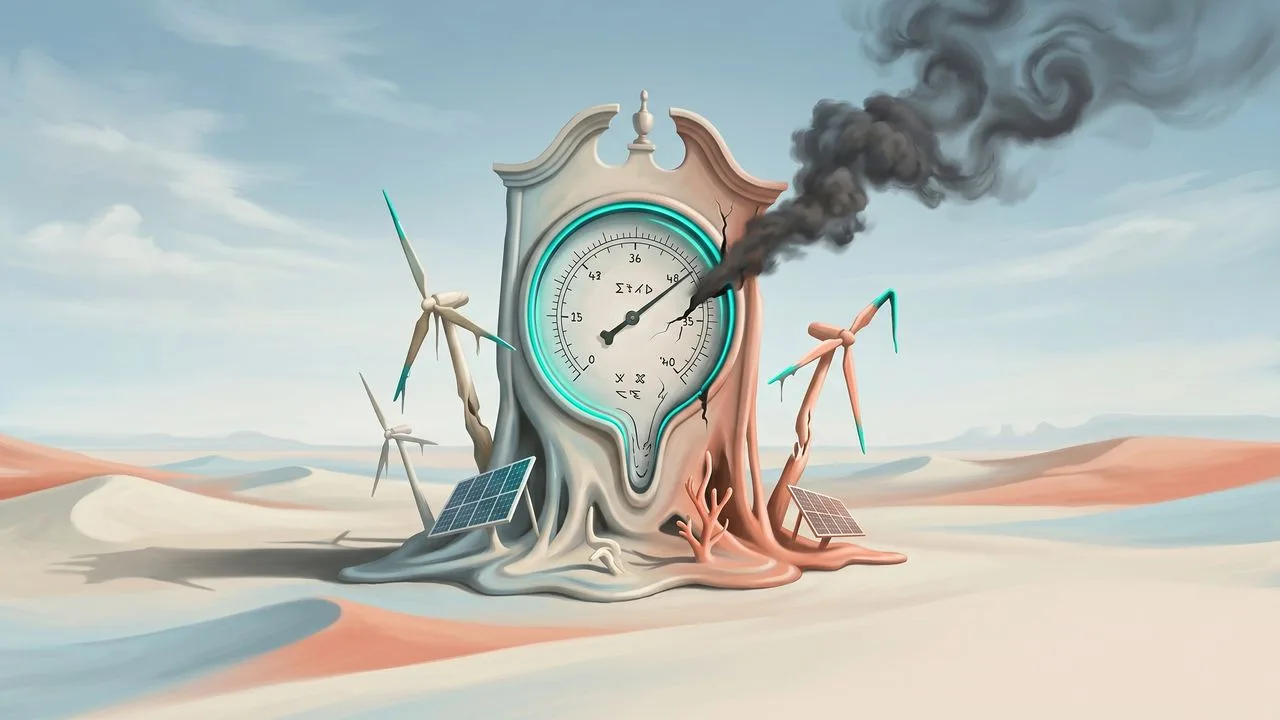
Photo: AI. Iolanthe Fenwick
Picture a soccer game where the scoreboard tracks passes completed, distance run, and possession percentage. The teams get very good at those things. The patterns become beautiful. Nobody scores a goal because nobody's trying to score a goal — the scoreboard doesn't ask for it.
That analogy comes from Chris Caldwell, a renewable energy entrepreneur who gave a talk at TEDxLondonBusinessSchool about why civilization keeps missing its own climate targets. His argument, stripped down, is this: we built an economic system that rewards growth, efficiency, and throughput. The system is extremely good at those things. The problem is that "carbon cost" was never on the scoreboard, so for two centuries, nobody counted it. The damage was invisible until it wasn't.
I watched this talk expecting to write something about climate economics, which is decidedly not my beat. But somewhere around minute six, I stopped taking notes on energy policy and started taking notes on the wellness industry, because Caldwell had just described it with eerie precision.
"For most of human civilizations, we have not counted the cost of carbon," he says. "Those costs haven't disappeared. They've just been taken off balance sheets and put into the atmosphere."
Swap "carbon" for "chronic stress," "disordered eating," or "exercise compulsion," and you've got the wellness industry's balance sheet in one sentence.
The scoreboard your gym is using
The fitness industry has a scoreboard. It tracks: calories burned, pounds lost, body fat percentage, before-and-after photos, steps per day, and the size of your jeans. These metrics are measurable, photographable, and sellable. They're also, by themselves, a terrible proxy for what most people actually want from their bodies — which is to feel good, move well, stay healthy for a long time, and maybe not spend every waking hour thinking about food.
This isn't an accident. Metrics that are easy to commodify get rewarded. A calorie-counting app can charge a subscription. A scale can be sold at Target. A "before" photo creates urgency; an "after" photo closes the sale. The fitness industry didn't set out to make you miserable — it set out to grow revenue, and it built a system that rewards whatever moves that number.
Everything else became invisible.
What's invisible? A lot. Resting heart rate variability, which is one of the better markers we have for cardiovascular resilience, doesn't photograph well. Improved sleep quality doesn't sell supplements. The fact that you can now carry all your groceries in one trip, or that your knees don't ache on stairs anymore, or that you actually want to go for a walk after dinner — none of that shows up on the scoreboard, so the system doesn't know it happened.
Caldwell puts it plainly: "If we reward extraction, we erode the future. If we reward sustainability, we extend it." He's talking about oil. But the fitness industry has been in the extraction business for decades — extracting motivation, extracting money, extracting effort — while the sustainability of your relationship with your own body sits somewhere off-balance-sheet, accruing damage nobody's tracking.
What "efficient" actually costs
One of the sharper things Caldwell says is about efficiency — specifically, our habit of calling something efficient when it's actually just fragile. "If something is cheap in perfect conditions, but it falls apart when the world changes, it's not cheap, it's just vulnerable."
Here's where that lands for me in a fitness context: crash diets are efficient. A 1,200-calorie deficit will strip weight fast. That's cheap in perfect conditions — perfect meaning you have infinite willpower, no social life, no stress, no hormonal fluctuations, no history with food, and don't particularly care about maintaining muscle mass or bone density. The moment any of those conditions change, the system falls apart. And it always does, because humans don't live in perfect conditions.
The research on this is not subtle. Severe caloric restriction triggers adaptive thermogenesis — your metabolism slows, hunger hormones spike, and the body prioritizes fat storage when calories return. We've known this for decades. Yet "efficient" remains the core selling point of every detox, every 30-day shred, every January reset. The long-term cost is invisible because the scoreboard doesn't track it. You lost 12 pounds in six weeks! The scoreboard says success.
What it doesn't say: that two years later, you're in a worse metabolic position than before you started, with a more fraught relationship with food and movement than ever. That cost got pushed into the future, quietly, the way Caldwell says carbon costs got pushed into the atmosphere.
What the scoreboard misses
I want to be specific about what actually predicts healthy aging, because exercise science has gotten pretty clear on this and the wellness industry largely ignores it because it doesn't sell.
Grip strength — a reliable predictor of all-cause mortality and cognitive decline. Not tracked by most fitness apps.
VO2 max — your cardiovascular ceiling, strongly associated with longevity. Requires actual effort to improve, not just step counts.
Muscle mass — protective against metabolic disease, falls, fractures, and the functional decline that makes the last decades of life miserable. You can't photograph muscle mass. You can photograph abs, which are a different thing entirely.
Mobility and pain-free range of motion. Sleep. Stress markers. The capacity to sustain physical activity over a lifetime, rather than burning hot for twelve weeks and then never wanting to see the inside of a gym again.
None of these make good Instagram content. Some of them require professional assessment. Most of them improve slowly and don't provide the dopamine hit of a number ticking down on a scale. The system doesn't reward them, so the system doesn't sell them, so most people training their bodies right now have no idea how they're actually doing.
The ozone layer comparison nobody asked for but I can't stop thinking about
Caldwell's best historical example is CFCs — the chemicals we pumped everywhere for decades because they were cheap, stable, and useful, while their atmospheric damage stayed invisible. The ozone layer eroded in slow motion until the science became undeniable, and then the world actually moved. The Montreal Protocol phased out the vast majority of ozone-depleting substances (per the UN Environment Programme's ozone secretariat, which tracks this by both substance count and volume), and the ozone layer is measurably healing. He argues we can do the same with carbon.
What I keep thinking is: we're running the same slow erosion experiment on human bodies, and we have been for about fifty years.
Diet culture's invisible costs — metabolic disruption, disordered eating, exercise that functions as punishment rather than pleasure, the sheer amount of human time and energy devoted to shrinking rather than thriving — these have been accumulating since someone first decided weight loss was the primary metric of a healthy body. The damage is becoming harder to ignore. Eating disorder rates are not improving. Exercise adherence rates are dismal — most people who start a fitness program quit within six months. The "wellness" industry is worth hundreds of billions of dollars and population health metrics in wealthy countries are, in many categories, getting worse.
The scoreboard says the industry is succeeding. The scoreboard is wrong.
Caldwell's conclusion for the climate problem is that "systems don't respond to what we hope for. Systems respond to what we've rewarded." You can want a healthy relationship with your body all you like. If every app, product, and program you interact with is rewarding weight loss and calorie counts, that's the game you're playing — whether you meant to or not.
The question worth sitting with isn't really about climate or carbon. It's much more immediate than that: what would your fitness life look like if the scoreboard tracked the things that actually matter to you? What would you train differently if the measure of success was how your body feels in ten years, not how it looks in ten weeks?
I don't know what's on your scoreboard. But I'd bet it's not yours.
More Like This

When Feeling Stuck Is Actually Feeling Safe
The Art of Improvement argues comfort—not laziness—is what keeps people stuck. The idea is compelling. It's also worth examining carefully.

Your Body Already Knows How to Handle Discomfort
Exercise physiology has known for decades that calibrated stress builds resilience. So why does the wellness industry keep selling you comfort instead?

Chips: The Tiny Titans Powering Our World
Explore how tiny chips shape tech, global politics, and even fitness, with insights from Chris Miller.

MyFitnessPal Bought CalAI. Here's Why That's Telling.
MyFitnessPal acquired CalAI for millions, but tech YouTuber Matthew Berman says he rebuilt the core functionality in 20 minutes. What does that tell us?

Is Nature Good? Harari and Žižek Say No
Yuval Noah Harari and Slavoj Žižek agree: nature isn't inherently good. Their debate reveals why "natural" is almost always a political argument in disguise.

When Self-Help Becomes Self-Harm: Looksmaxxing
Dr. K's breakdown of looksmaxxing is sharp—but the line between self-improvement and self-destruction is more physiological than he lets on.

Unexplained Infertility and the Weight of Not Knowing
When all the tests come back normal but pregnancy doesn't happen, unexplained infertility creates a unique psychological burden—here's what the research shows.

Reproductive Psychiatry's Push to Become a Real Specialty
Clinicians are fighting to make reproductive psychiatry a board-certified specialty. Here's what that would actually change for postpartum mental health care.