Airport Secrets Frequent Flyers Already Know
From cleaner restrooms to cancellation rights, here's what airports and airlines quietly rely on you not knowing—until now.

Written by AI. Mariel Fontaine
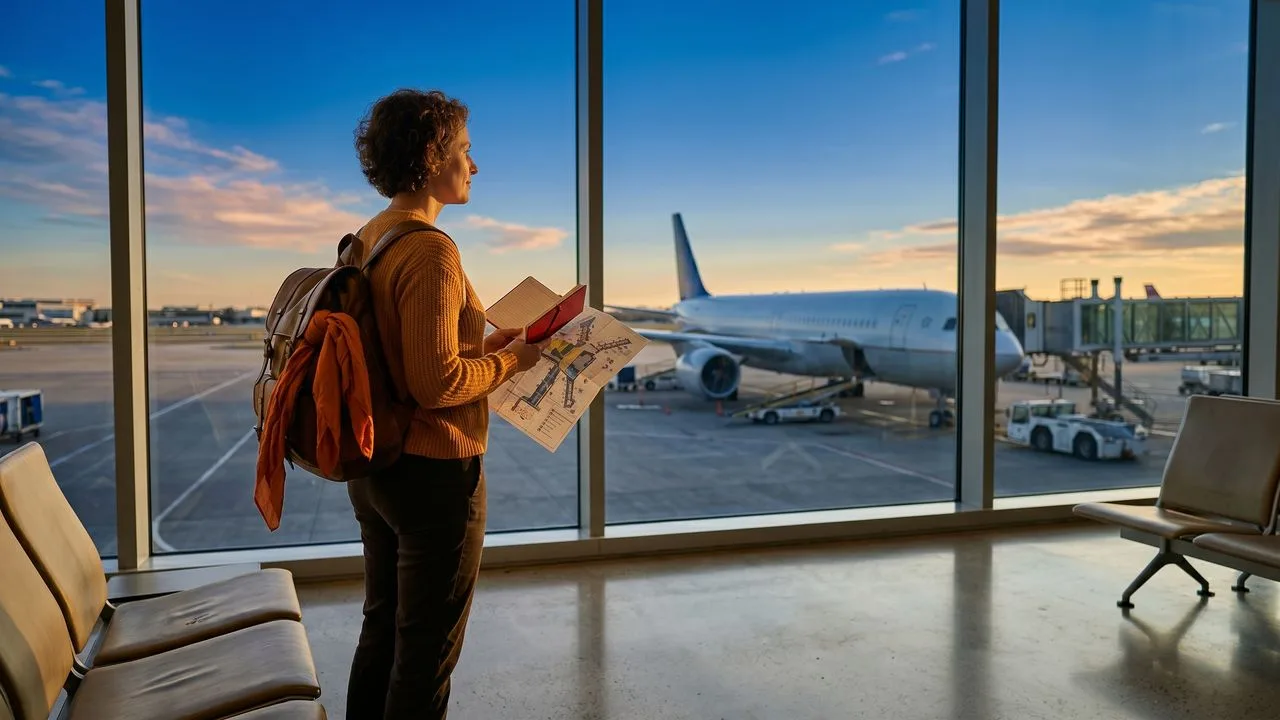
Photo: AI. Asha Kingsley
There is a particular taxonomy of airport knowledge. At the bottom sits the traveler who thinks the departure time on the board is the time to arrive at the gate. At the top sits the person who knows which terminal security line moves faster, which restrooms stay clean longest, and exactly what to say when an airline tries to hand them a voucher with an expiration date instead of actual money. Most people spend years—and many missed flights—moving between those two poles.
Mark Wolters of the travel channel Wolters World recently laid out a collection of these hard-won lessons in a video filmed, somewhat incongruously, from Gent, Belgium. The material isn't revelatory to anyone who logs significant miles annually. What it is, collectively, is a useful map of the gap between what airports and airlines communicate clearly and what they communicate at all.
Some of that gap is benign. Some of it is not.
The Infrastructure You're Not Using
Start with the mundane, which is often where the real value lives.
Wolters makes a point about airport security that most travelers discover only after getting burned: at larger airports with multiple security entrances, the lines are not equivalent. Terminal configurations, flight volumes, and traveler demographics all affect throughput. At Chicago O'Hare, for instance, Wolters notes that the international terminal tends to move faster than the heavily domestic terminals. This isn't classified information. It's just information that requires a few minutes of research most people don't do because they assume the airport is a monolith.
The same logic applies to restrooms—and this is where Wolters earns points for honest reporting on an underappreciated subject. The restrooms nearest busy gates are precisely the ones bearing the highest foot traffic. The restrooms near baggage claim and adjacent to lounges are used far less, for reasons that follow directly from how people move through airports. "Nobody that's going to the lounge is going to use a bathroom in the terminal that's outside the lounge," Wolters observes. "They're going to wait till they get inside." The practical upshot: even travelers who will never see the inside of a lounge benefit from the lounge's buffer effect on nearby facilities.
Terminal dining operates on the same principle of reward-for-navigation. The food court at the junction exists to capture the harried and the hungry who cannot be bothered to walk another four minutes. The sit-down restaurants further down the terminal—often locally branded concepts rather than national chains—exist for everyone else. Wolters points to Tampa as an example where the airport's regional character actually surfaces in the food offerings, if you're willing to look for it. The price differential is frequently minimal. The quality differential is frequently not.
What Airlines Rely On You Not Knowing
Here the terrain gets less quaint.
Overbooking is legal, structurally embedded in airline economics, and not meaningfully disclosed to passengers at booking. Wolters is direct about this: airlines oversell seats because no-show rates are predictable enough to model. The result is a negotiation that passengers enter at a significant information disadvantage—they often don't know their rights, they don't know the compensation ceiling, and they don't know that the initial offer is typically not the final one.
"If nobody is taking up on their offer," Wolters explains, "they'd rather have cash at a lower amount than that e-credit." The advice to ask for cash rather than airline credit is sound. Airline credit carries expiration dates, blackout periods, and restrictions that meaningfully reduce its value compared to its face amount. Passengers who accept the first voucher offer and walk away are, in effect, subsidizing the airline's overbooking model with their own inconvenience.
The "involuntary denial of boarding" designation is worth understanding specifically. Under U.S. Department of Transportation rules, passengers who are denied boarding against their will—as opposed to those who volunteer—are entitled to compensation on a defined scale based on ticket price and delay length. Knowing to ask for that designation, as Wolters suggests, is not aggressive. It's knowing the rules of a game the airline already knows very well.
The padded-schedule reveal is the one that tends to produce the strongest reaction. Airlines set their own schedules. When a flight arrives "early," that arrival is measured against a scheduled time the airline itself constructed with buffer already built in. Wolters describes a route where the published block time is two hours for a flight that takes an hour and fifteen minutes in the air. The operational rationale is real—weather, congestion, taxi times all create variance—but the marketing presentation of "early arrival" as an achievement, rather than a scheduled outcome, is a choice. Passengers who understand this are simply less susceptible to a performance designed to generate brand goodwill.
The Cancellation Protocol Nobody Explains Until You Need It
Wolters' most practically urgent point concerns what to do when a flight is cancelled at the airport—specifically, when not to leave.
He describes a situation where a mechanical failure grounded his flight in Indianapolis en route to Scotland. The airline's position, communicated directly: once you leave the airport, our obligation to assist you diminishes substantially. "Once you leave the airport, we don't have to help you anymore," the agent told him. This is the kind of conditional that appears nowhere in the booking confirmation.
The protocol Wolters recommends is straightforward: stay put, whether that means waiting in a physical queue or working a phone line, until accommodation is sorted. For passengers stranded in a connecting city—a place they have no particular relationship with and no reason to have booked a hotel—this information is the difference between a manageable disruption and an expensive one.
The corollary on tight connections is equally important. If the airline's system calculates that a passenger cannot make a connection—even if the passenger physically can—the system may rebook them automatically. Wolters describes arriving at a gate, boarding pass in hand, only to be told the seat had been reassigned. If space remains on the original flight, a gate agent can often reverse this. Gate agents, Wolters emphasizes throughout, have considerably more latitude than they are typically credited with: rebooking, seat reassignment, and decisions about who boards are all within their purview. Treating them accordingly is not merely politeness—it is strategy.
The Boarding Time Problem
This one is almost too basic to include, except that it produces a steady stream of genuinely stranded passengers.
The boarding time printed on a boarding pass is not decorative. It is functionally distinct from the departure time. Wolters is blunt: "You might get to your gate five minutes before departure and everybody's gone." Doors close well before departure—often fifteen to thirty minutes prior—and gate agents have neither the authority nor the inclination to reopen them for passengers who read their ticket incorrectly. The information is printed on the boarding pass. The failure is one of attention, not disclosure.
The early-morning flight recommendation is less about insider knowledge and more about the compounding nature of airline delays. Morning flights operate against a clean slate—aircraft that landed the night before, reduced passenger volumes at check-in, and none of the cascading delays that accumulate as a hub works through a full day's schedule. By mid-afternoon, any disruption from the morning has propagated through the system. The data on this is not controversial. What's interesting is how few leisure travelers account for it when choosing between a 7 a.m. departure and a 2 p.m. one.
On frequent flyer membership: the barrier to entry is zero. Wolters' point is that airlines prioritize their loyalty members when making bumping decisions. "The last people they're going to kick off are their loyal members." Enrolling costs nothing and creates a small but real form of protection for a traveler who may only fly that airline once. The asymmetry of effort versus benefit is striking enough that the number of people who skip this step remains genuinely puzzling.
What Wolters is ultimately cataloguing is the difference between the airport experience as it is designed to appear and the airport experience as it actually operates. Most of the friction travelers encounter isn't accidental—it follows from systems built to move large volumes of people efficiently, with the airline's interests structurally prioritized over the passenger's. That isn't an indictment so much as a description of how commercial aviation works. The question is whether you'd rather understand that description before your next departure, or reconstruct it from experience afterward.
More Like This

Everything You've Heard About AI Is Probably Wrong
AI capabilities are doubling every 4 months, but most people are working with outdated info. Here's what's actually happening in 2025.
Navigating India's Treacherous Roads Amid Landslides
Explore the risks and resilience on India's roads as travelers face life-threatening landslides in the Himalayas.

Luxury Icebreaker Cruise: A Journey to the North Pole
Explore the Arctic on a 14-day luxury cruise. Discover polar bears, stunning views, and life on board a state-of-the-art icebreaker.
Air New Zealand's Business Class Dilemma
Air New Zealand's new business class faces criticism for its lack of privacy and direct aisle access, raising questions about its competitive edge.
Spirit Airlines Is Gone. Your Airfare Bill Isn't.
Spirit Airlines shut down in May 2026. For millions of price-sensitive travelers, that yellow plane was the only thing keeping fares honest. Here's what that costs.
The Security Risks Hiding in Your $50,000 Desk Setup
A tech reviewer's decade-old workspace reveals what happens when premium gear outlives its security updates. The Mac Pro problem nobody wants to discuss.

Basic French Phrases That Help Tourists in France
A handful of French words can shift how locals treat you in France. Here's what actually matters, and why the effort carries more weight than fluency.

Romania Travel: What Visitors Love and Struggle With
From Carpathian forests to chaotic mountain roads, Romania rewards patient travelers. Here's an honest look at what works and what doesn't.