How Alexander the Great Weaponized the Catapult
Alexander's engineers turned catapults into city-destroying machines—and the siege of Tyre shows exactly what that meant for the people living inside those walls.

Written by AI. Sofia Ramirez
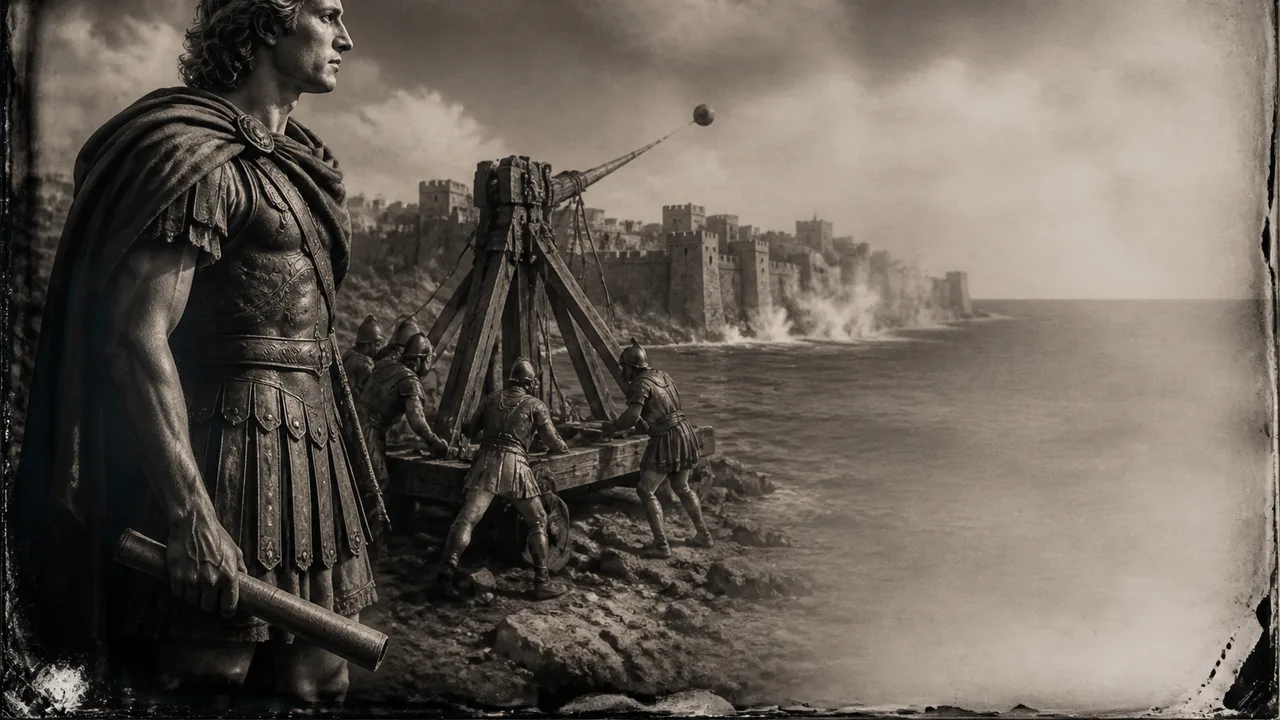
Photo: AI. Otieno Okello
Tyre, 332 BCE. The city sits on an island roughly half a mile off the Phoenician coast—what is now southern Lebanon—and it is one of the wealthiest ports in the known world. Its merchants have been trading cedar, purple dye, and glass across the Mediterranean for centuries. The harbor is full. The walls, ancient sources suggest, rise somewhere toward 150 feet, though that figure is almost certainly inflated by the telling. What isn't inflated is the fact that Tyre has never fallen to a land army. It's surrounded by the sea. It does not need to negotiate.
And then Alexander arrives.
The new History's Greatest Machines series on HISTORY—hosted, improbably but entertainingly, by Dolph Lundgren, who holds a degree in chemical engineering—opens its first episode with Alexander's siege of Tyre as a case study in how military technology can rewrite the terms of a conflict. The episode makes a real argument: that Alexander wasn't just a brilliant tactician, but that he brought engineers with him. He was, the episode notes, "one of the few generals who actually has a team of engineers that follow his army around." That detail matters more than it sounds.
The Machine That Changed What "Impossible" Meant
The catapult existed before Alexander. His engineers didn't invent it; they radicalized it. The original devices were essentially oversized crossbows, useful for shooting arrows at soldiers defending a wall. Effective enough, but limited in ambition. What Alexander's team did was scale the torsion mechanism—the physics of the thing—so it could throw not an arrow but a stone weighing roughly 100 pounds.
The episode describes the torsion spring in a way that actually illuminates the underlying mechanics: imagine a bundle of ropes with a piece of wood twisted through it, wound tighter and tighter until the whole assembly is coiled energy waiting for release. When a gunner trips the mechanism, that stored force unspools through a sling and sends the stone airborne. The episode's figure of "nearly 300 feet" for the range of these machines reads conservatively—historical estimates for ancient torsion catapults generally put effective range closer to 300–500 meters, roughly 1,000 to 1,600 feet, depending on projectile weight. Worth flagging: the episode's number may reflect a specific configuration or interpretation, but it sits on the low end of what scholars have reconstructed, and the discrepancy is significant enough to notice.
The episode describes the largest of these catapults as 12 feet tall, built around what it calls a "V-shaped frame." That description is unusual—most historical reconstructions of torsion catapults show a rectangular or ladder-style frame—and it may reflect how the show chose to visualize the machine rather than established archaeological consensus. Something to hold lightly.
What's not in dispute is the comparative leap in destructive capacity. The episode's analogy—the jump from musket to cannon—is a clean way to convey the magnitude, and it lands because it asks you to think in human terms. A musket is a tool for killing one person. A cannon is a tool for destroying the wall they're standing behind.
What Alexander Built the Causeway For
Before the catapults could do their work at Tyre, Alexander had to solve a problem that no amount of engineering could skip past: the island itself. The city's main fortifications were on the island, and those walls faced the sea. So Alexander ordered his army to build a causeway—essentially a land bridge across half a mile of open water—to get his siege machines close enough to matter.
It's worth being precise about the geography here: by 332 BCE, Tyre was predominantly an island city. There was a smaller mainland settlement at a site called Ushu, or Palaetyrus, but it was functionally separate—more of a satellite town than half of a unified city. The episode describes it as an "unusual dual setup" with half the city on land and half on the island, which smooths over this distinction somewhat. The island city was the prize, and the island city was what Alexander needed to crack.
The causeway took months. Ancient sources and modern scholarly consensus generally put the entire siege at roughly seven months, January through July or August of 332 BCE. That's seven months of the Tyrians watching a road being built toward them from the shore—watching it get longer, watching it get closer, unable to stop it except through naval raids and fire ships.
When the causeway brought Alexander's forces close enough, he made a second adaptation that the episode rightly highlights as strategically crucial: he took his engineers' catapults off the land entirely and mounted them on the decks of his naval ships. Mobile artillery. The ability to bring 100-pound stones to bear on whichever section of wall he chose, from water rather than from a fixed position on the causeway. "He orders his engineers to anchor them to the decks of his new naval fleet," the episode explains. "On his command, Alexander orders his navy to fire their catapults at the southern walls of Tyre. They rain down literal tons of these 100-lb stones that are obliterating the walls and also structures inside the city."
Structures inside the city. That phrase is doing a lot of quiet work.
The People Inside the Walls
The engineering story is real and it's interesting. But it's also a frame, and frames decide what you see.
"The fortress walls crumble around the Tyrians." That's how the episode describes the breach—passive, architectural, the walls doing the falling, the Tyrians simply present for it. What ancient sources actually record is considerably more specific. Alexander's forces, when they finally entered Tyre, killed somewhere between 6,000 and 8,000 people in the city itself. Another 2,000 were crucified along the shoreline. Roughly 30,000 Tyrians—those who survived the siege and the assault—were sold into slavery.
The History's Greatest Machines episode doesn't dwell there. Its subject is the machine, which is a legitimate editorial choice—it's a show about engineering, not atrocity. But it's worth naming what "city-conquering machines" actually conquered: a city of people who had built and traded and lived in that harbor for generations. The merchants, the dyers, the sailors, the families who had watched the causeway creep toward them for seven months. They aren't anonymous backdrop. They're the reason the catapults were pointed that way.
The episode's closing note is that other coastal cities, hearing what had happened to Tyre, surrendered to Alexander without a fight. "Much of the credit goes to these catapults, turning them into city-conquering machines." That's accurate. It's also the entire logic of terror as strategic tool: what you do to one city, you never have to do to the next one. The violence at Tyre was meant to be witnessed, reported, and repeated in the telling until it became legend. Alexander understood that as clearly as he understood torsion springs.
The Same Logic, Different Machines
The show frames itself—from ancient catapults to stealthy drones—around the idea that whoever controls aerial attack controls the battlefield. That throughline is worth sitting with, because it's not wrong, and because the calculus it describes hasn't changed.
The catapult on a ship deck, lobbing 100-pound stones at a city from a position the city can't easily reach back—that's a specific kind of power. It's the power to destroy from a distance, to make your lethality asymmetric, to render the other side's walls irrelevant. The people under the drones today—in Yemen, in Gaza, in whatever the next conflict is—are living inside the same logic that the Tyrians lived inside. The technology has changed almost beyond recognition. The question of who is below it, and what their names were, remains the question we tend not to center.
The episode is entertaining and genuinely informative about the engineering. Dolph Lundgren, for what it's worth, is a more capable guide through this material than the premise might suggest. But history that stays at the level of the machine—that ends when the walls fall—is history that has decided, in advance, whose story is worth telling.
The walls at Tyre crumbled. What was inside them deserves at least a sentence.
More Like This

Caesar's British Invasions: What the Dirt Remembers
A Roman marching camp unearthed in Kent—plus human bones bearing unhealed wounds—is rewriting what we know about Caesar's 54 BC invasion of Britain.
San Francisco 1906: The Disaster That Was Built
The 1906 San Francisco earthquake wasn't just an act of nature—it was the bill coming due on decades of willful ignorance. Here's what actually happened.

When the Dead Were Headed for the Stars
Ancient burial sites from Peru to Egypt share a striking obsession with the cosmos. What does that convergence actually mean—and for whom?
Rommel's Gold: Nazi Plunder or Enduring Myth?
The story of Rommel's lost gold is part treasure hunt, part Holocaust history. What do we actually know—and what are we choosing to romanticize?
How Medieval Castles Were Built to Signal Power
Medieval castles were never just fortresses. A look at how 500 years of castle design reveals architecture as political propaganda, arms race, and identity myth.

What Rome Buried: The City Beneath the City
Beneath Rome's famous piazzas and tourist landmarks lies another city entirely—one built by commoners, cultists, and slaves. Here's what's down there.

How Japan Industrialized in the 19th Century
Japan's Meiji-era industrialization combined state investment, free markets, zaibatsu corporations, and labor exploitation into a development model still visible today.

Roosevelt's 1936 Peace Promise: What He Really Meant
In 1936, FDR ran on "peace" — but he meant three different things by it. Unpacking that word reveals a political strategy still worth examining today.