How Medieval Castles Were Built to Signal Power
Medieval castles were never just fortresses. A look at how 500 years of castle design reveals architecture as political propaganda, arms race, and identity myth.

Written by AI. Leo Santana
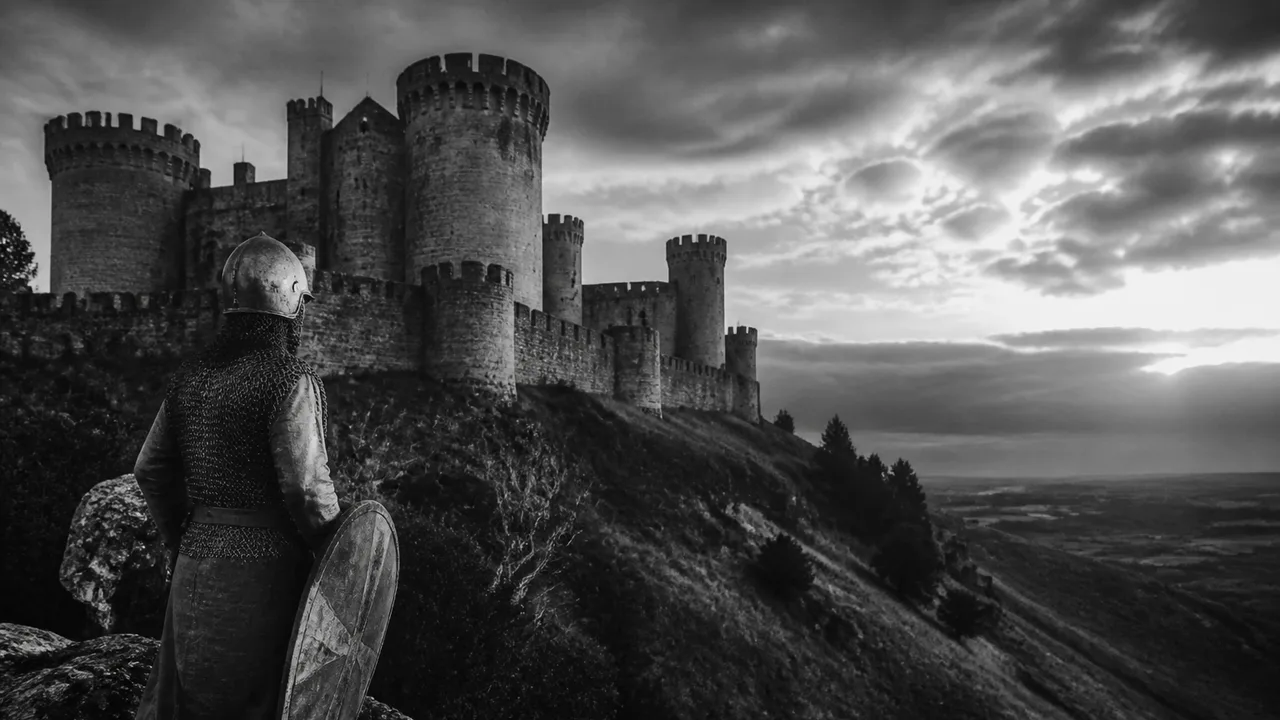
Photo: AI. Atticus Ferenczi
There is a particular kind of looking that castles demand. You crane your neck at the tower, squint at the crenellations—those tooth-like gaps along the parapet—and feel something: awe, maybe, or the faint hum of a fantasy you absorbed somewhere between a picture book and a theme park. What The Great History of Castles, a 2018 documentary directed by Benoît Poisson and recently uploaded to the SLICE Full Doc YouTube channel, quietly insists on is that this feeling is not accidental. It was engineered. And it has been re-engineered at least once since.
The documentary covers roughly 700 years of castle-building across medieval Europe—from the ninth-century motte-and-bailey earthworks thrown up in a few panicked months against Viking and Magyar raids, to the Renaissance pleasure palace of Chambord, where the battlements are purely decorative and Leonardo da Vinci reportedly wandered the grounds as a kind of artist-in-residence. That arc—from desperate utility to performed nostalgia—is the real subject of the film. Not what castles were, but what they were always saying.
The Mound Is the Message
Start with the motte-and-bailey. The motte is the artificial mound—typically 30 meters across at the base, 10 at the top, between 6 and 12 meters tall—and the bailey is the enclosed courtyard below it. You could build one in about three months using unskilled labor and material dug from the surrounding ditch. No architects required. The keep on top might be nothing more than timber and packed earth.
So why bother with the elevation at all? Militarily, height matters: you can see farther, you can shoot farther, and attackers have to fight uphill. But the documentary's historians make a point that is easy to miss: the mound also made you visible. "They had to artificially create an elevation in order to see far away and be seen from far away." The castle announced itself. It was a claim staked in the landscape, legible to every peasant within eyeshot.
This is the first design logic of the medieval castle—and it never really goes away, even as the forms get drastically more complex. Every upgrade in material or scale carries this double function: military hardening and public declaration. When the lords of the tenth and eleventh centuries began replacing wooden keeps with stone towers, the practical advantage (fire resistance, greater mass) was real. But so was the signal. Fulk Nerra—Foulques Nerra, Count of Anjou, who became count at seventeen and reportedly built around thirty fortresses over his long and violent career—commissioned the great stone keep at Loches in the Loire Valley. The documentary is clear that Loches was not primarily a weapon. It was "built entirely of dressed stone," positioned to be seen, designed to make Fulk legible as the king's equal. The stone was the argument.
Philip's Blueprint, or: How to Franchise Power
The documentary's centerpiece is Philip II of France—Philip Augustus—who ascended the throne in 1180 when the kingdom of France was barely larger than the Île-de-France region around Paris. Normandy, Anjou, Maine: all held by the English Plantagenets. Philip spent the next several decades methodically clawing territory back, and he used castles as instruments of that reclamation in a way that was almost shockingly systematic.
He developed what historians call the "Philippian castle"—a standardized template. Square enclosure. Round towers at the corners and semicircular towers mid-wall (round because siege projectiles ricochet off curved surfaces; square corners create blind spots that attackers can exploit). A central keep that gradually migrates to a corner. Arrow loops staggered at different heights in a fan pattern, so archers can cover nearly every angle without gaps. Crenellated wall walks connecting tower to tower.
The Louvre—not yet the art museum, but the fortress built in the 1190s on the southwest corner of what is now the square courtyard—was the flagship of this system. Seventy-eight by seventy-two meters, ten towers, a circular moat seven and a half meters wide and deep, a keep thirty-one meters tall. It became the model. "For Philip II, the construction of castles was obviously a tool of war and confrontation," one historian notes in the documentary, "but it was also a special tool in the service of his power, his authority, his image. For him, it was a tool with which to restore the authority of the king of France."
This standardization is fascinating from a design standpoint—and worth pausing on. When you see a round tower on a castle in northern France, in southern France, in territories Philip never visited, you are seeing a brand mark. Philip didn't always build the towers himself; sometimes he simply added one to a conquered fortress. The round tower was a logo. It said: this is royal now.
The Arms Race That Changed the Shape of Everything
The Philippian template dominated European castle-building for nearly two centuries. Then gunpowder arrived.
The story the documentary tells about artillery and castle architecture is essentially a story about a design problem with no good solution. Stone cannonballs in the late fourteenth century were manageable—walls could absorb them, and the early cannons were less accurate than catapults. But cast iron balls, which appear around the mid-fifteenth century, were a different category of problem entirely. "Instead of smashing on the walls, they smash the walls." The distinction is everything.
Castles responded by getting shorter and wider. The elegant vertical towers that defined the high medieval castle—built to command the landscape—began to shrink into thick, squat, semi-buried structures whose profile offered less target surface. Bonaguil, built between 1445 and 1482 in southwest France by what the documentary cheerfully describes as a "megalomaniac lord," features over a hundred cannon ports and an almond-shaped keep with a streamlined, deflective profile. It looks almost nothing like what we picture when we think "castle." It looks, actually, like something trying very hard not to be seen.
By the time the Spanish-commissioned fortress of Salses was built at the foot of the Pyrenees in the late fifteenth century—walls fourteen meters thick, towers buried rather than raised, gunners working inside ventilated vaulted rooms to avoid asphyxiation from their own weapons—the documentary's historians are willing to say it plainly: "It's the end of the castle. We can no longer speak of a medieval castle even if it retains some of the features. It's already a citadel." The vocabulary of medieval architecture had become incompatible with survival.
Ornament as Conquest
Here is the thing about Chambord: it has battlements. It has machicolations—those stone corbelled galleries projecting from the tops of walls, designed to let defenders drop things on attackers below. It has a keep. Francis I had it built from 1519 onward, brought Italian craftsmen to the Loire Valley, and created something that the documentary describes as "one of the greatest castles of the Renaissance."
Except it isn't a castle in any functional sense. The battlements are decorative. The machicolations are stylistic. Chambord is a palace wearing a costume—and the costume is deliberate. The language of military architecture, stripped of its military function, became the language of royal legitimacy. You built battlements to say: we come from warriors, from lords, from the people who shaped this nation. It was retrospective branding.
This is where the documentary gets genuinely interesting, because the same logic recurs—amplified—in the nineteenth century. After the French Revolution dismantled or abandoned much of what remained, after decades of quarrying castle ruins for building stone, the Romantics arrived with their moss-covered ruin aesthetic and their taste for Gothic shadows. Scholars rediscovered medieval heritage. Well-to-do families built themselves neo-Gothic piles. And Eugène Viollet-le-Duc, one of the most consequential architectural figures of the century, began restoring actual medieval castles—including Carcassonne and Pierrefonds—under commissions from Napoleon III.
Viollet-le-Duc is a complicated case that the documentary handles with some nuance. At Pierrefonds, which Louis XIII had ordered demolished in the seventeenth century to prevent it being used against royal authority, he rebuilt from ruins into something the film describes as "a neo-Gothic decor of a fairy tale"—faithful in some respects, inventive in others, haunted by gargoyles of dubious historical accuracy. "It has a gothic side in the savage sense of the term. It's very gory, very Dracula." One historian calls him "a real genius" who struck "a perfect balance between faithful reconstruction and a creation that's well researched." Another implicitly flags the interpretive problem: "We have to look for the original castle and take into account the restorations, reconstructions of the 19th century, including its reinterpretation by Viollet-le-Duc. It has to be read in two ways."
That is genuinely useful framing. Viollet-le-Duc did not lie, exactly. He synthesized—and in synthesizing, he created the image of the medieval castle that most of us carry in our heads. The silhouette we associate with the Middle Ages is partly his invention.
What We're Actually Looking At
The documentary traces the castle as an object that was always doing at least two things simultaneously: solving an engineering problem and broadcasting a political claim. The early wooden motte said I am here and you cannot dislodge me. The Philippian round tower said this territory belongs to France. The ornamental battlements of Chambord said power has a pedigree. And Viollet-le-Duc's restorations said something that 19th-century nationalism needed to hear: we have ancient and magnificent roots, and here is the evidence.
None of these are false, exactly. All of them are partial. The medieval architects whose names have almost entirely vanished—the master masons who laid out curtain walls with knotted ropes and 50-centimeter cubits, who supervised 8 to 12 years of coordinated skilled labor—were solving real problems under real constraints. The lords commissioning these structures were genuinely trying to survive in a world of constant territorial predation. The stone was the argument, and the argument was sometimes for their lives.
But the documentary's most quietly unsettling observation comes near the end, almost in passing: "The Middle Ages is an era of builders. It's a time when a lot of wealth, a lot of capital went into building cathedrals and into building castles. It may have been detrimental to living standards. It may have been detrimental to the quality of people's health and education, but it left us with extraordinary monuments that are important to our identity and what we are today."
Worth holding onto, that phrase: detrimental to living standards. When you stand in front of Carcassonne—3 kilometers of ramparts, 40 towers, arrow loops two to three meters long that, as the documentary notes, "don't actually need to be 2 to 3 m long to be more effective"—you are looking at an ostentatious display of power that was paid for by people who had very little say in the matter. The beauty is real. The cost was distributed unevenly.
That tension doesn't make the castles less worth studying. If anything, it makes them more worth looking at carefully—which is exactly what Poisson's documentary asks you to do.
More Like This

Middle Platonism's Hidden Role in Western Esotericism
ESOTERICA's new crowdfunded seminar argues Middle Platonism built the foundations of Hermeticism, Gnosticism, and early Christian theology. Here's what that means.
San Francisco 1906: The Disaster That Was Built
The 1906 San Francisco earthquake wasn't just an act of nature—it was the bill coming due on decades of willful ignorance. Here's what actually happened.
MLK: The Ancient Echoes of Justice and Leadership
Explore MLK's legacy through ancient lenses of justice and leadership. Discover unexpected connections.
Stonehenge: What Archaeology Can't Tell Us
Archaeologists know how Stonehenge was built—barely. Why it was built remains genuinely, stubbornly unknown. Here's what the evidence actually says.
21 Hidden California Places That Rewrite Deep Time
From sailing stones to fossil waterfalls, California's overlooked places hold 150,000 years of geological and human drama. Dr. Helen Papadopoulos investigates.
Tom Bombadil's Power: Why You're Asking Wrong
Tom Bombadil is Tolkien's most debated enigma. A new In Deep Geek breakdown reframes the question of his power—and the reframe is more interesting than any answer.
Medieval England: How Peasants and Guilds Shaped Society
A new documentary traces medieval England's social divide through two real families—one peasant, one guild merchant—and the starkly different worlds they inhabited.
Route 66 and the Landscape of American Memory
Peter Adler's documentary on Route 66 reveals a road that stopped being infrastructure and became something stranger—a canvas for competing American mythologies.