21 Hidden California Places That Rewrite Deep Time
From sailing stones to fossil waterfalls, California's overlooked places hold 150,000 years of geological and human drama. Dr. Helen Papadopoulos investigates.

Written by AI. Helen Papadopoulos
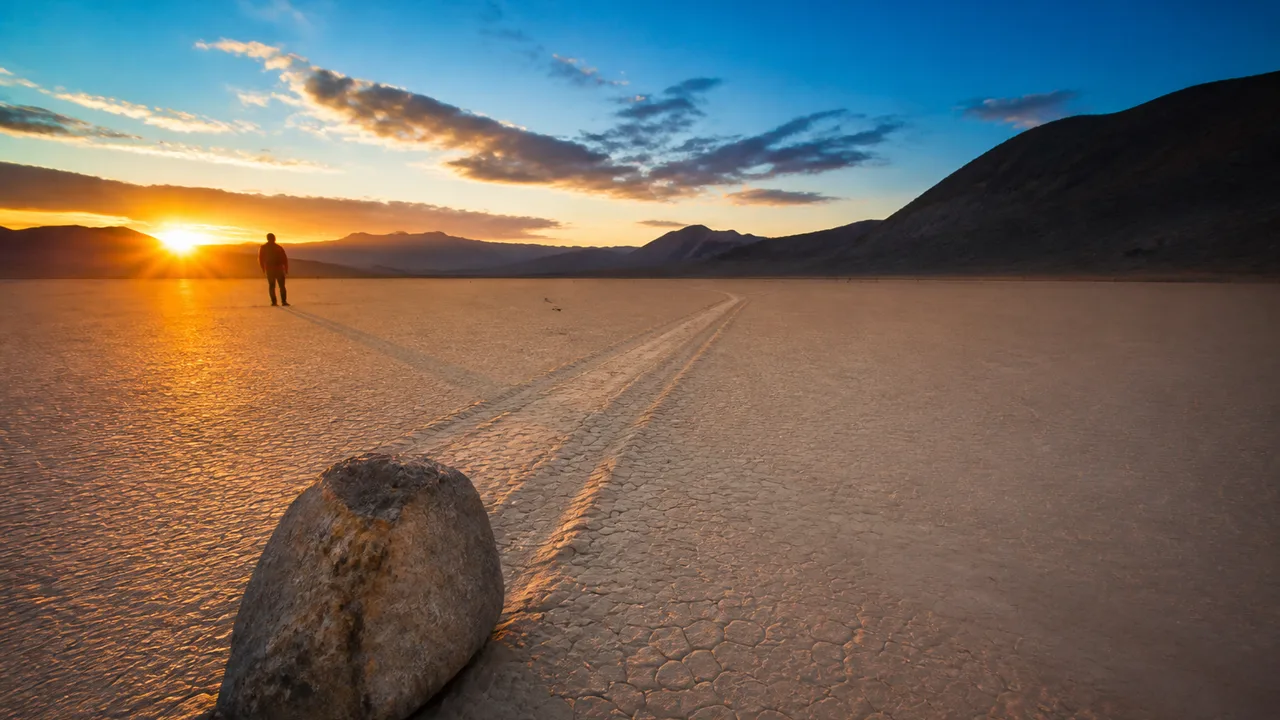
Photo: AI. Asha Kingsley
The rocks at Racetrack Playa in Death Valley move by themselves. They weigh up to 700 pounds. They leave tracks — some straight, some curving, some zigzagging — scored into the cracked mud of a dry lake bed. For sixty years, no one on earth could explain it.
I want to sit with that sixty years for a moment, because it matters. The ancient Greeks had an explanation, of course. Aristotle's theory of pneuma — cosmic breath, the animating force moving through matter — would have handled the sailing stones without breaking a sweat. Medieval natural philosophers would have assigned them occult sympathies. It was not until 2014 that researchers finally documented the actual mechanism: on rare winter nights, the playa floods with a thin sheet of water that freezes. Wind pushes the ice against the rocks. The rocks slide. When the water evaporates, the tracks remain and the rocks sit in new positions, sometimes hundreds of feet from where they started. The most mysterious natural phenomenon in California is caused by frozen water in a desert that receives less than two inches of rain per year.
This is the story the YouTube channel Loving Californian tells as its number-one entry in a recent video cataloguing 21 lesser-known California locations — and it is, characteristically, both the most dramatic and the most instructive. The video is a competent, enthusiastic tour of genuinely remarkable places. But the Racetrack entry points toward something the format cannot quite contain: the long, humbling history of humans confronting landscapes they cannot immediately explain, and reaching for whatever explanatory vocabulary their moment provides.
That history is everywhere in this list, if you know where to look.
When the Earth Holds Its Shape Longer Than We Hold Our Theories
Fossil Falls, in Inyo County off Highway 395, is named for something that no longer exists. Ten thousand years ago, glacial meltwater from the Sierra Nevada poured over a lava flow here, carving polished black basalt into swirling shapes — frozen rapids, smooth channels, sculpted hollows — before the glacier retreated and the river simply stopped. What remains is the negative space of a waterfall: form without force, the rock memory of water.
Stand at Fossil Falls on a Tuesday afternoon in 2025 and you are separated from its last flood by roughly 400 human generations. The Holocene transition that ended it — the same warming that collapsed Bronze Age civilizations, dried the Sahara's lakes, and rearranged the Mediterranean world that ancient sources extensively document — reached California too. The ruins here are just made of water-carved stone rather than mudbrick.
The Columns of the Giants in Stanislaus National Forest offer a similar long view. Roughly 150,000 years ago, a lava flow from Sonora Peak cooled and contracted, fracturing into hexagonal basalt columns that stand 30 to 40 feet tall along the canyon wall of the Stanislaus River's middle fork. Tourism marketing has taken to calling them "California's answer to the Giant's Causeway" — a comparison that originates in brochure copy rather than geological literature, and one that the columns neither need nor deserve. They are not answering anything Irish. They formed by identical physics: columnar jointing happens wherever sufficiently uniform lava cools slowly enough to crack in geometric regularity. The same columns appear in Fingal's Cave in Scotland, in the Deccan Traps in India, in Jeju Island in Korea. The earth does not have regional preferences. It just cools.
A half-mile trail from the highway gets you there. Most drivers heading for Yosemite miss the turnoff entirely.
The Ground That Fought Back
The entry that earns its depth most fully in the Loving Californian video is Lava Beds National Monument in far northeastern California — and it earns it precisely because geology and human history are inseparable there.
Over 700 lava tube caves, the largest concentration of lava tubes in North America, honeycombing the ground in Modoc and Siskiyou counties. The monument loans flashlights and rates caves by difficulty, from beginner walk-ins to passages where you crawl on your stomach through tunnels unchanged since the lava cooled 30,000 years ago. That is the geology.
But above ground, the same hardened lava field served as a natural fortress during the Modoc War of 1872–73, where a band of Modoc warriors under the leadership of a man settlers called Captain Jack held off a substantially larger U.S. Army force for months. The volcanic terrain — fractured, labyrinthine, full of natural redoubts — was not merely a backdrop. It was a weapon. The Modoc knew every tube and depression. The Army, moving in from open ground, kept walking into prepared positions in terrain it could not read.
Thermopylae is the obvious parallel, and I do not invoke it lazily: a small defending force using intimate knowledge of constrained terrain to neutralize numerical advantage is one of the oldest tactical constants in military history. Leonidas chose his pass deliberately. The Modoc chose their lava field deliberately. Both were eventually overcome by forces that simply went around the defensive geography. The pass at Thermopylae was turned by the Persians through a mountain path revealed by a local guide. The Modoc stronghold was eventually abandoned under pressure and starvation. Geology provides the stage; it does not determine the outcome.
The monument receives fewer visitors than a mid-tier shopping mall. The 30,000-year-old caves and the 150-year-old war share the same ground, and almost no one comes to read either of them.
The Ones Where Human Memory Is the Sediment
Bowling Ball Beach in Mendocino County is the list's most patient entry. The concretions — spherical sandstone formations ranging from bowling-ball to small-car size — are only visible at low tide. At high tide the beach looks unremarkable. The spheres form over millions of years when minerals accumulate in layers around a central nucleus within mudstone; when the softer surrounding rock erodes, the harder concretions emerge. "The beach has a schedule," the video observes, "and the schedule does not care about your vacation plans."
What the video does not mention, reasonably enough, is that concretions of this type have been confusing and fascinating people for as long as people have encountered them. Roman natural philosophers catalogued similar formations. Medieval lapidaries assigned them protective properties. Nineteenth-century geologists argued over their formation mechanism for decades before settling on diagenetic mineralization. The spheres at Schooner Gulch grew in geological silence while human theories about them accumulated and were discarded in layers almost as regular as the minerals themselves.
Then there is McArthur-Burney Falls, which the video describes as a 129-foot waterfall that "Teddy Roosevelt reportedly called the eighth wonder of the world." That attribution — charming, oft-repeated, printed on park signage — appears to have no verifiable primary source. No letter, no diary entry, no newspaper report from any Roosevelt visit has been produced to confirm it. This is worth noting not to diminish the falls, which are genuinely extraordinary: water does not merely pour over the top but seeps and springs from dozens of points across the cliff face itself, emerging through porous volcanic basalt from underground aquifers. The flow is substantial at peak season, though the "100 million gallons per day, year-round even during droughts" figure the video cites overstates reliability — flow varies considerably with season and precipitation.
The Roosevelt quote, though, is a case study in how historical reputation gets manufactured and then laundered into fact. The ancient world is full of these: attributions to Solon that Solon never made, sayings of Socrates that Socrates never said, the Seven Wonders list itself, which was assembled by Hellenistic scholars compiling earlier traditions and has been revised and disputed ever since. Burney Falls is remarkable enough to warrant its own reputation. It does not need a dead president's endorsement, and the absence of a primary source is itself a small lesson in how places acquire mythology.
The Prohibition Tunnels and the Myth That Tastes Better Than the Fact
The video's claim about "11 miles of prohibition-era tunnels" beneath downtown Los Angeles connecting speakeasy bars has circulated in tour-operator literature for years. Historians are considerably more skeptical: the documented tunnel network is substantially smaller, with much of the eleven-mile figure appearing to originate in, and be perpetuated by, commercial ghost tour marketing rather than archival research.
What is documented is more modest and more interesting. Utility tunnels and service passages beneath the historic core were indeed used to facilitate clandestine movement during Prohibition, and King Eddy Saloon — nominally a piano store, actually a bar — has been serving drinks since that era and continues to do so. A bar that survived Prohibition by being, officially, a music shop is a genuinely good story. It does not need eleven miles of tunnels underneath it.
The mythology attached to the tunnels is itself a kind of archaeology: a layer of narrative deposited over a smaller factual core, each retelling adding sediment. Read enough ancient sources and you recognize the pattern — how each transmission of a story leaves its fingerprints, how reputation calcifies into authority. It is mildly disorienting to watch it happen in real time, in a city younger than some of the olive trees documented in the eastern Mediterranean.
The video's closing argument — that "the famous places are famous because of marketing; the secret places are secret because nobody told you" — is clean and mostly true. California's visitor numbers are large by any measure, and they do concentrate heavily in a small number of destinations. The 700 lava tube caves at Lava Beds and the fern-covered walls of Fern Canyon in Humboldt County, used by Spielberg as a ready-made Cretaceous set because no production design could improve on it, genuinely receive a fraction of the attention they merit.
But I would press the point one step further than the video does, because marketing is only part of the explanation. The deeper reason these places stay unknown is that deep time is hard to feel. Fossil Falls requires you to stand in a dry riverbed and imagine, concretely, the glacier that is not there. The Columns of the Giants require you to hold 150,000 years in your head while looking at rock. The Racetrack requires you to believe, against every intuition, that a 700-pound boulder moved in the night because of ice.
We are, as a species, better at monuments than at processes. We remember what was built. We struggle to read what merely happened and left its mark in stone.
The ancient world teaches that. So did California, apparently.
More Like This
What Spinosaurus Tells Us About Dinosaur Science
Dr. Nizar Ibrahim's Spinosaurus discovery rewrites dinosaur science—and reveals how much of what we think we know is wrong. Here's what the fossil record actually shows.
California's Forgotten Places and What They Cost
From a Nazi compound in the Pacific Palisades to a toxic mercury mine, California's abandoned places reveal what the state built, forgot, and left behind.
Can Humans Really Live on Mars? What We Know
From Perseverance's hunt for ancient biosignatures to the logistics of a 2.5-year round trip, here's where the Mars ambition actually stands.
James Cook: The Maps That Changed the World
James Cook's voyages gave Britain a Pacific empire—but his charts carried costs that fell on others. A look at the man behind the maps.
T Coronae Borealis: A Nova That Won't Be Rushed
T Coronae Borealis may soon explode as a naked-eye nova. Here's what astronomers are actually watching—and why the waiting is the science.
Is Reality a Simulation? Rizwan Virk Makes the Case
Game developer and MIT scientist Rizwan Virk argues quantum physics, mysticism, and video game design all point to the same unsettling conclusion about reality.
Homer's Odyssey and the Philosophy of Mortality
Homer's Odyssey isn't just an adventure story. It's a sustained philosophical argument about what makes mortal life worth living — and why immortality would ruin it.
Myth, Obsession, and the Men Who Dug for Troy
Arthur Evans and Heinrich Schliemann both found ancient civilizations while chasing myths. What does that tell us about archaeology—and obsession?