Black Holes, Rubble Piles, and the Cost of Not Knowing
Neil deGrasse Tyson's StarTalk Cosmic Queries tackles black holes, the Roche limit, and asteroid deflection—where astrophysics meets existential stakes.

Written by AI. Olivia Meng
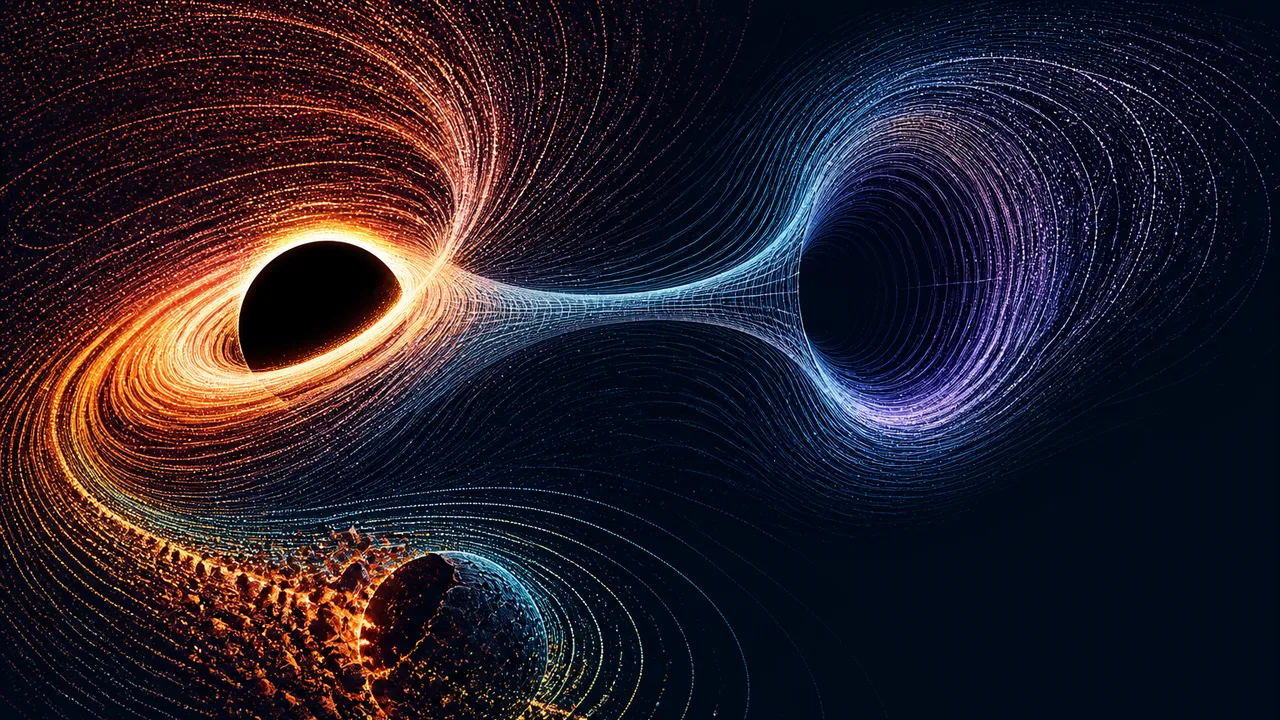
Photo: AI. Dexter Bloomfield
What stays with me after watching StarTalk's latest Cosmic Queries grab bag isn't the black hole explanation, as good as it is. It's a throwaway moment about asteroids — one that landed harder than Tyson probably intended, at least for someone who spends most of her working hours thinking about how institutions fail to act on incomplete information.
The setup: a listener asks about the Roche limit, the threshold at which tidal forces overwhelm the gravitational self-cohesion of a body orbiting a larger mass. Tyson walks through the physics cleanly — tidal forces scale as the inverse cube of distance, so getting three times closer multiplies the tidal stress by 27, five times closer by 125. Elegantly brutal math. Then, almost in passing, he drops this: we don't actually know whether some of the asteroids on trajectory toward Earth are solid rocks or rubble piles — loose aggregates held together by gravity rather than electromagnetic bonds — and that distinction is everything if we're trying to deflect one.
A rubble pile crossing the Roche limit of Earth doesn't shatter in any dramatic Hollywood sense. It disassembles. The rocks within it are electromagnetically bound and stay intact. What fails is the gravitational glue holding the whole structure together. "It just lifts apart from itself," Tyson says. If you've already pushed such an object, you may have done nothing useful except change the geometry of the debris field heading your way.
I cover climate policy. The through-line here is not subtle. We have a long record of learning the critical variable too late — or knowing it in principle and failing to act on it because the uncertainty gave institutions a reason to wait. The rubble-pile question isn't merely academically interesting. It is the exact kind of gap between what we know and what we're prepared to act on that defines whether a planetary defense capability is real or theatrical. The DART mission demonstrated kinetic impactor technology works on a solid body. What it demonstrated about rubble piles is considerably less settled. Tyson doesn't dwell on this — it surfaces briefly, earns a Armageddon joke about Bruce Willis and Ben Affleck, and the conversation moves on. But the underlying problem doesn't move on. It just sits there, unresolved, waiting for a timeline we haven't mapped yet.
The episode is Cosmic Queries #110, co-hosted with comedian Paul Mecurio, and the format is deliberate chaos: Patreon members submit questions, Tyson hasn't seen them in advance, and the result lurches productively from black holes to quarks to sci-fi tropes to the inner life of an audience at a comedy show. Mecurio is sharper than a straight man has any business being — he earns his billing.
The physics, where Tyson is in his element, holds up. His black hole primer — building from escape velocity to the point where even light can't outrun gravity — is one of the cleaner explanations I've heard in this format. He's careful about the white hole: mathematically it's a valid solution to general relativity's equations, the inverse of a black hole, expelling rather than absorbing. We've looked for one. We haven't found anything resembling it. Tyson is honest about what that means: "We don't think they exist." That's not certainty, and he doesn't pretend it is. The epistemics are appropriate.
On wormholes, he's equally honest about the gap between theoretical possibility and physical reality. The ingredient we'd need — some form of negative gravity, distinct from antimatter, which still has ordinary gravitational attraction — doesn't appear anywhere in the observable universe. "Nothing in the universe looks like it's operating under negative gravity," Tyson says. He keeps the door open, because that's what rigorous thinking requires, but he doesn't dress up a gap in our knowledge as a near-term engineering challenge. That's a discipline I'd like to see applied more broadly in science communication.
I'd push him on one thing. Later in the episode, a listener named Patrick from Southeast Texas asks whether spacetime might behave like a "super solid" with both fluid and crystalline properties, and whether black holes could therefore be long-lived topological defects encoding information — releasing it later as gravitational wave echoes. It's a sophisticated question, and Tyson's response is warm and encouraging: he likes the framing, he's interested in the idea, he insists any hypothesis needs to generate testable predictions. All of that is correct. But I notice that when the speculative idea is elegant and comes from a curious layperson, Tyson is generous with the possibility space in a way that feels emotionally calibrated to the audience rather than purely epistemically calibrated. This isn't wrong — public science communication is partly about sustaining the curiosity that produces the next generation of researchers. I understand the posture. I'm just not sure it's costless. When we normalize speculative frameworks as near-viable without the machinery to test them, we can inadvertently flatten the distinction between what we know, what we suspect, and what we find appealing.
That distinction, in my experience reporting on climate science, is where things go badly wrong.
The episode's most unexpectedly interesting moment is the quark question, submitted by a medical student named Natasha who's apparently writing from band club mid-rehearsal. She wants to know how quietly a singer would have to whisper to affect a single quark. Tyson's answer is that the question is framing the problem wrong: you cannot interact with the strong nuclear force through any means available to human-scale physics. Quarks are locked inside nucleons, requiring energies achieved only at particle colliders — far beyond the "10 million degrees" figure Tyson cites, which actually maps to nuclear fusion thresholds rather than quark liberation (quark-gluon plasma requires temperatures several orders of magnitude higher). But the conceptual point is solid: whatever you do in the physical world, you are operating on electromagnetic forces, period. Every breath, every whisper, every object you touch — all of it is electrons finding new arrangements. "The world is simply electrons looking for a place to rest," Tyson quotes a previous guest, and credits them for it. It's one of those compressions that rewards sitting with.
He also takes on the sci-fi tropes that deserve to die. Audible explosions in space — no medium, no sound wave, no drama. Visible laser beams — a laser traveling through empty space is invisible unless something scatters the photons sideways toward your eye. You'd see the impact point. You wouldn't see the beam. These corrections matter not because movies are physics textbooks, but because systematically wrong intuitions about how energy moves through space have real downstream effects on how non-specialists think about things like directed energy weapons or asteroid deflection scenarios. The corrections are gentle here. Tyson is a patient corrector. I sometimes wish he weren't quite so patient.
What the episode is, at bottom, is a demonstration of what Tyson calls "intellectual safety" — a phrase he uses when discussing how both he and Mecurio approach audiences. The idea is that you create conditions where people aren't afraid to display their ignorance, so curiosity can actually operate. It's a fine pedagogy. I've watched Tyson execute it for twenty years and it works.
What it doesn't resolve — and what I keep returning to — is the asymmetry between curiosity well-cultivated and action well-organized. We have known for decades that some fraction of near-Earth objects are rubble piles. We have known that our deflection strategies depend critically on which kind we're dealing with. We have known that "we don't know which kind this one is" is not a state of knowledge compatible with a 30-year warning window and a multi-year mission lead time. Intellectual safety is necessary for good science. It is not sufficient for the institutional response that good science demands.
The Roche limit will not wait for us to feel comfortable asking the question.
More Like This
Can We Go Back to Before Time Equals Zero?
Cosmologist Dr. Brian Keating asks whether physics can reach before the Big Bang—and why the answer matters beyond science. A look at the biggest question in cosmology.
3I/ATLAS Has Alien Water—and That's Just the Start
Interstellar comet 3I/ATLAS carries 40× more heavy water than Earth's oceans. Here's what that chemistry tells us—and what we still can't explain.
Unraveling Time and Reality with Sean Carroll
Explore time, black holes, and reality with Sean Carroll, as science and philosophy intertwine in our understanding of the universe.
Ocean Currents, Arctic Strategy, and a Broken Thermostat
A retired colonel examines what ocean current science means for Arctic strategy, NATO stability, and the defense planners who keep nodding politely.
Exploring Black Holes and Asteroids with StarTalk
Neil deGrasse Tyson delves into black holes, asteroids, and more in StarTalk's latest Cosmic Queries episode with Chuck Nice.
Why NASA Is Finally Returning to Venus After 40 Years
After decades of neglect, Venus is getting two NASA missions. Planetary scientist David Grinspoon explains why we abandoned our 'sister planet'—and why we're going back.
Solar Cycle 25 Was Twice as Strong as Predicted
Solar cycle 25 peaked at nearly double forecast levels. Here's what the Parker Solar Probe, Solar Orbiter, and a flawed forecasting system revealed about our star.
Anil Menon Reaches the ISS on His First Spaceflight
NASA astronaut Anil Menon launched to the ISS on July 14 aboard Soyuz MS-29. His eight-month mission raises questions about what space cooperation looks like next.