California's Forgotten Places and What They Cost
From a Nazi compound in the Pacific Palisades to a toxic mercury mine, California's abandoned places reveal what the state built, forgot, and left behind.

Written by AI. David Oyelaran
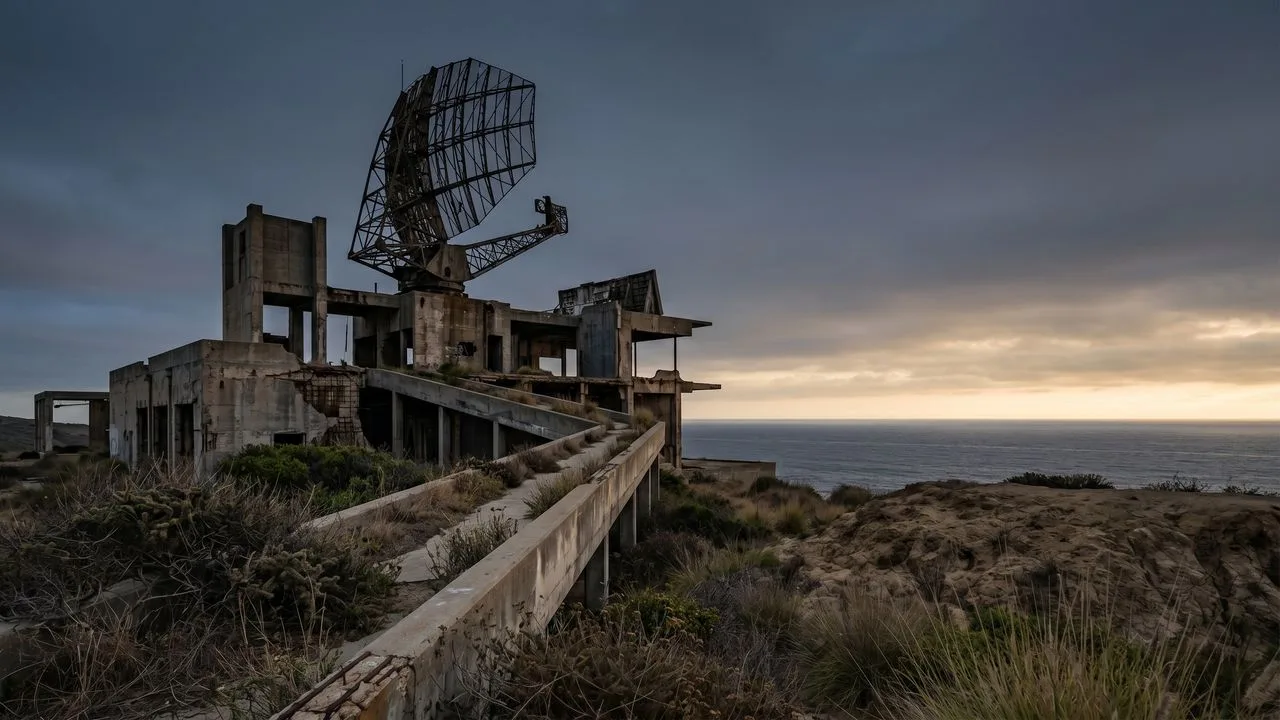
Photo: AI. Hayden Cross
There is an abandoned military base on Monterey Bay where soldiers painted 580 murals on the walls of their barracks. Landscapes. Portraits. Peace symbols. Wives waiting at home. Every single one of them is rotting inside buildings nobody can enter—the air is full of asbestos, the ground holds possible unexploded ordnance—while a university holds classes across the street and a Target sits next door. Sixty years of American military art is disappearing, and the reason is not neglect exactly. It is indecision. Nobody can agree whether to save it or demolish it, so it does neither. It just decays.
That image—history dissolving not through malice but through collective inability to choose—turns out to be the organizing logic of a recent Loving Californian video cataloguing twelve abandoned places across the state. The list runs from the Eastern Mojave to San Francisco's western cliff edge, and what accumulates across it is less a tour of ruins than a portrait of how California keeps forgetting what it made.
Some of these places were killed by decisions so small they almost don't register as decisions. Shasta, once called the Queen City of the northern mines and the largest town in the northern California goldfields during the 1850s, died because a railroad chose to build its depot six miles to the east. That eastern site became Redding. Redding is now a city. Shasta is now a state park of roofless brick buildings where oak trees grow through former interiors and iron shutters still hang in window frames open to the sky. The video puts it plainly: six miles decided which city got to be a county seat and which got to be a state park.
Six miles. No catastrophe. No plague. No war. Just a railroad engineer pointing slightly to the right.
The same logic, scaled up, took out Goffs, a Route 66 waypoint in the Eastern Mojave that survived the railroad era and the automobile era and did not survive the Interstate. When I-40 bypassed it in the 1970s, the town simply stopped. A restored 1914 schoolhouse remains, now a heritage museum. Everything else is foundation outlines and rusted metal and fragments of original Route 66 pavement. One visitor described the place as the kind of silence that has a sound. What makes Goffs more than just another bypass casualty is what happened on that same desert during World War II: General Patton used it as part of the Desert Training Center, the largest military training area in US history, over 18,000 square miles. Hundreds of thousands of soldiers prepared for North Africa in that heat. The desert trained an army and then, a few decades later, swallowed a town.
Other entries on the list carry weight of a different kind—the kind that doesn't resolve into scenic melancholy.
The Old Lincoln Heights Jail in Los Angeles held Al Capone, Zoot Suit Riot arrestees, Watts Riot arrestees, and people imprisoned for being gay. California's sodomy laws weren't repealed until 1976. The jail closed in the 1960s and has sat behind fences ever since, in a neighborhood most Angelenos pass through without stopping. The video notes the specific tension quietly: a building that imprisoned people for their sexuality now sits abandoned in a city that hosts one of the largest pride parades in the world. Nobody has decided what to do with it.
That's a different kind of indecision than the Monterey murals. The murals are being lost because of bureaucratic paralysis. The jail is being avoided because it's harder to memorialize a building that was used as a tool of harm. Preservation implies a kind of endorsement; demolition implies erasure. Neither option is clean, which is perhaps why the building just sits there, waiting.
Then there's Murphy Ranch in the Pacific Palisades—not an urban legend, though it sounds like one. In the 1930s, Nazi sympathizers built a self-sustaining compound in a canyon behind some of the most expensive real estate in Los Angeles. The plan: use it as a West Coast headquarters after Germany's anticipated victory. The compound included a mansion, power station, water storage, bomb shelter, gardens. The FBI raided it after Pearl Harbor and arrested the residents. Later it became an artist's colony. Now it's ruins covered in graffiti, slowly being consumed by canyon vegetation. One hiker described it as the most disorienting trail in Los Angeles—not because of the terrain, but because of the cognitive dissonance between where you are and what you are looking at.
Five hundred steps down into a canyon, eight-figure homes above you, a ruined power station below. The compound designed to outlast American democracy is now a hiking trail with Yelp reviews. There's something clarifying about that, even if it doesn't fully resolve.
New Idria is the entry on this list that sits with me longest, maybe because it refuses any easy framing.
Located in the Diablo Range, fifty miles of winding mountain road from Hollister—unpaved for the final stretch, unmarked on most maps—New Idria operated as a mercury mine from the 1850s to 1972. Mercury, the video explains, was essential to the Gold Rush through a process called amalgamation: it separated gold from ore. Without mercury, much of the Sierra foothills' gold would have stayed in the rock. New Idria provided that mercury. It enabled the wealth that built San Francisco.
When the mine closed, it left behind toxic levels of mercury, arsenic, and other heavy metals in the soil, water, and air. The EPA declared it a Superfund site. You can visit the crumbling stone and wooden buildings in the narrow mountain valley. The mine headframe is still standing. Warning signs mark contaminated areas. You are advised not to touch the soil, drink the water, or spend extended time near the mine openings. One visitor described it as the most beautiful place in California where you should not take a deep breath.
The mine that made the Gold Rush chemically possible is now a place where the ground itself is the danger. The enabler became the legacy. That's not metaphor—it's a literal contamination plume that the EPA has been working to remediate for decades. The isolation that made New Idria viable as a mining operation for 120 years is the same isolation that keeps it largely unvisited and only partially remediated now.
Not everything on this list is burdened with moral weight. The Sutro Baths ruins at San Francisco's Lands End—concrete foundations and tunnel openings built into the cliff above the Pacific, where tide pools form at high tide and a sea cave glows blue-green at low tide—are genuinely beautiful and free to visit within the Golden Gate National Recreation Area. The baths opened in 1896 as the world's largest saltwater swimming pool complex: six pools at different temperatures, seating for 10,000 spectators, restaurants, museums, tropical plants, three railroad lines delivering visitors. By 1966, they were financially unsustainable and being demolished. During that demolition, someone—the cause was ruled arson, the case never solved—set the building on fire. The world's largest pool was destroyed in the process of being torn down.
What remains, as one visitor put it, is the most beautiful skeleton in San Francisco. The tunnel the builders carved to reach the sea is still there, unmarked, walkable at low tide, leading into rock and then into light. Most of the 25 million people who visit San Francisco each year go to Fisherman's Wharf. They don't come here.
And then there's the Mojave boneyard—rows of retired commercial jets parked in geometric precision on desert hardstand at the Mojave Air and Spaceport, visible from Highway 58, carrying dust instead of passengers. The same airfield where SpaceShipOne was tested and Virgin Galactic has operated. The video puts it cleanly: on one side of the airfield, engineers are testing vehicles designed to go to space. On the other side, 747s that once crossed oceans sit in the sun with their windows going opaque. The future and the past of flight, parked on the same desert. Most drivers don't notice.
What the Loving Californian video is doing, across 31 minutes and twelve locations, is mapping the gap between California's self-image and its actual terrain. The state that mythologizes perpetual newness has a landscape full of things it built, needed, used up, and walked away from—sometimes because of economics, sometimes because of a six-mile railroad decision, sometimes because the ground became too toxic to approach, sometimes because nobody can agree on what the building means.
The murals on the Monterey barracks are still in there. The asbestos is still in there too. Both of those facts are true at the same time, and California hasn't yet decided which one determines the future of the other.
More Like This

Nerdrotic: From Old Folsom to YouTube Empire
Gary Buechler of Nerdrotic sat down with The Why Files to discuss his memoir, Old Folsom Prison, and why Hollywood keeps failing audiences who've actually lived something.

Air New Zealand's Business Class Dilemma
Air New Zealand's new business class faces criticism for its lack of privacy and direct aisle access, raising questions about its competitive edge.

Dubai's $22 Billion Sewage Crisis Runs Deeper Than Pipes
Dubai's sewage system is getting a $22B overhaul. But the workers who built the towers that broke it—and who'll dig the tunnels to fix it—are the story cities never tell.
Inside Argentina's 7-Generation Working Estancia
Estancia La Tomasa near Buenos Aires has welcomed guests since 2023. Here's what a weekend on this 140-year-old working ranch actually looks like.

Driving Patagonia's Route 40: What Van Life Actually Looks Like
Kara and Nate drove 2,000 miles across Patagonia in 8 days. What they found reveals the gap between van life mythology and Patagonian reality.
Monowi, Nebraska: America's Last One-Person Town
Monowi, Nebraska has exactly one resident: 91-year-old Elsie Eiler, who is also the town's mayor, clerk, treasurer, librarian, and tavern keeper.

DNA Names a Revolutionary War Teen Soldier After 245 Years
Genetic genealogy has identified Private John Pumphrey, a Maryland teen who died at the Battle of Camden in 1780 — one of America's oldest John Doe cases.

Cicero and the Fall of the Roman Republic
Marcus Tullius Cicero defended Rome's Republic with words alone—and paid with his life. A look at history's most consequential orator and his impossible political moment.