Monowi, Nebraska: America's Last One-Person Town
Monowi, Nebraska has exactly one resident: 91-year-old Elsie Eiler, who is also the town's mayor, clerk, treasurer, librarian, and tavern keeper.

Written by AI. Mariel Fontaine
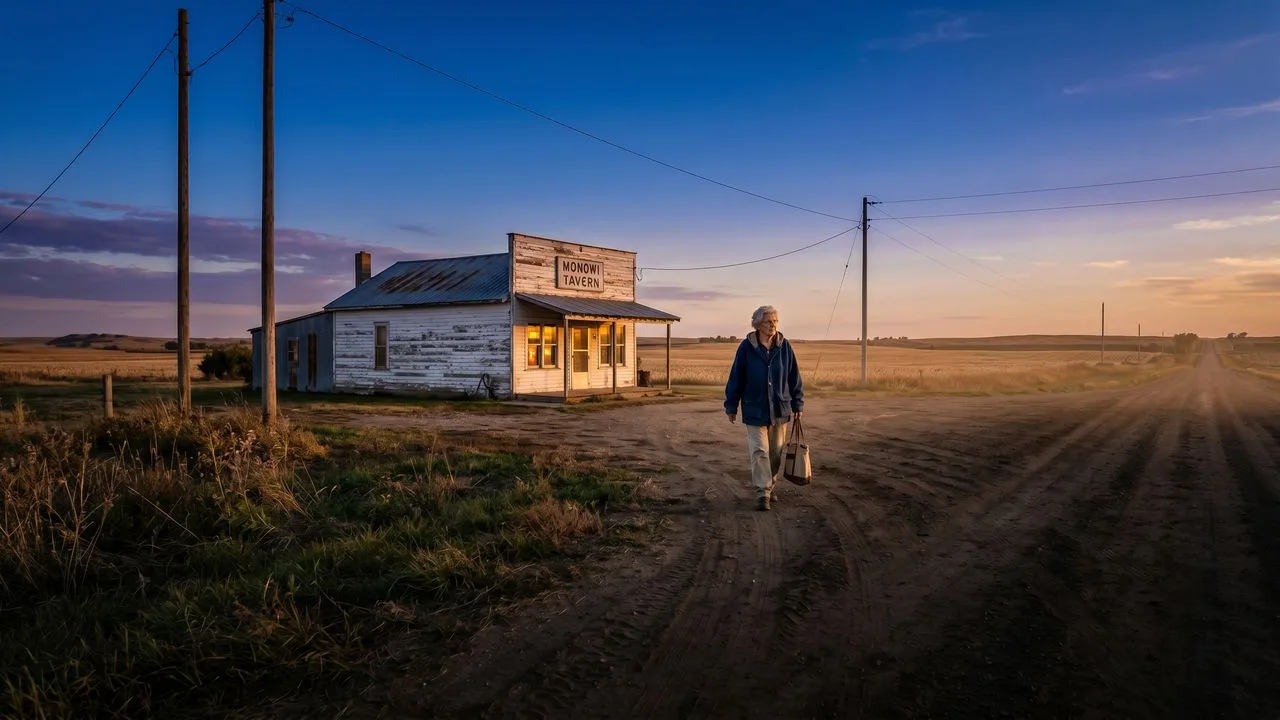
Photo: AI. Asha Kingsley
Somewhere north of Boyd County, just shy of the South Dakota line, there is a sign that reads "Population: 1." Most drivers, apparently, assume it's a mile marker.
It is not a mile marker.
Monowi, Nebraska holds the distinction of being the smallest incorporated municipality in the United States — a designation that requires exactly one person to maintain. That person is Elsie Eiler, 91 years old, who has lived in or near Monowi since she was roughly eighteen months old and has run the Monowi Tavern since 1971. She is, simultaneously, the town's mayor, clerk, treasurer, and librarian. She issued herself her own liquor license. The paperwork, one assumes, moved efficiently.
Travel creators Eric and Allison of The Endless Adventure made the detour on a road trip from Los Angeles back to Missouri, pulling off the main route to document what remains of a place that once held between 150 and 160 residents — enough for a high school, a church, and a couple of grocery stores. What they found was a single operating building surrounded by structures in various states of dignified collapse, and one woman who has chosen, deliberately and repeatedly, to stay.
What a town of one actually looks like
The physical reality of Monowi is worth sitting with. Drive in and you'll find the Monowi Tavern — kitschy country decor, a working fryer, cold beer, and a wall covered in decades of accumulated memorabilia. Adjacent to it, a dilapidated building that was once a general store. Down the road, a small shed that functions as Rudy's Library, named for Elsie's late husband Rudy, who died in 2004. The library contains actual books and, reportedly, actual Google reviews. One reviewer noted they applied for a library card and were denied on residency grounds. This seems correct.
In that library, the visitors found what appears to be the town's articles of incorporation, handwritten in 1905, sitting unlocked and accessible in a shed. Whether this is charming or alarming probably depends on your relationship with archival preservation.
The residential streets — and there are streets, plural, lined with the skeletons of houses — tell the longer story. Elsie mentioned that some of the old homes were purchased and physically relocated rather than demolished; people wanted the structures but not the location. Some are reportedly still occupied elsewhere. The ones that remain in Monowi are receding into the tree line.
"His top was well between 150 and 160," Elsie told the visitors, referring to the town's peak population. "The high school, the church, and couple grocery stores."
The arithmetic of that decline — from a functioning small community with civic institutions to a single resident managing every municipal function herself — spans roughly a century of rural American economic history. The specific causes vary by region but the pattern is consistent: agricultural consolidation, highway routing decisions, the slow evacuation of young people toward cities, the closure of schools that accelerates that evacuation. Monowi is an extreme case, but it is not an anomaly in kind.
The question of what Elsie Eiler represents
There is a version of this story that is purely heartwarming — the indomitable elderly woman, the tavern that keeps going, the visitors from around the world who come to eat a cheeseburger at the end of the earth. The BBC has covered her. Larry the Cable Guy stopped in. The Endless Adventure crew described meeting her as "like reconnecting with an old friend or a grandma."
That version is not wrong, exactly. But it's incomplete.
Elsie has run this tavern and this town for over five decades, through her husband's death and the town's continuing depopulation, and by all accounts she does so with considerable wit. The tavern sign guarantees "the coldest beer in town," which is both accurate and funnier the longer you think about it. She has a designated chair. She signs the t-shirts she sells to visitors.
What the vlog format tends to smooth over is the structural question underneath: what happens to Monowi's legal status when Elsie is gone? An incorporated municipality requires a resident to maintain its charter. Property records, road maintenance obligations, the liquor license — these don't simply evaporate. Nebraska has procedures for dissolving municipalities, but the timeline and mechanics are not something a cheerful road trip video is positioned to explore.
Elsie herself gestured toward this in her conversation with the visitors. "She did say that she would like to maybe move on from this place after 55 years," they noted. Her eyesight is failing. The subtext of "get here ASAP" is worth reading clearly: this particular version of Monowi has a horizon.
She also mentioned that people call regularly asking about property — single women, apparently, drawn to the idea of rural solitude. "They're terror downers," one of the hosts said, describing the actual state of the available structures. "Burn it downer and walk awayers." Which is funny, but it also describes the real estate situation with more accuracy than most listings would.
The road trip as frame, and its limits
Eric and Allison are engaging on-camera presences, and their affection for Monowi reads as genuine rather than performed. The detour cost them time on a drive with an actual deadline — a best friend's wedding — which gives the visit a different texture than an itinerary built around content production.
But the road trip format, however sincere, has structural constraints. You arrive, you eat the cheeseburger, you sign the guest book, you leave. The Monowi Tavern's guest book apparently dates back to 2024, which suggests recent visitors — a function, probably, of the same media coverage cycle that brought the BBC and now travel vloggers with drone equipment. Whether that attention is net positive for Elsie is a question worth asking and one the format doesn't pause to ask.
There is a meaningful difference between visitors who seek out Monowi because they are genuinely curious about rural American decline and the forces that produce a place like this, and visitors who want the novelty photograph and the story for their feed. Elsie, for her part, seems to have made peace with both categories. She fries the burgers either way.
The parallel visit to Omaha — largest city in Nebraska, brownstone buildings, cobblestone streets, what the hosts called "Midwestern Brooklyn vibes" — functions in the video as tonal contrast and little more. But it points at something real: the population that left Monowi over the past century went somewhere. Much of it, likely, went to places exactly like Omaha, or further. The urban concentration and rural evacuation are the same story told from different ends.
Monowi was incorporated in 1902, three years before those handwritten articles the visitors found in the library shed. It has outlasted its population by a considerable margin. What it means for a town to persist when the community that gave it reason to exist has dispersed — that's the question Elsie Eiler has been living inside for decades, whether or not anyone visiting for an afternoon thinks to ask it.
More Like This

Strategic Moves: Racing Through Taiwan's Train Stations
A strategic race across Taiwan's train stations reveals the art of decision-making under pressure.

Luxury Train Journey Across Australia: Worth the Cost?
Explore a luxurious 80-hour train journey across Australia and its opulent offerings.
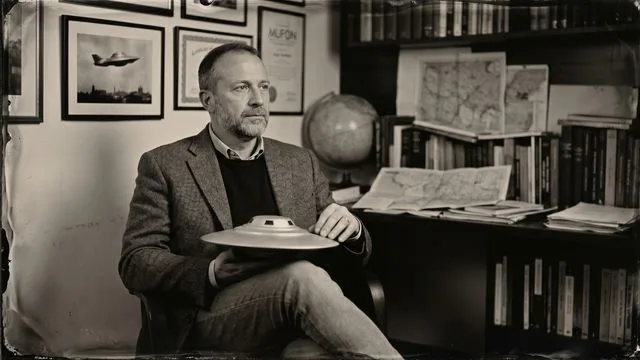
The UFO Investigator Who Started at Age Nine
Luigi Vendittelli's grandfather saw something over Montreal in 1965. Nobody believed him. That moment built Canada's most obsessive UFO investigator.
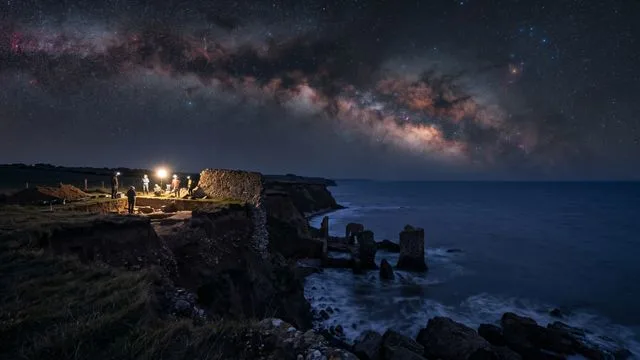
Dunwich: What Britain Is Choosing to Let Drown
Dunwich's medieval ruins are eroding into the North Sea. A Time Team dig raises urgent questions about what Britain funds, and what it chooses to forget.
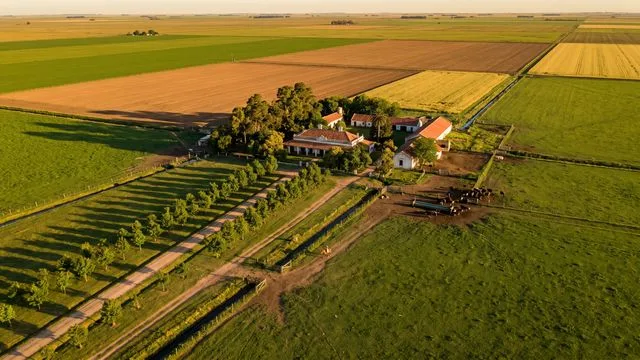
Inside Argentina's 7-Generation Working Estancia
Estancia La Tomasa near Buenos Aires has welcomed guests since 2023. Here's what a weekend on this 140-year-old working ranch actually looks like.

Driving Patagonia's Route 40: What Van Life Actually Looks Like
Kara and Nate drove 2,000 miles across Patagonia in 8 days. What they found reveals the gap between van life mythology and Patagonian reality.
Airport Behavior That Makes Flying Worse for Everyone
From gate lice to baggage claim crowding, Mark Wolters of Wolters World maps the airport habits that slow everyone down—and why they persist.

Basic French Phrases That Help Tourists in France
A handful of French words can shift how locals treat you in France. Here's what actually matters, and why the effort carries more weight than fluency.