How Rome Conquered Greece: Strategy Over Strength
Rome didn't overpower Greece—it outmaneuvered it. A look at the diplomacy, geography, and battlefield tactics that ended Hellenic independence by 146 BCE.

Written by AI. James Morrison
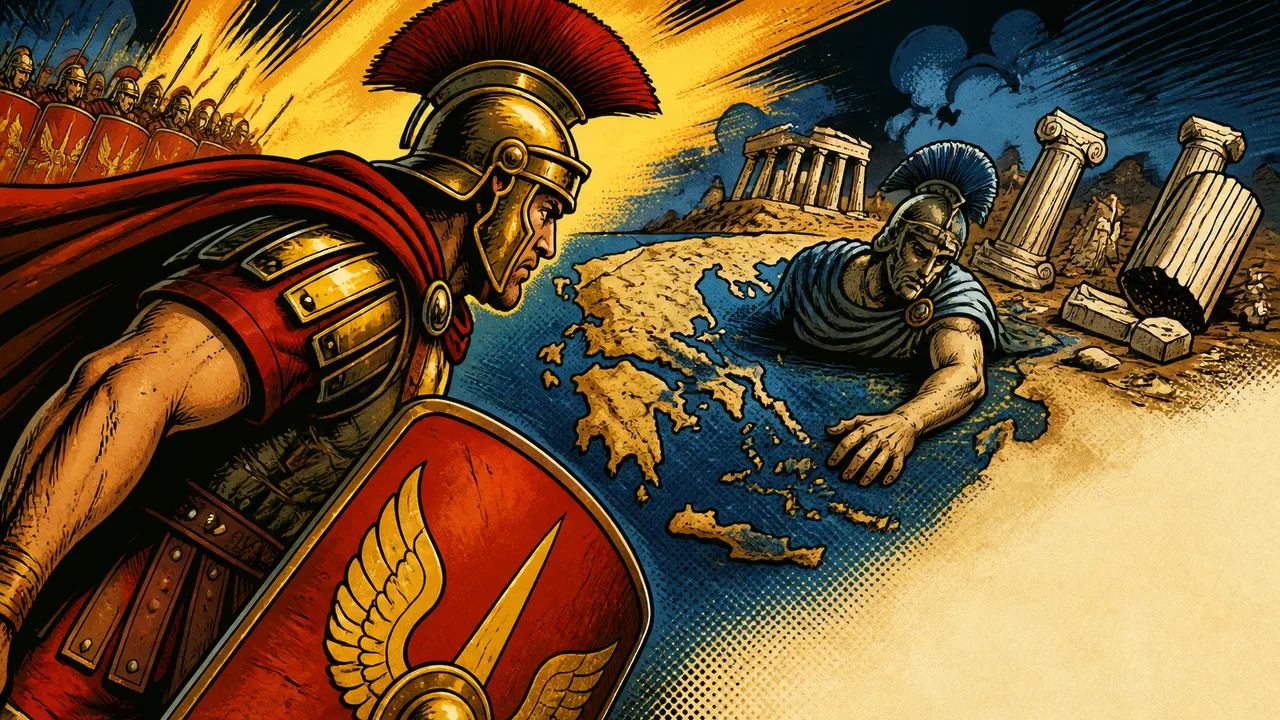
Photo: AI. Marco Velez
The story most people carry around about Rome conquering Greece goes something like this: disciplined Roman legions marched east and crushed the disorganized remnants of Alexander's world. It's a clean narrative. It's also mostly wrong, or at least radically incomplete.
A recent Kings and Generals documentary—scripted by Christos Nicolaou and narrated by Liam Taylor—spends nearly twenty minutes dismantling that shorthand. What the video constructs in its place is a considerably more interesting picture: a methodical, multi-generational campaign of alliance-building, psychological operations, and battlefield adaptation that unfolded over nearly seven decades, from 214 to 146 BCE. Rome didn't overpower Greece. It outmaneuvered it, from the inside.
That distinction matters—not just for ancient historians, but for anyone who thinks seriously about how great powers actually expand.
The Diplomacy Came First
The video's strongest argument is also its most counterintuitive: Rome's military victories in Greece were downstream of its political victories. Before a single Roman soldier crossed into the Greek peninsula in force, the Republic had been receiving embassies, cultivating friendships, and carefully diversifying its alliance portfolio among the fractious city-states and leagues of the Hellenistic world.
The mechanism was straightforward, even if the execution required patience bordering on the glacial. During the First and Second Macedonian Wars (215–204 and 200–197 BCE), Rome secured the allegiance of the Aetolian League—a confederation of city-states positioned near the strategically vital Isthmus of Corinth. That real estate gave Roman forces a foothold in the peninsula. The relationship with the Achaean League of the Peloponnese was more complicated; Rome allied with them at some points and fought against them at others. The video notes this wasn't inconsistency—it was leverage. If one league misbehaved, Rome simply pivoted to the other.
Pergamon and Rhodes followed similar logic from their side. Both polities calculated that in a crowded field of powerful, proximate rivals—Macedon, the Seleucid Empire, aggressive Cretan pirates—the safest patron was the one farthest away. Rome, across the Adriatic, had reach but not the daily territorial appetites of neighbors. The video summarizes this neatly: "many Greek polities reasoned that in a war among multiple stronger competitors, securing the support of the strongest and most geographically distant patron would ensure their freedom."
History has a habit of being unkind to that particular calculation.
The Propaganda Genius of Flamininus
No element of Rome's Greek campaign has aged with more uncomfortable familiarity than its messaging operation. Titus Quinctius Flamininus—Roman proconsul, declared enemy of Philip V of Macedon, and apparently gifted publicist—arrived in Greece in 198 BCE not with a blunt declaration of conquest but with a demand for liberation. All Macedonian garrisons, he argued, had to go. The states housing them were not free.
After defeating Philip V at Cynoscephalae in 197 BCE, Flamininus appeared at the Isthmian Games near Corinth and had a herald read aloud a proclamation that Plutarch recorded for posterity. It declared that the Roman Senate and Flamininus himself had "restored to freedom without garrisons and without imposts and to the enjoyment of their ancient laws" a catalogue of Greek peoples—Corinthians, Locrians, Phocians, Euboeans, Thessalians, and others.
The crowd's reaction, according to ancient sources, was rapturous. Romans as liberators. The formula had worked.
The video's framing here is precise: "While they were expanding their control over the Greek peninsula, they were framing it as liberation from familiar autocrats." Anti-Macedonian sentiment among southern Greek states ran deep and genuine—Philip II had forcibly unified Greece in the fourth century, and the memory had not softened. Rome didn't manufacture that grievance. It simply understood its value and deployed it with considerable skill.
The withdrawal of Roman legions after each campaign reinforced the liberation narrative. Troops went home. Greek autonomy appeared restored. The sphere of influence, meanwhile, quietly consolidated.
Geography as Weapon
Military historians tend to talk about terrain as a complicating factor—something commanders have to account for. The video makes a more pointed argument: Rome actively weaponized Greek geography against Greek formations.
Two battles frame the case. At Cynoscephalae in 197 BCE, fog pushed the Macedonian army into broken, hilly ground that was catastrophically unsuited to the phalanx—the dense, spear-bristling infantry formation that had broken Persian armies and carried Alexander to the edge of the known world. The sarissa, the Macedonian pike that could reach eighteen feet in length, required flat, stable ground and tight cohesion to function. On a hillside in fog, it became an organizational liability. The Roman manipular legion—organized into smaller, more independent tactical units capable of adjusting to uneven terrain—exploited the resulting disorder.
At Pydna in 168 BCE, the dynamic reversed and then repeated. The Macedonians under Perseus initially held flat ground near the shore and pushed the Romans back in the early fighting. But when the phalanx advanced into the foothills, its formation fragmented. Flanks opened. Roman soldiers poured into the gaps. Another Macedonian army died in the hills.
The phalanx was not a bad system. Against Persia, on chosen ground, it had been revelatory. But it was an instrument optimized for a specific set of conditions, and the Greek world's own fractured geography kept denying it those conditions. The Romans, coming out of the brutal, varied experience of the Punic Wars in Spain and North Africa, had learned to fight in bad terrain. That institutional knowledge compounded over decades.
Experience, Not Just Tactics
The video is careful to separate Roman military flexibility from Roman military superiority as a fixed quality. When Roman forces first arrived in Greece, the Macedonians were, by most accounts including the historian Polybius, considerably better cavalry fighters. The Romans recognized the gap and addressed it by working with local partners to build a capable horse force before the next major engagement.
That capacity for adaptation—identifying a deficiency, finding a fix, implementing it—is harder to sustain than raw martial prowess, and it draws on something beyond battlefield courage. It draws on institutional memory and professional culture.
The video makes the point that the Marian reforms and the full professionalization of the Roman army lay in the future—Gaius Marius wouldn't restructure the legions until the late second century BCE, after the Greek conquest was complete. But veterans of Scipio Africanus's campaigns in Spain and North Africa were already present and serving in leadership and support roles. Those men had fought across multiple theaters, against diverse enemies, under logistical conditions that Greek citizen-soldiers—who typically fought close to home, in familiar territory, against familiar adversaries—had never encountered.
The Macedonians were the partial exception. They had campaigned broadly under Alexander and his successors. But even their experience was narrower than the Roman veteran pool by the time the two powers met at Cynoscephalae and Pydna.
What the Greeks Were Up Against
It would be misleading to read the Greek defeat purely as Roman achievement. The video is honest about the other side of the ledger.
Alexander the Great died in 323 BCE without an adequate succession plan, and the wars of the Diadochi—his successors—consumed the Hellenistic world for generations. Macedon, the Seleucid Empire, Ptolemaic Egypt, the Aetolian League, the Achaean League, Pergamon, Rhodes: all were capable polities. None could subordinate its particular interests to a unified response to Rome. When Rome arrived in Greece, it wasn't entering a coherent civilization capable of concerted resistance. It was entering a system already fracturing under its own contradictions.
The destruction of Corinth in 146 BCE—the same year Rome razed Carthage—punctuates this. Corinth had the naval capacity and commercial network to potentially challenge Roman maritime dominance in the Aegean. Rome leveled the city, killed the men, and enslaved the women. It was a demonstration, not just a punishment: a signal to every remaining Greek polity about what challenging Roman primacy actually cost. By then, the Greeks understood they had been conquered. They had simply understood it too late to act on that understanding.
There's a pattern here that recurs across military history—and I've watched it play out in different forms across different centuries. The most durable conquests aren't the ones won in the largest battles. They're the ones where the decisive work was done before the fighting, in the patient accumulation of alliances, information advantages, and legitimizing narratives. By the time the phalanx met the legion on the slopes at Cynoscephalae, Rome had already won most of what mattered.
The military history is fascinating. But the diplomatic history is the story.
More Like This

The KGB's Cyanide Newspaper Gun That Almost Worked
How a KGB poison weapon hidden in a rolled newspaper killed Ukrainian nationalist Stepan Bandera in 1957—and why one mistake unraveled the whole operation.
Unraveling Rome's Dodecahedron Mystery
Exploring the enigmatic Roman dodecahedron, its theories, and historical significance in modern archaeology.
The Roman Triumph: Power, Humiliation, and Legacy
Explore the Roman Triumph, a spectacle of power and humiliation, and its enduring legacy.

FBI's Struggle Against Omega 7: A Tale of Terrorism and Intrigue
Explore the FBI's complex investigation of Omega 7, a Cuban exile terrorist group, amid community challenges and evolving tactics.

Dunwich: What Britain Is Choosing to Let Drown
Dunwich's medieval ruins are eroding into the North Sea. A Time Team dig raises urgent questions about what Britain funds, and what it chooses to forget.
Attila the Hun: Scourge of God or Economic Strategist?
Attila never sacked Rome—yet he's history's ultimate barbarian. The real story is stranger, and more familiar, than the legend.
Audie Murphy: Soldier, Icon, and Haunted Man
Audie Murphy was America's most decorated WWII soldier. His battlefield heroism and Hollywood fame masked a man deeply scarred by combat and survivor's guilt.
The Crusades: Two Centuries of Holy War Explained
From Pope Urban II's 1095 call to arms to the fall of Acre in 1291, the Crusades reshaped Christianity, Islam, and the medieval world permanently.