Digging for King John's Palace at Clipstone
Time Team excavates Clipstone, Nottinghamshire, hunting for King John's lost royal palace on the edge of Sherwood Forest. Here's what they found.

Written by AI. Sarah O'Brien
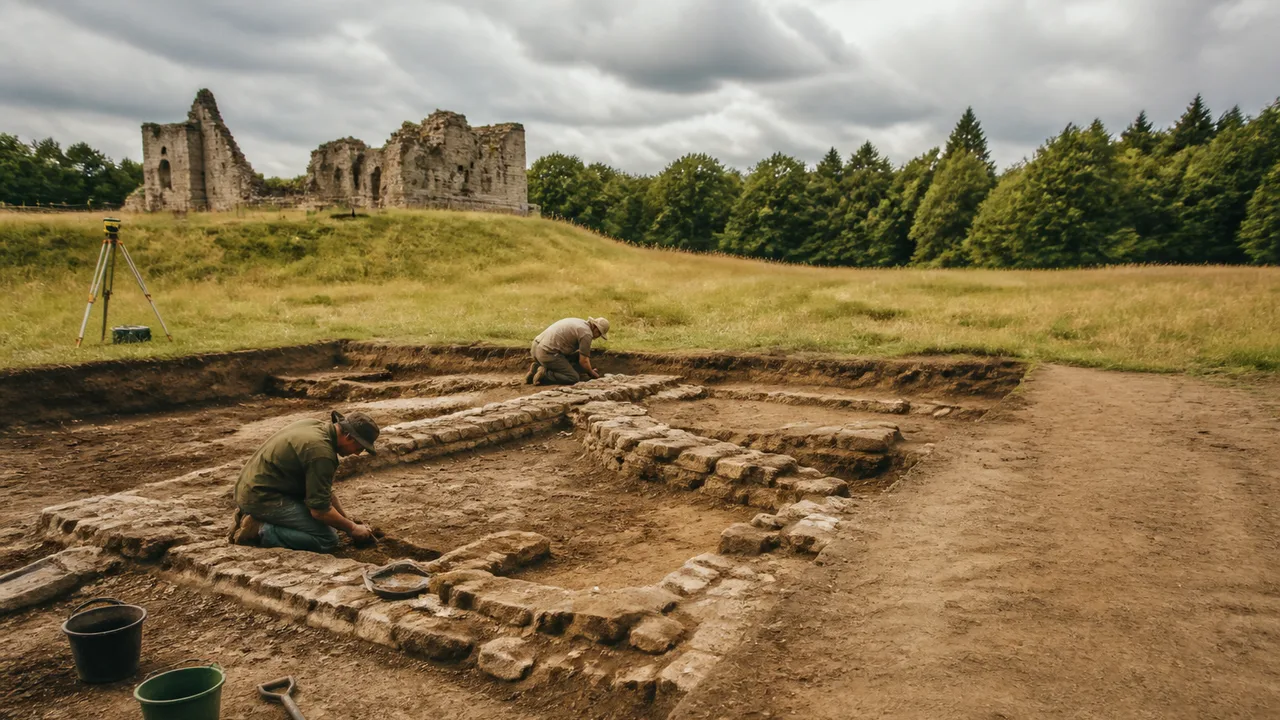
Photo: AI. Marcel Dubois
There is a particular kind of frustration that only archaeology can produce. You have the documents. You have the geophysics. You have eight centuries of local tradition pointing at a specific field and saying: there. And then you dig, and what you get is rubble.
That's the situation Time Team walked into at Old Clipstone, Nottinghamshire — a village on the edge of what was once a far larger Sherwood Forest, where three crumbling walls in a farmer's field have long been identified in the history books as the remains of a royal hunting lodge. The locals have always believed it was something more: a palace, a complex of chambers and chapels and feasting halls where King John came to hunt deer and hold court. The question the team spent three days trying to answer was whether the archaeology could square with that claim, or whether the village was, after all these centuries, simply wrong.
The Gap Between Paper and Ground
The documentary record for Clipstone is, by medieval standards, unusually rich. Records show a king's chamber rebuilt in 1234 for £130 — a sum worth something close to £100,000 today. There's a queen's hall, a new chapel, glazed passageways connecting buildings. A stable capable of housing 200 horses. A great pond. A gatehouse. By the mid-14th century the complex had been expanded repeatedly, with successive monarchs — Henry III, Edward I — pouring money into the site. On paper, this is unambiguously a palace.
Under the ground, the picture is considerably murkier, and for a reason that took the team most of the dig to fully reckon with. The stonework didn't just decay. It was systematically removed. The Duke of Portland, in the 19th century, put in a drainage scheme for the surrounding water meadows, and while he apparently issued instructions against disturbing the ruins, the workers raided the site anyway — a 1844 directory records "much spoliation was made on the venerable walls." Before that, the stone had already been migrating into local buildings for generations. Alex found chisel-marked medieval masonry in back gardens. He found a perimeter wall built into a resident's cottage, hidden behind decades of lime plaster, discovered only after some careful work behind the household piano. The palace had been disassembled piece by piece, and its stones had walked away to become someone else's drainage channel, someone else's garden wall, someone else's living room.
What this means practically is that the standard archaeological signal — stratified layers, intact walls, in-situ features — is almost entirely absent from the central dig area. What replaced it was demolition rubble: a deep, homogeneous layer of decayed mortar and smashed masonry that buried whatever survived at foundation level. As one of the team explained, the act of demolition itself creates the problem: "You're burying the site that went with the wall under the debris as you dismantle the wall." To properly understand what stood here, you would need to strip hundreds of square meters of demolition material. Three days — or even three decades — wouldn't cut it.
What the Rubbish Tells You
This is where the dig gets genuinely interesting, and where the archaeology starts talking in ways nobody initially expected.
The pottery scattered through the demolition rubble isn't medieval domestic ware. It's drinking vessels — small black cups, nothing associated with cooking or eating. The interpretation offered by the ceramics specialist is that this is the workmen's rubbish: the medieval equivalent of Coke cans left behind by the crews who spent months or years systematically stripping the palace for its stone, probably between 1470 and 1530. The demolition debris isn't an obstacle to reading the site — it is a reading of the site, a record of the building's end.
Meanwhile, the faunal evidence tells a story about the site's heyday. The bones recovered from across the site include significant quantities of deer, and — crucially — they come predominantly from the right-hand side of the animal. This matters because of the ritual known as "the unmaking of the deer," the formal butchery protocol attached to royal hunting, in which the carcass was divided according to strict social hierarchy. The right side went to the best hunter. Finding right-side deer bones concentrated on a high-status site rather than scattered through the surrounding villages suggests, as the bone specialist put it, that "the king is the best hunter and they're all here." The bones are a record of royal theatre.
Lodge or Palace? The Evidence That Shifted Things
The honest answer, by the end of three days, is that the team found enough to be confident in the site's significance without being able to close the definitional question with anything like certainty.
On the high-status side of the ledger: glazed cockscomb ridge tiles of a kind found only on elite buildings; window lead and plaster consistent with a chapel rather than a domestic structure; a mason's mark on architectural stone that had been brought in from a considerable distance; a carved stone hand grasping a column, ecclesiastical in character, recovered from demolition rubble that predates a 13th-century foundation trench — meaning something was knocked down to build the chapel the team found, and that earlier something could plausibly date to King John's reign. The Nottingham splash glaze ware, a pottery type that disappears by the end of the 12th century, places occupation at exactly the right period.
On the other side: the team never found a single intact wall in its primary context. The "mysterious tower" suggested by the ground-penetrating radar remained mysterious throughout. Mick's initial instinct — that the standing remains were more hunting lodge than palace — was never definitively overturned, only made harder to sustain by the accumulating weight of high-status finds.
Phil, characteristically, put it plainly after a day of ego-bruising reversals in his trench: "The palace, if that's what it is, is here." The hedge is doing real work in that sentence.
Why Clipstone Needed Scheduling
There is a reason this episode isn't just a three-day puzzle about a medieval king's leisure habits. The landowner, Mickey Bradley, had a specific goal in mind when Time Team arrived: get the site enough documented evidence to qualify for scheduling as a protected monument. Without that designation, the ruins were vulnerable. With it, future development requires consent, and the record — however incomplete — is locked in.
"Then it can be scheduled, it can be listed, and it will be made safe even when I'm not here," Bradley said at the start of the dig. That's not sentiment. That's an owner who understands that the only thing standing between a medieval site and a digger is paperwork.
The team's evidence — the chapel foundation, the perimeter wall in the cottage, the coherent body of high-status finds, the match with the documentary record — was sufficient. The site got its scheduling recommendation. What that preserves isn't the palace as it stood in King John's time, but the record of everything that happened to it afterward: the occupation, the abandonment, the stripping, the reuse, the forgetting, the rediscovery. That's not a consolation prize. That's the actual history.
The distinction between a hunting lodge and a palace may be less meaningful than it first appears. The documentary record describes a complex that grew for over two centuries, used by successive monarchs for ceremony, diplomacy, and recreation. Whether you call that a lodge or a palace depends partly on your definition, partly on which phase of its history you're looking at. What's not in question is that something significant stood here, that most of it is now in someone's drainage ditch, and that what remains is worth protecting precisely because we've already lost so much of it.
The stones in the water meadows aren't going anywhere. But the context that would let us read them properly is finite, fragile, and sitting under a field that isn't scheduled yet.
More Like This

California's Channel Islands Hold 13,000 Years of History
From pygmy mammoths to the Lone Woman of San Nicolas, California's Channel Islands preserve one of North America's deepest human records — if we bother to look.
Medieval England: How Peasants and Guilds Shaped Society
A new documentary traces medieval England's social divide through two real families—one peasant, one guild merchant—and the starkly different worlds they inhabited.

Seine-Nord Europe Canal: Building Through the Somme
France's €7.3bn Seine-Nord Europe Canal will link its waterways to Rotterdam and Antwerp—but it's being dug through ground that never finished burying its dead.

Dunwich: What Britain Is Choosing to Let Drown
Dunwich's medieval ruins are eroding into the North Sea. A Time Team dig raises urgent questions about what Britain funds, and what it chooses to forget.
Searching for London's First Roman Road Under Lambeth
Time Team investigates whether London's first Roman road ran through Lambeth Palace gardens—and why the Romans crossed the Thames there before building Londinium.

Exploring Mont Orgueil: A Fortress of Secrets
Discover the hidden history and strategic significance of Mont Orgueil Castle in Jersey, unearthed by Time Team's archaeological investigation.

Rolls-Royce: Craft, Class, and a Century of Decline
How Rolls-Royce built the world's finest cars on bespoke craftsmanship — and what was really lost when that tradition could no longer survive.

Fallout Season 3 Is Filming, and the Franchise Has Come Far
Walton Goggins confirms Fallout Season 3 is filming. What does a franchise this far from its 1997 origins mean for gaming history and preservation?