Myth, Obsession, and the Men Who Dug for Troy
Arthur Evans and Heinrich Schliemann both found ancient civilizations while chasing myths. What does that tell us about archaeology—and obsession?

Written by AI. Helen Papadopoulos
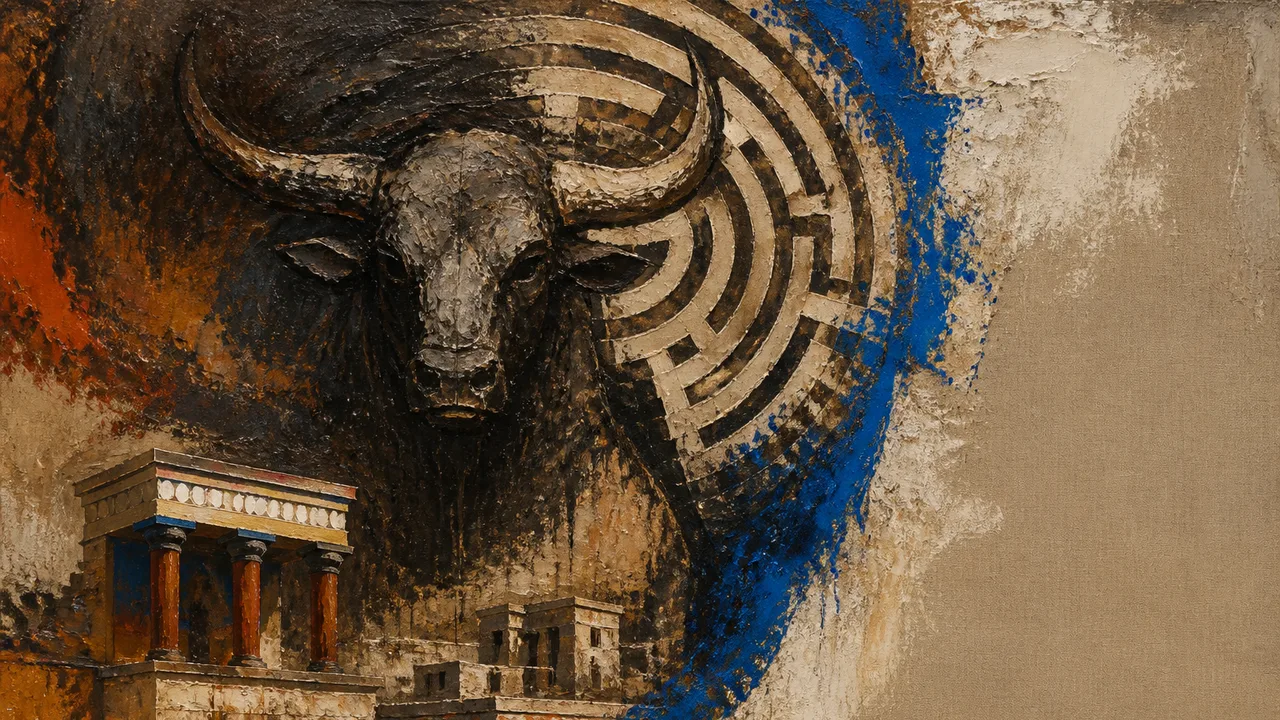
Photo: AI. Saskia Aaltonen
The labyrinth was never supposed to be found. That was the point. In Greek myth, the maze beneath the palace of King Minos was designed to be inescapable — a prison for a monster and a death sentence for anyone foolish enough to enter. Theseus made it out, barely, with a thread and a sword. The archaeologists who went looking for the real thing had only their convictions to guide them back.
What the Odyssey documentary The Hunt For The Real Minotaur: Did We Find The Labyrinth? maps across nearly two hours is something more interesting than a treasure hunt. It traces the psychological architecture of two men — Arthur Evans and Heinrich Schliemann — who turned ancient myths into excavation briefs, and in doing so, made some of the most consequential archaeological discoveries of the modern era. The irony the film keeps returning to is this: they found extraordinary things, just not exactly what they were looking for.
The Son Problem
Evans and Schliemann share a biographical undertow that the documentary is smart enough not to ignore. Both men were shadowed by powerful fathers. Both were dismissed — Evans literally called "little Evans" in his professional circles — and both turned archaeology into a theater of self-vindication.
Evans's father, John Evans, was one of the foremost geologists of Victorian England. Arthur, by contrast, had been jailed twice in the Balkans, deported for encouraging rebellion, and eventually landed a low-paid curatorial post at Oxford's Ashmolean Museum through family connections. He was not, by any conventional measure, a man on the rise. But the Ashmolean gave him something: time to think, and a desk.
When the Reverend Greville Chester donated a collection of ancient seal stones to the museum in 1888, Evans recognized in those small semi-precious gems — jasper, amethyst, cornelian — something no one else had thought to look for. The stones were engraved with symbols. Not decorative patterns: a language. "He knows that they have something to say," one of the documentary's commentators observes. "They're going to tell a big story and he wants to be the person to tell that story."
The argument Evans was building was elegant and ambitious. Schliemann had found Troy and Mycenae. He'd proved Greek myths had Bronze Age roots. But Schliemann, as Evans saw it, had missed the obvious question: where was the writing? "Schliemann was looking for Mycenae rich in gold. He found the gold. Schliemann wasn't looking for script." Without writing, you have architecture and gold and pottery, but not history in any defensible sense. Evans wanted the script.
Knossos and the Shape of an Obsession
The trail from the seal stones led to Crete — specifically to Knossos, a hill in an olive field that had been rumored for decades to hide the palace of King Minos. Evans bought a quarter-share of the land in 1896 for £235. He eventually acquired the rest and, in 1900, began excavating with the help of Duncan McKenzie, a tall, gregarious Scottish archaeologist who was, in nearly every respect, Evans's temperamental opposite.
What they found was staggering. Early in the excavation, workers uncovered a clay tub filled with hundreds of inscribed tablets — a script Evans called Linear B, far more systematically complex than the seal stone symbols. Pottery found alongside the tablets connected the site stylistically to Mycenae and dated to roughly 1,400 BC, making this writing at least 900 years older than the Greek alphabet.
Deeper layers revealed something even older: a simpler script Evans labeled Linear A. He now believed he'd found three developmental stages of Europe's earliest writing system. The discovery earned him a knighthood in 1911. "He's making the sort of discovery that allows him to rise up shoulder-to-shoulder with his father," one commentator notes, and you sense the excavation had been about that all along.
But the myth kept pulling. Three weeks into the dig, workers found a fragment of wall painting — a bull's hoof. Then, embedded in a wall, an imposing stone chair. Evans announced it as the first throne of Europe and named its occupant without hesitation: Minos. On day fifty-five, they uncovered a three-dimensional lime plaster fresco of a raging bull, life-sized, nostrils flaring. The workers, according to the documentary, leapt back in horror — for them it resembled an image of the devil. For Evans, it was the Minotaur.
The building that emerged over thirty-one years of excavation covered 22,000 square meters. It had a grand staircase, a vast central courtyard, aqueducts, a sewage system, and a network of corridors and chambers that Evans experienced as unmistakably labyrinthine. He had found his maze. He had found his monster. He had, he believed, found Minos himself.
Later archaeologists were less convinced. Evans had reconstructed the building based substantially on his own imagination. He had assembled a composite "king" from fresco fragments that came from different sources. The stone chair's occupant remains unknown. The documentary notes plainly that Evans "turned it into the sort of civilization that he wanted and centered it around the Greek myths about Crete." Some scholars have since argued that Knossos was not a palace at all but a religious complex — though the documentary presents this as a challenge to Evans's framework rather than settled fact.
What is not in dispute: the Minoans were real, they were ancient (flourishing from the twenty-seventh century BC), and we know about them because Evans went looking. Linear B was eventually translated after Evans's death in 1941 and proved to be the earliest known form of the Greek language — a Mycenaean script adapted from Minoan writing, predating the Greek alphabet by at least four centuries. Evans was wrong about whose writing it was. He was right that it rewrote European prehistory.
Schliemann's Useful Delusions
The documentary spends equal time on Schliemann, and the portrait is less sympathetic but equally fascinating. Where Evans was methodical in his pursuit of script, Schliemann was essentially a businessman who decided to take Homer literally, which is not a research methodology that tends to go well.
He taught himself ancient Greek in a few months, fluent enough to read the Iliad in the original. He used it like a surveyor's map. When he needed to test whether Bunarbashi in western Turkey was the site of Troy, he attempted to run around it three times — reenacting Achilles chasing Hector — and found the terrain impossible. Homer was right; therefore Bunarbashi wasn't Troy. The logic is circular, but the conclusion happened to be correct.
Hisarlik, eight kilometers away, was the real site. Schliemann found it with the help of British archaeologist Frank Calvert, who had already purchased part of the land and done preliminary excavations. What Calvert couldn't provide was money. What Schliemann couldn't provide was patience. He drove a massive trench through the middle of the mound with winches, battering rams, and dynamite, destroying in the process untold amounts of evidence from the very layer he was ultimately seeking.
In 1873, he found gold. Bracelets, necklaces, rings, goblets — an astonishing cache he immediately declared to be the treasure of King Priam, the jewels of Helen of Troy. According to the documentary, Schliemann claimed his wife Sophia was present as a witness when he uncovered it. She was not. She had left the site earlier that season to return to Athens. As the website Tales of Times Forgotten has documented, Schliemann appears to have invented a witness to his greatest discovery — one of several inconsistencies in his account, including contradictory descriptions of where exactly in Troy 2 the treasure was found.
The gold was real enough. When the collection later surfaced at Moscow's Pushkin Museum — it had disappeared from Berlin during the Soviet advance in 1945 and the Russians denied having it for decades before acknowledging possession in 1994 — archaeologist Donald Easton, among those invited to examine the collection after its disclosure, concluded that the objects had genuinely come out of the ground and had not been manufactured to order in the nineteenth century. What they were not, as he confirmed, was Priam's treasure. Troy 2, where Schliemann found the gold, dates to around 2,300 BC — a thousand years before any Trojan War that might have taken place. The treasure was real. The identification was fiction.
Troy 6, the layer Schliemann and his architect Wilhelm Dörpfeld identified in 1890 as the actual Homeric Troy, was both his vindication and his ruin. It was bigger. Its pottery matched Mycenae. It was the right period. And it meant that Schliemann, in blasting through the mound two decades earlier, had destroyed much of the city he spent his life looking for. According to the documentary, he retreated to his tent for three days when the implication became clear. When he emerged, he said quietly: "I think you're right." He went to his grave publicly defending Troy 2.
What the Maze Is For
Both men found civilizations they weren't looking for, by following myths that didn't quite lead where they promised. That's not a romantic coincidence — it's a structural feature of how the discipline developed. Victorian archaeology was, in many respects, myth made methodological. The question of where European civilization "came from" was already ideologically loaded before a single shovel touched Cretan soil.
The Minoans were real. Troy was real. The writing was real. The labyrinth — in the sense of a sinuous Bronze Age complex that could plausibly have given rise to a story about a maze — was real enough. But the king, the monster, the hero: those were always what Evans and Schliemann needed them to be.
The documentary frames this as a psychological parable about father-son rivalry and the monsters men confront in themselves. That reading is too tidy for me, but it points somewhere useful. The question of what we bring to the evidence — what we desperately need the evidence to say — is not an abstract problem for Victorian gentlemen-archaeologists. It's the central problem of the discipline, then and now.
Linear A, the oldest Minoan script, still hasn't been deciphered. Whatever the people of Knossos were actually writing about remains, for the moment, beyond us. That seems like the right place to leave it.
More Like This
WW1 Trench Life: What the Western Front Was Really Like
From Pals' Battalions to the Vickers gun, a new documentary unpacks the grim machinery of survival on the WW1 Western Front in unflinching detail.
Common History Myths That Schools Still Teach
From Napoleon's height to Viking helmets, a new video maps the historical myths that textbooks kept alive—and asks why bad history is so hard to dislodge.
Digging for King John's Palace at Clipstone
Time Team excavates Clipstone, Nottinghamshire, hunting for King John's lost royal palace on the edge of Sherwood Forest. Here's what they found.
Ancient Greece: Democracy, Empire, and Extremes
From Homer's epics to Alexander's conquests, ancient Greece shaped the Western world through democracy, warfare, and cultural fusion. Here's what the evidence shows.
Pavlopetri: Inside the World's Oldest Sunken City
A Bronze Age city has sat submerged off southern Greece for 3,500 years. New technology is finally letting archaeologists read what it says about us.
Belzoni's Tomb: The Strongman Who Found Seti I
Giovanni Belzoni was a circus strongman who became Egypt's greatest explorer. His 1817 discovery of Seti I's tomb rewrote what we knew about the ancient world.
Troy Was Real — But Not How Homer Told It
Hittite cuneiform tablets and Bronze Age archaeology suggest a real conflict at Troy — one far stranger and more geopolitically tangled than the Iliad admits.
Pliny the Younger's Letters on the Eruption of Vesuvius
Pliny the Younger's two letters to Tacitus remain the only eyewitness account of Vesuvius's eruption in 79 AD — and they still read like dispatches from the end of the world.