California's Hidden Underground: Caves, Tunnels, and Buried History
From a buried Gold Rush city to survival tunnels built by Chinese immigrants, California's underground holds layers of geology, history, and forgotten infrastructure.

Written by AI. Sofia Ramirez
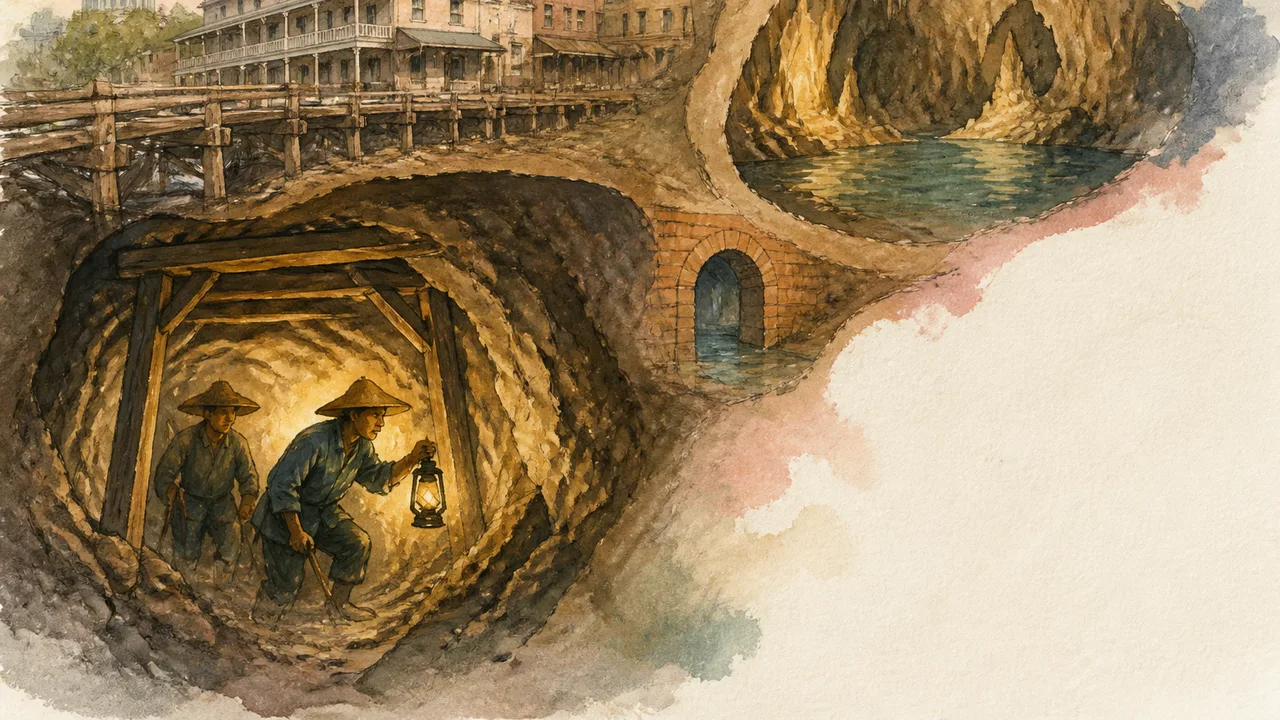
Photo: AI. Júlia Almeida
The surface of California is a lot. Sequoias so wide you can drive through them. Coastline that takes your breath clean out of your chest. But there's a version of this state that most people will never see because it's directly below wherever they're standing—and a recent video from the channel Loving Californian maps out eighteen of those underground places in something close to obsessive detail.
The list runs from geological wonders to military infrastructure to, most compellingly, the places people built underground not because it was interesting but because they had no other choice.
What the ground remembers
Start with Moaning Cavern in Calaveras County, which the video ranks first. It's the deepest publicly accessible cave in California—a single vertical chamber large enough to fit the Statue of Liberty upright with room above the torch. Gold Rush miners found the entrance in 1851, drawn by a moaning sound the wind made passing through the natural opening. What they found at the bottom was more unsettling: human remains dating back 13,000 years. People who fell in before agriculture existed. Before anyone had a word for California.
You can rappel into it today. The video puts the situation plainly: "The rope is the only difference between you and the people who fell in 13,000 years ago. The cave does not care about the difference."
That line is doing something useful. It collapses the distance we usually maintain from deep time and reminds us that the ground underneath a tourist attraction has its own memory, one that predates the attraction by orders of magnitude.
The geological entries on this list tend to work this way—each one revealing something the surface conceals. Black Chasm Cavern in Amador County contains helictites, crystal formations that grow sideways, upward, and in spiraling directions that appear to ignore gravity entirely. Scientists haven't settled on a full explanation. The cave sits near a town called Volcano, which is not, in fact, a volcano. Crystal Cave in Sequoia National Park holds marble formations that predate the giant sequoias above it by millions of years. The trees get the postcards. The crystals get a spiderweb gate and inconveniently located ticket sales—deliberately so, because formations that took geological epochs to build can be destroyed by a single careless generation of visitors.
Mitchell Caverns in the Eastern Mojave sits at 65 degrees Fahrenheit while the desert outside pushes 115. The caves were closed for over a decade due to state budget cuts and only reopened in 2023. Most Californians still don't know they exist.
Ambition sealed underground
Several entries on the list are the remains of human industry—places where labor was extracted from the earth and the earth still shows the marks.
Empire Mine in Grass Valley is the clearest example. The mine operated continuously from 1850 to 1956, 106 years, producing 5.8 million ounces of gold. At current prices, that's over $14 billion pulled from beneath a small foothill town. The shafts descend nearly a mile. The lateral tunnel network runs 367 miles—about the driving distance from San Francisco to Los Angeles. Residents of Grass Valley live above all of it. There are no signs at the grocery store. No plaques in the parking lot. The video describes it as "a root system made of darkness" running beneath a town that now mostly thinks about coffee and weekend farmers markets.
The Donner Pass Railroad Tunnels tell a related story from a different angle. The 1,659-foot Summit Tunnel through solid granite was the most difficult section of the transcontinental railroad—hand-drilled by Chinese workers using black powder in Sierra winters that buried them in snow. The tunnel was abandoned in 1993 when the railroad rerouted. You can hike through it now and touch the drill marks. The video's note on this is brief but accurate: "The hands that built the transcontinental railroad left their marks in stone. The railroad left them behind."
Below San Jose's Almaden Quicksilver County Park, miles of tunnels from the New Almaden mercury mine—the most productive in North America—extend beneath weekend hiking trails. The mercury enabled Gold Rush gold extraction through amalgamation. The wealth that built San Francisco ran through these tunnels. The mine entrances are sealed but visible on the trail, occasionally surprising someone in Patagonia gear who had no idea the park they were walking through sits on top of a 130-year toxic metal operation.
The tunnels that survival built
The entry that refuses to stay in its lane as entertainment is number eleven on the list: the Chinese underground passages beneath Fresno's Chinatown.
In the late 1800s and early 1900s, anti-Chinese violence, targeted harassment, and discriminatory legislation made surface travel genuinely dangerous for Fresno's Chinese community. The Chinese Exclusion Act of 1882 had made them legally vulnerable. Street-level movement carried real risk. So the community built underground—connecting basements of homes, businesses, and gathering spaces into a network that allowed daily life to continue beneath streets that were hostile above.
The tunnels are documented. Sections have surfaced during construction projects and building renovations over the decades. They are not a myth or a folk legend. The video makes the distinction between this entry and every other on the list explicit: "Every other underground place on this list is here because it is fascinating. The Chinese tunnels are here because the reason they exist is the most important thing about them. These are not smuggler passages or geological curiosities. They are a physical record of a community forced underground by racism."
That framing is worth sitting with. Most of what we call hidden history is hidden by accident—by floods, by rerouted railroads, by sealed blast doors. These tunnels were hidden by design, because visibility was the danger. The community's survival architecture is now a documented archaeological record of what official California was doing to its Chinese residents at the same moment it was building its reputation as a land of gold and possibility.
Cities that buried themselves
The Old Sacramento Underground is a different kind of hidden: not concealed, but forgotten by proximity.
In the 1850s, Sacramento flooded catastrophically and repeatedly, sitting at the confluence of two rivers with no effective drainage. The city's solution was radical: raise the entire street level by one full story. Ground floors became basements. Sidewalks were elevated. Streets were filled in. The original 1850 storefronts, with their intact brick walls and wooden floors, were sealed beneath the new street level and left there.
Tours now take visitors into those original storefronts. The ceiling you look up at is the underside of the current sidewalk. The walls are 170 years old. Modern utility pipes run through what was once open air. "You are not visiting a building that was built underground," the video observes. "You are visiting a building that used to be the surface and was swallowed by a city that decided to grow upward from its own remains."
Two Sacramentos at the same address. One operating, one preserved.
Los Angeles offers a different version of civic burial. At 417 South Hill Street, a residential loft building sits above an intact 1925 subway station—platforms, tile work, and sealed tunnel entrances from the Pacific Electric Subway, a separate underground system from the more famous Red Car surface trolleys. When the Pacific Electric was dismantled as Los Angeles reorganized itself around the automobile, the underground station was simply sealed. The building above was converted to apartments. Residents now pay premium rent above transit infrastructure the city decided to abandon, while sitting in traffic on streets that could have looked very different.
The video's observation on this is pointed without being preachy: Los Angeles had underground transit before most American cities had paved roads. The tunnels are still there. The irony, as the video puts it, "is eternal."
What the surface conceals
There's a thread running through all eighteen entries that's worth naming. California's underground is not a single kind of hidden—it's several. There's geological concealment, where formations grow for millions of years in marble chambers no one looks for because the tree above is more famous. There's industrial concealment, where the labor and toxic cost of a state's wealth gets sealed behind hiking trail gates and left to decompose quietly. There's civic concealment, where infrastructure decisions bury entire transit systems or flood-damaged cities and the surface re-forms over them within a generation. And there's the concealment of violence—the passages a community builds when it cannot safely exist above ground.
Fort Point, the Civil War-era brick fortress that sits at the base of the Golden Gate Bridge, is hidden in plain sight: the bridge was redesigned to arch over it rather than demolish it, which means the most photographed structure in California shares GPS coordinates with a fort built for a naval attack that never came. Battery Townsley in the Marin Headlands stores the bones of a WWII ammunition magazine under a popular dog-walking trail, accessible one Sunday per month through a blast door that weighs several tons.
What these places share is not mystery, exactly. They're not lost. Historians know where they are. Archaeologists have documented them. The question the video is actually asking—without quite stating it—is what it means that most of us move through a landscape this layered without any of it registering.
Every surface you walk on in California is above something. That's not a metaphor. It's just true.
More Like This
The Bari Disaster: Mustard Gas, Secrecy, and 1943
On December 2, 1943, a German raid on Bari killed over a thousand people—and released mustard gas that officials spent decades trying to erase from history.

Attila the Hun: Scourge of God or Economic Strategist?
Attila never sacked Rome—yet he's history's ultimate barbarian. The real story is stranger, and more familiar, than the legend.
California's Ghost Towns Google Maps Can't Find
13 hidden California ghost towns erased by floods, fraud, and water wars—each with a stranger story than anything Bodie ever offered.
California's Most Remarkable Abandoned Places
From a concrete ship with a dance floor to nuclear missile bunkers beneath a tourist park, California's abandoned places hold stories the state never bothered to tell.
What Tourists Keep Getting Wrong About California
From Pacific Ocean temps to parking nightmares and budget shock, here's what first-time visitors consistently misunderstand about California travel.
Route 66 and the Landscape of American Memory
Peter Adler's documentary on Route 66 reveals a road that stopped being infrastructure and became something stranger—a canvas for competing American mythologies.
Neil Armstrong: The Reluctant Hero of Apollo 11
Neil Armstrong flew 78 combat missions, survived two near-fatal crashes, and walked on the moon—then spent the rest of his life insisting it was all just luck.
Who Owns the Sky? The Human Cost of Giant Telescopes
From Mauna Kea protests to the Columbia Seven, the race to build the world's biggest telescopes carries human costs science documentaries rarely pause to name.