California's Ghost Towns Google Maps Can't Find
13 hidden California ghost towns erased by floods, fraud, and water wars—each with a stranger story than anything Bodie ever offered.

Written by AI. Margaret "Maggie" Holloway
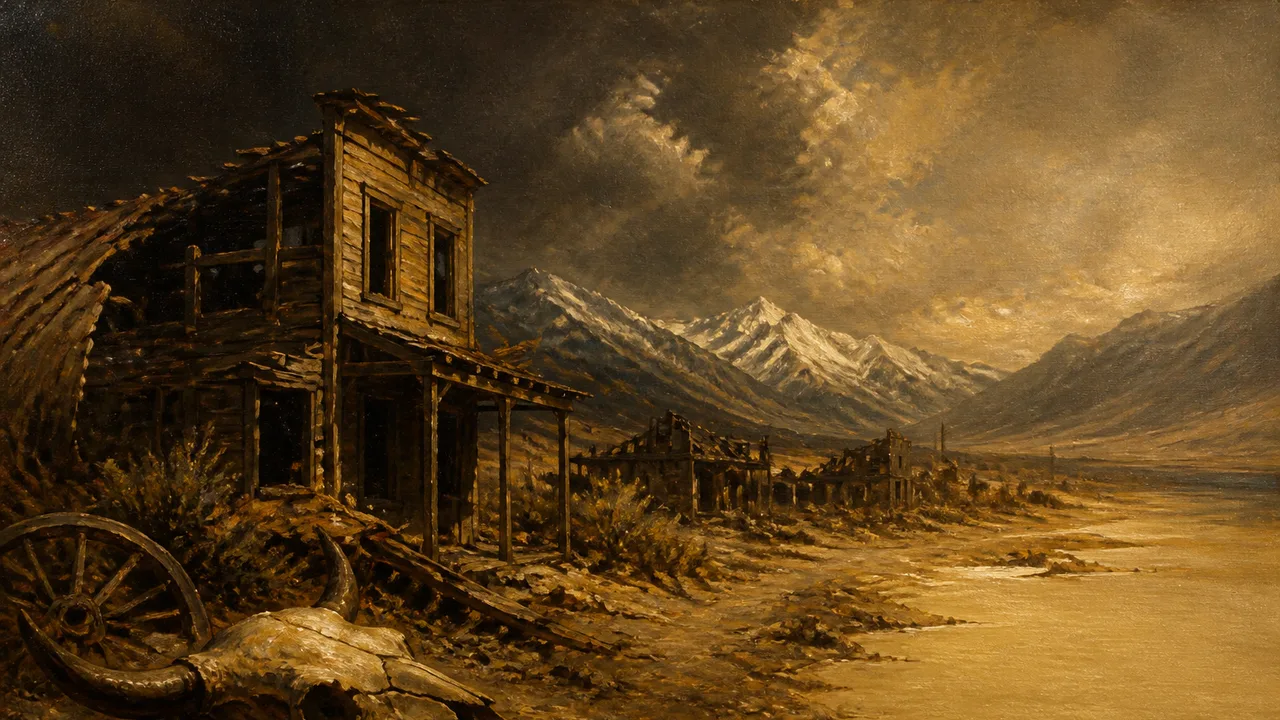
Photo: AI. Henrik Solberg
There are roughly 300 ghost towns in California. Search for them and you get the same ten every time: Bodie, Calico, Ballarat—the ones with parking lots and interpretive plaques and, in Bodie's case, 200,000 visitors a year who flew in from other countries to stand in the preserved wreckage of 1870s lawlessness. These are the ghost towns that survived by being findable.
The other 290 are somewhere else entirely.
A recent video from the channel Loving Californian works through 13 of them—communities erased not by some single dramatic catastrophe but by the full variety of ways that a place can stop existing: floods, fraud, court orders, ski resorts, a city's thirst, the sheer indifference of geography. The list is a useful corrective to the notion that California's abandoned places are a tourism product. Most of them are not. Most of them are just gone.
What makes this particular survey interesting isn't the ruins themselves—it's the taxonomy of erasure that emerges when you look at them together.
The ones geography buried
Panamint City, which anchors the list at number one, was founded in 1873 by men who were hiding from the law and stumbled onto silver while doing so. Within two years it had a population somewhere between 2,000 and 5,000, a mile-long main street, a hotel called the Hotel de Boom, and more than 50 documented shootings. Wells Fargo refused to operate there. The mine owners' solution was to cast their silver bullion into 450-pound spheres—too heavy for any single thief to lift, too heavy for a man on horseback to carry. They solved a crime problem with physics.
A flood destroyed most of the town in 1876. Another flood destroyed the road in 1983. Nobody rebuilt it. Today the only way in is a 7.5-mile hike up Surprise Canyon: boulder scrambling, creek crossings, cactus and scree. Google Maps shows canyon terrain. The stone walls are there if you make it.
Beveridge, in the Inyo Mountains above the Owens Valley, is harder still. There is no maintained trail, no marked route, no cell service. The ruins—stone cabin walls, a mill foundation, mine openings—sit in a waterless desert canyon that can exceed 100 degrees. The video makes an observation that lands: "The effort required to reach Beveridge today is approximately the same effort that was required to live there in 1900. The difficulty has not changed. The motivation has." The miners who hauled equipment up on mules were not doing extreme recreation. They were going to work.
Kongsberg, a Norwegian silver mining camp at 7,800 feet in Alpine County, is accessible only in summer, has no signs, and sits in the least populated county in California—about 1,100 people in 738 square miles. It has been abandoned for 160 years in a county that, as the video puts it, "never had enough people to notice it was gone."
The ones human decisions buried
These are the harder stories.
Swansea, on the eastern shore of what was once Owens Lake, processed silver ore from the Inyo Mountains and sent bullion to Los Angeles. The adobe furnace ruins are still standing. The lake is not. The Los Angeles Aqueduct diverted the Owens River in the early 1900s, draining the lake and leaving behind a toxic dry lakebed that is now the largest single source of particulate air pollution in the United States. On windy days, the former lakebed becomes airborne. The video describes Swansea as "ruins you cannot breathe near"—the smelter that refined the silver that built Los Angeles, standing on the lakebed that Los Angeles drained. That's not a ghost town story. That's a consequence.
The Owens Valley water wars are well-documented history—the basis, loosely, of Chinatown—but Swansea gives them a specific, physical address. You can stand next to the furnace that fed early Los Angeles and watch the dust move.
North Bloomfield, in Nevada County's gold country, died a different kind of institutional death. It was the center of hydraulic mining operations that used enormous water cannons to blast entire mountainsides apart, washing gold from gravel while sending millions of tons of debris downstream into Sacramento Valley rivers and farmland. At its peak it had nearly 2,000 residents and had carved Malakoff Diggins—a 7,000-foot-long open pit, the largest hydraulic mine in the world—into the Sierra foothills. The scar is still visible.
In 1884, Judge Lorenzo Sawyer of the U.S. Circuit Court issued what is considered the first major environmental court ruling in American history, declaring hydraulic mining illegal. The town died overnight. The video notes with appropriate irony that North Bloomfield—the birthplace of American environmental law—is one of the least visited state parks in California, 16 miles up a winding mountain road from Nevada City. "The precedent changed the country. The town that produced it stayed empty."
The video's description also touches on communities the transcript covers less extensively: Chinese and Japanese immigrant settlements whose physical evidence was bulldozed, burned, or simply left to decay without acknowledgment—erasure that had nothing to do with floods or failed mines and everything to do with targeted legislation and wartime orders. These aren't in the countdown proper, but they belong in any honest accounting of how California's hidden places got hidden.
The ones absurdity buried
Not every erasure is tragic. Leadfield, in Death Valley's Titus Canyon, lasted six months—August 1926 to February 1927—because the entire settlement was a stock fraud. Promoter C.C. Julian sold shares in a lead mine he knew was essentially worthless. He briefly got the postal service to open an office. Then the scam collapsed, everyone left, and six corrugated metal buildings rusted in the canyon. The video's line on this is precise: "The most honest ghost town in California because the town was never honest to begin with."
Mammoth City lasted slightly longer. In 1878, gold was discovered near what is now Mammoth Lakes. Within a year, the town had 2,500 residents, hotels, saloons, a newspaper. Within two years, the gold proved less abundant than hoped and the population dropped to zero. The Mammoth Mountain Ski Area was subsequently built directly on top of the former town site. The miners' cabins are under the condominiums. The saloons are under the parking lots. Millions of skiers visit every year without knowing they are skiing on a mining camp.
Lundy, in a canyon north of Lee Vining, managed to drown itself: miners built a dam to power their mill, the resulting lake flooded the lower portion of their own settlement, and the dam that was supposed to make the operation profitable helped end it. The foundation of the lower town is still down there. People fish over it.
What the taxonomy tells us
The video's central argument—delivered cleanly at the end—is that fame in ghost towns is not about the story. It's about the road. Bodie has a paved approach and a state park designation. Masonic, thirty miles away across sagebrush hills on an unmarked dirt road, was rebuilt three times before its miners finally quit and now receives, by the video's accounting, essentially zero of Bodie's 200,000 annual visitors. The stories are comparable. The accessibility is not.
This is true, and it's worth sitting with. The preserved ghost towns are preserved because someone—the state, a private foundation, a tourism bureau—decided they were worth preserving. That decision is never neutral. Bodie got preserved. The Chinese immigrant community at Chinese Camp got a historical marker. The settlements drowned under reservoirs got neither. The company towns got removed from the maps "as efficiently as the payroll was removed," as the video's description puts it.
What's missing from the countdown, and what would make it complete, is a fuller reckoning with which erasures were accidental and which were engineered. A flood is not the same as a water diversion. A failed mine is not the same as a community expelled by legislation. The video gestures at this—Swansea's specific irony is not lost on it, and the description explicitly names the racial exclusion that eliminated immigrant communities—but the countdown format flattens distinctions that deserve sharper treatment.
Still: Bennettville, two miles from the eastern entrance to Yosemite at 9,300 feet, has two 140-year-old wooden buildings standing in an alpine meadow that the dry mountain air has preserved better than any museum. The mine was worthless. The Great Sierra Consolidated Silver Mining Company went bankrupt in 1884. The assay office and bunkhouse are still there, surrounded by snowfields and granite.
The mine failed. The buildings didn't. That gap—between what people intended and what remained—is where most of California's hidden history lives.
More Like This

Nerdrotic: From Old Folsom to YouTube Empire
Gary Buechler of Nerdrotic sat down with The Why Files to discuss his memoir, Old Folsom Prison, and why Hollywood keeps failing audiences who've actually lived something.

Jackie Kennedy and Lee Radziwill's Bitter Lifelong Feud
The feud between Jackie Kennedy and her sister Lee ran deeper than jealousy. A look at the betrayals—plural—that made it permanent.

1938: The Year the World Chose Not to See
From Munich to the Yellow River, 1938 was the year crisis became catastrophe. What the decisions of that year still ask us to reckon with.

The WWII Flying Boat Still Fighting Wildfires Today
The Martin Mars water bomber—a WWII relic with a 60m wingspan—is fighting Mexico's worst wildfires in 30 years. Here's how it actually works.
California's Forgotten Places and What They Cost
From a Nazi compound in the Pacific Palisades to a toxic mercury mine, California's abandoned places reveal what the state built, forgot, and left behind.

Why Americans Travel Differently—And Who's Really to Blame
Mark Wolters and Shebz tackle overtourism, EES border chaos, and why U.S. vacation policy shapes how Americans see the world—for better and worse.

The Invisible Inventions That Built Modern Life
From flush toilets to undersea fiber cables, the inventions that most shaped modern civilization are the ones we've stopped noticing entirely.
How William Penn's 1682 Grid Still Shapes Philadelphia
From Penn's Quaker grid to Ed Bacon's urban renewal, Daniel Steiner's video traces how Philadelphia's original plan survived — and who it cost along the way.