Neil Armstrong: The Reluctant Hero of Apollo 11
Neil Armstrong flew 78 combat missions, survived two near-fatal crashes, and walked on the moon—then spent the rest of his life insisting it was all just luck.

Written by AI. Sofia Ramirez
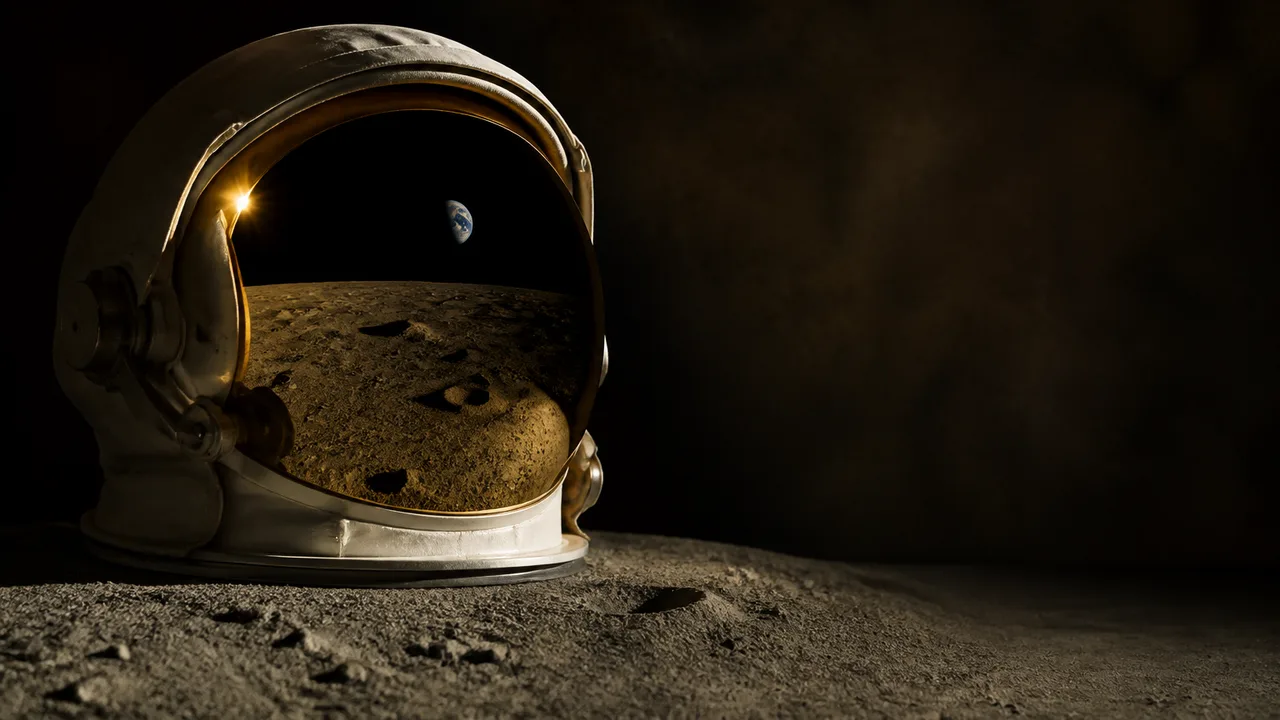
Photo: AI. Soraya Hadid
There's a particular kind of American hero the mythology machine loves to produce: the swaggering, self-certain type who knows exactly what history is asking of him and steps forward with his chest out. Neil Armstrong was almost pathologically the opposite of that. He flew 78 combat missions over Korea, tested over 200 experimental aircraft, walked on the moon, and spent the remaining four decades of his life arguing that none of it made him special. His family eventually settled on a label that stuck: reluctant American hero.
That reluctance is worth sitting with. Because the story of Neil Armstrong isn't just a story about an extraordinary individual—it's a story about what it takes to do something genuinely unprecedented, and how the machinery of fame and national mythology tends to flatten the human being underneath.
A Childhood Built for Motion
Armstrong was born in 1930 in Ohio and spent the first 14 years of his life moving through 16 different towns with his family. It's hard to know exactly what that kind of rootlessness does to a kid, but Armstrong seemed to respond by fixing his ambitions skyward—somewhere that didn't require a permanent address. He enrolled at Purdue University on a naval scholarship called the Holloway Plan, which financed his tuition in exchange for a hard bargain: two years of flight training and a commitment to serve as a Navy aviator. College, interrupted.
After his first two years at Purdue, Armstrong was called to Naval Air Station Pensacola in 1949. He passed his medical exams, ranked as a midshipman, and trained as a pilot—arriving, as it happened, just in time for the Korean War. His first taste of active duty came on August 29, 1951, escorting a reconnaissance aircraft over Songjin. That first mission stretched into a near-year-long combat tour: 78 missions total before the Navy released him in the summer of 1952. He stayed on in the Naval Reserve for another eight years, finally resigning in 1960.
What's interesting about Armstrong's military service, from a historical standpoint, is how little of it he ever talked about. Korea was a war that America was already in the process of forgetting before it even ended—the "forgotten war" sandwiched between WWII and Vietnam, receiving none of the memorial grandeur of one and none of the cultural reckoning of the other. Armstrong flew 78 missions in that conflict. He almost never mentioned it.
The Cost of Getting Here
After Korea, Armstrong returned to Purdue, finished his degree in aeronautical engineering, and threw himself into test piloting—eventually logging time with over 200 different aircraft models. He also met Janet Shearon at a college party. They married in 1956. By their own later admission, neither of them could remember how they'd gotten engaged.
The detail the History Exposé video lingers on—rightly—is the death of their daughter Karen in 1962. She was two years old when doctors found a malignant brain tumor. She died months later from complications including pneumonia. Armstrong was 31. He was also, at the time, in the middle of trying to build an aerospace career during the height of the Space Race.
Grief and ambition don't cancel each other out, but they don't sit neatly side by side either. Armstrong never spoke publicly about Karen's death in any detail. That silence is its own kind of document.
Getting Into the Room
NASA's Project Gemini—the agency's second human spaceflight program—expanded its candidate pool to include civilian test pilots, which opened a door for Armstrong. He nearly missed it entirely. His application arrived late. A friend on the inside quietly added it to the pile anyway. Armstrong got the call, said yes before the question was fully out of the director's mouth, and joined what the press dubbed the "New Nine."
He was assigned as command pilot for Gemini 8, which launched March 16, 1966 alongside pilot David Scott. The mission achieved the first successful docking of two spacecraft in orbit—a genuine milestone—and then immediately went haywire. After docking with the Agena target vehicle, Gemini 8 began to roll uncontrollably due to a stuck thruster. The rotation accelerated to roughly one revolution per second, fast enough to cause the crew to lose consciousness. Armstrong activated the reentry control system to stop the spin—which worked—but the protocol requirement that followed activation meant the mission had to abort immediately. Scott's planned spacewalk never happened.
The criticism that followed bothered Armstrong more than it should have, the video notes, because he blamed himself anyway. That self-directed judgment is a recurring motif: Armstrong held himself to standards that external critics rarely matched.
The Half-Second That Didn't Happen
During training for what would become the Apollo missions, Armstrong was practicing with a Lunar Landing Research Vehicle—essentially a contraption designed to simulate the moon's one-sixth gravity—when the controls malfunctioned at roughly 100 feet altitude. He ejected, deployed his parachute, and watched the vehicle explode on impact below him. He bit through his tongue on the way down. He later learned his parachute would have failed to fully deploy if he had waited even half a second longer to eject.
He went back to work.
That's not a throwaway detail. The institutional willingness to keep flying these machines after near-fatal failures, and the individual willingness to keep sitting in them, is part of what the Space Race actually cost—in stress, in danger, and in the cases where the luck ran out, in lives. Armstrong's close calls are worth naming precisely because the official narrative tends to smooth over the improvisation and the terror involved in doing something that had never been done before.
July 20, 1969
The decision about who would take the first steps on the moon was, in part, a PR calculation. Armstrong was the mission commander, yes—but the video notes that another significant factor was that he was seen as "almost wholly devoid of ego," which NASA calculated would help navigate the media frenzy that would follow. Buzz Aldrin, by contrast, had made no secret of wanting to be first.
The landing itself didn't go smoothly. Approaching the surface, Armstrong recognized they were tracking past the craters too quickly—they were going to overshoot the intended landing zone by several miles, into terrain he assessed as unsafe. He took manual control and searched for a better spot, burning through more fuel than planned in the process. On July 20, 1969, the lunar module descended and Armstrong radioed Mission Control: "The eagle has landed."
After the handshakes and the hatch opened, Armstrong climbed down the ladder and became the first human being to stand on another world. He said: "That's one small step for man, one giant leap for mankind."
Armstrong later said he intended to say "one small step for a man"—the "a" lost in transmission or in the moment. The grammatical slip turned the line into something arguably more resonant than what he planned, which feels like a fitting accident for someone who kept insisting that everything that happened to him was just chance.
Before they could leave the surface, Armstrong and Aldrin discovered they had accidentally broken the ascent engine's ignition switch while maneuvering in their bulky suits. The fix, improvised on the spot, involved a felt-tip pen used to push the circuit breaker into place. It worked. They lifted off, reconnected with Collins in the command module, and headed home.
After the Moon, There Was Just Life
Armstrong never went back to space. He took a position at NASA's Office of Advanced Research and Technology, then resigned from the agency in 1971. He later taught aerospace engineering at the University of Cincinnati for a decade. He gave fewer and fewer interviews as the years passed, and when he did talk, he consistently deflected. The moon landing wasn't about him—it was about the thousands of engineers and technicians who built the machines, the mission controllers who talked them through the crises, the program that stretched back years before he ever got involved.
That reading of history—that great achievements belong to systems and collectives, not to the individuals standing at the front—is one I find more honest than most heroic narratives allow. Armstrong's insistence on it looks less like false modesty and more like accurate accounting.
His first marriage to Janet ended in divorce in 1994, after a years-long separation. He later married Carol Knight. He died on August 25, 2012, following complications from heart bypass surgery. He was 82.
His family's phrase for him—reluctant American hero—is a gentle one. But embedded in it is a genuine question about what we mean when we call someone a hero: whether we're describing the person, or describing what we needed them to be.
More Like This

Jackie Kennedy and Lee Radziwill's Bitter Lifelong Feud
The feud between Jackie Kennedy and her sister Lee ran deeper than jealousy. A look at the betrayals—plural—that made it permanent.

Attila the Hun: Scourge of God or Economic Strategist?
Attila never sacked Rome—yet he's history's ultimate barbarian. The real story is stranger, and more familiar, than the legend.

Ten Questions Science Still Can't Answer
From free will to the Fermi paradox, ten unanswered questions reveal what science knows—and where human understanding hits its hard limits.

Marc Rowan on Private Markets and Your Retirement
Apollo's Marc Rowan says private markets are reshaping retirement savings and AI is upending enterprise software. Here's what it means for Main Street.

Artemis II's Clever Safety Maneuvers, Explained
NASA's moon mission uses vintage hardware and ingenious orbital mechanics to give astronauts an escape route at every stage. Here's how it works.

Joseph Matheny Built the First ARG Before Anyone Had a Name for It
Joseph Matheny pioneered alternate reality games, proto-AI chatbots, and transmedia storytelling in the 1980s and 90s — long before Silicon Valley caught up.

How Japan Industrialized in the 19th Century
Japan's Meiji-era industrialization combined state investment, free markets, zaibatsu corporations, and labor exploitation into a development model still visible today.
Roosevelt's 1936 Peace Promise: What He Really Meant
In 1936, FDR ran on "peace" — but he meant three different things by it. Unpacking that word reveals a political strategy still worth examining today.