Joseph Matheny Built the First ARG Before Anyone Had a Name for It
Joseph Matheny pioneered alternate reality games, proto-AI chatbots, and transmedia storytelling in the 1980s and 90s — long before Silicon Valley caught up.

Written by AI. Margaret "Maggie" Holloway
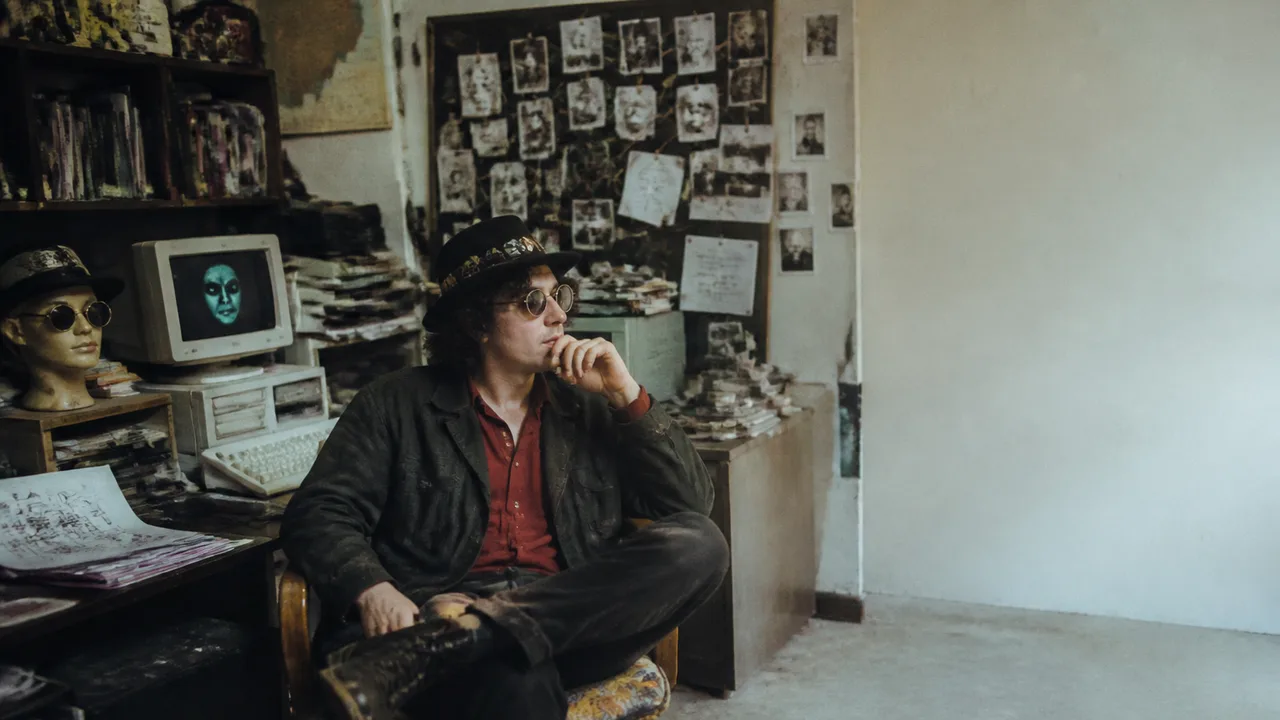
Photo: AI. Marcel Dubois
There's a specific kind of person who sees a new technology and thinks, immediately, what story can I tell with this? Not what product. Not what market. A story. Joseph Matheny was that person, and he arrived at the party about a decade ahead of everyone else.
In a recent episode of The Why Files — a nearly three-hour basement conversation with host AJ Gentile — Matheny walked through the biography of someone who kept inventing things nobody had names for yet. The internet's first alternate reality game. A proto-AI chatbot trained on occult subculture and Discordian philosophy. A transmedia story experience built in 1984 using a VHS tape, a book of poems, and a live theatrical performance that players stumbled into without knowing they were watching fiction. He did all of this before the web, before Netscape, before anyone in a position of cultural authority had decided these were interesting problems.
The Navy eventually called him to ask how he'd done it. He turned them down.
Matheny grew up working-class in Chicago, a voracious reader subsidized by garage sales. The origin story he tells is one of productive accidents: at twelve, he bought what he thought was an astrology book for a nickel. It was Tropic of Cancer. Henry Miller led him to Kerouac, Kerouac to Bukowski, Bukowski to a broader counterculture he absorbed from the older artists and improv people who let him hang around Chicago's bookstores and bars as a mascot-kid who could recite Jim Morrison lyrics on demand.
One of the more interesting threads in the conversation is his connection to Del Close — the Second City theorist whose influence on American comedy is hard to overstate. Matheny mentions something the Del Close Theater in Hollywood apparently didn't know: Close was a practicing Golden Dawn magician, and his famous improv theories were derived from thelemic ritual principles. The "yes, and" structure of improv — the commitment to the fiction in front of you — turns out to map cleanly onto ceremonial magic's requirement that the practitioner treat an imagined presence as genuinely real. "This is an initiation ceremony," Matheny says. "It's just two actors."
Whether or not you find that reading of improv convincing, it illuminates something about Matheny's own practice: the blurring of fiction and experience wasn't a bug in his storytelling, it was the entire engine.
The Robert Anton Wilson chapter of his life arrives with the texture of a good novel. Matheny reads Cosmic Trigger, becomes obsessed with Philip K. Dick's VALIS (then out of print, nearly impossible to find), goes on a months-long used-bookstore quest that ends in a locked storefront with a silver-haired woman who may or may not have been running a business, buys the paperback, regrets not buying the hardcover, can never reach her again. "It doesn't have to be supernatural to be supernatural," he observes, with the equanimity of someone who has spent decades in the proximity of unexplained things.
A poster for a Wilson lecture leads him to a Zen Center on Chicago's lakefront, where a "squat little Irishman" bummed a cigarette from him outside. That turned out to be Wilson, who advised the young Matheny — when told about Timothy Leary's early software — to write code and do it himself. A few years later, Matheny loaded everything he owned into a car with his girlfriend and his cat Anubis, pointed it toward Berkeley, stopped for gas in a town called Santa Cruz, and never left. The neighbor downstairs turned out to be Nina Graboi, Timothy Leary's former secretary from Millbrook. Upstairs lived someone who knew Gordon Wasson. Wilson himself was about to move there — his children were already in Santa Cruz. Matheny became his driver.
"I was just riding the wave, man," he tells Gentile. "I didn't want to like think about the moment, because if you think about the moment, the moment is gone."
The Esalen LARP is the centerpiece of Matheny's early career as a reality-hacker. Wilson had booked a weekend at Esalen Institute — the cliffside retreat in Big Sur where the Project Stargate remote-viewing crowd mingled with whoever else was exploring the fringes of consciousness in hot tubs overlooking Monterey Bay. Wilson wanted the weekend to be an experience, not just a lecture series. Matheny suggested a live-action Illuminati game.
He game-mastered the entire thing from the position of Wilson's unassuming assistant. Attendees were told at the start that a game was in progress — "you were playing it before you walked in here, and you'll be playing it when you leave" — and that was the complete ruleset. Matheny circulated alone, finding people who'd wandered off, handing them a small chit, and announcing: "You've just been assassinated." Then he'd take them to a room and resurrect them as a member of his cell. Except he was running five cells simultaneously, feeding each of them information about the others that was sometimes accurate and sometimes not. Nobody knew who was on what side, because everyone was on all sides — which is, of course, the operating principle of Illuminatus! made flesh.
At the end of the final lecture, a player walked up to Wilson, pressed the chit he'd been killed with into Wilson's hand, and said: "You've just been killed. You're now a member of my group." The room stood and cheered. Matheny hadn't scripted it. The player had simply internalized the game's core instruction — think for yourself, take initiative, question authority — and executed it against the most authoritative figure in the room.
"I didn't see that coming," Matheny says. He sounds genuinely pleased about it.
The technology work happened in parallel. While driving Wilson to lectures and gaming the Esalen crowd on weekends, Matheny was building injectors for chemical vapor deposition reactors by day — the machines that make integrated circuits. He then moved into relational databases, worked at Adobe as a product manager when the PDF was still a wild frontier, and began constructing what he describes as a proto-large-language-model: a curated database of fringe knowledge (Discordian texts, VALIS, Church of the SubGenius material, conspiracy literature) paired with a Bayesian recommendation algorithm and a primitive chatbot interface that routed users through the content differently depending on their choices.
"A chatbot using an algorithm to talk to a database," he says. "It's called ChatGPT. It's just much more refined than what I was doing."
That system — eventually named Emory — became the technological engine beneath Ong's Hat, a narrative about a dimensional portal hidden in the New Jersey Pine Barrens, distributed not as a novel but as pamphlets, BBS posts, websites, and phone lines. It was designed to feel like the discovery of something real. It worked. People believed it. The Navy wanted to know how.
What makes Matheny's account genuinely interesting — rather than just a history of impressive firsts — is his framing of what storytelling is for. He holds a view that sits somewhere between anthropological and mystical: stories, he argues, are how humans encode survival knowledge in forms that survive transmission. The monster in the woods is the bear in the woods. The cosmological myth is the weather pattern. Strip the story down to plain instruction and the kid goes straight to see the bear. Dress it in monsters and it sticks, gets repeated, gets passed on.
"Storytelling is the most important thing that humans do," he tells Gentile. "And we shouldn't turn it over to corporations and bean counters. It's a very sacred thing. You have a responsibility as a storyteller to shepherd your story and protect it."
This is the premise that gives the later part of the conversation its sharpest edges. Matheny watched QAnon emerge and recognized the architecture immediately — not because he invented it, but because he'd built the same machine with different intentions and understood exactly how it ran. An ARG with no designated game master is not a game. It's a trap. The Esalen Illuminati LARP worked because a responsible hand held the puppet strings and knew when to let go. When that hand disappears — when the game has no author, or worse, when the author has an agenda and won't say so — the players have no way to find the exit.
He knows how the trick works. The question the conversation leaves open is whether knowing how a trick works is enough to protect you from it — or whether understanding the mechanism just makes you a more sophisticated mark.
More Like This

Nerdrotic: From Old Folsom to YouTube Empire
Gary Buechler of Nerdrotic sat down with The Why Files to discuss his memoir, Old Folsom Prison, and why Hollywood keeps failing audiences who've actually lived something.
Morphic Resonance: The Science Orthodoxy Tried to Burn
Rupert Sheldrake's morphic resonance theory was publicly burned by academia—while the U.S. military quietly funded similar research. Col. Morrison investigates.
The UFO Investigator Who Started at Age Nine
Luigi Vendittelli's grandfather saw something over Montreal in 1965. Nobody believed him. That moment built Canada's most obsessive UFO investigator.
Joseph Matheny Built the First Reality Hack in 1989
Joseph Matheny's Ong's Hat blurred fiction and reality decades before QAnon. What the people who showed up at his door were really looking for.

Is Reality a Simulation? Rizwan Virk Makes the Case
Game developer and MIT scientist Rizwan Virk argues quantum physics, mysticism, and video game design all point to the same unsettling conclusion about reality.

WarGames Got the Details Wrong—But the Feeling Right
How a 1983 film used real hardware and strategic Hollywood cheating to capture what early computing actually felt like—even when faking almost everything.
The Invisible Inventions That Built Modern Life
From flush toilets to undersea fiber cables, the inventions that most shaped modern civilization are the ones we've stopped noticing entirely.
How William Penn's 1682 Grid Still Shapes Philadelphia
From Penn's Quaker grid to Ed Bacon's urban renewal, Daniel Steiner's video traces how Philadelphia's original plan survived — and who it cost along the way.