Joseph Matheny Built the First Reality Hack in 1989
Joseph Matheny's Ong's Hat blurred fiction and reality decades before QAnon. What the people who showed up at his door were really looking for.

Written by AI. Sofia Ramirez
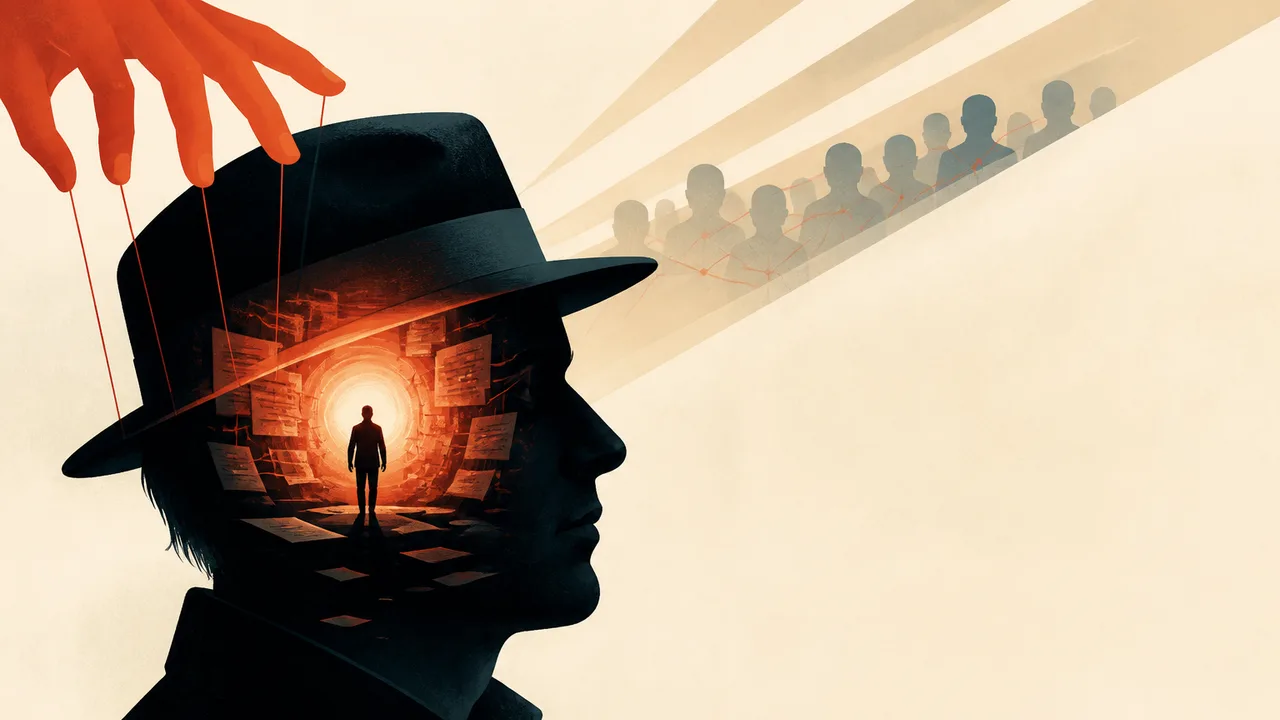
Photo: AI. Mika Sørensen
Somewhere in the early 1990s, people started showing up at Joseph Matheny's door.
Not fans exactly. Not readers in the usual sense. These were people who had encountered Ong's Hat — a story about a ghost town in the New Jersey Pine Barrens, renegade scientists, and a device that could punch holes between dimensions — and decided it was real. They wanted directions. To the portal.
I keep coming back to them. Not to Matheny, who is clearly a fascinating figure, but to the people on his doorstep. Because what do you have to be carrying, what gap has to exist inside you, to drive to a stranger's house in New Jersey looking for a doorway out of this world? The early '90s weren't exactly a golden age of American working-class security. The post-Cold War "peace dividend" never really landed for most people. Rust Belt deindustrialization was well underway. And here was a story — not a self-help book, not a political movement, not a church — that promised a literal escape hatch. Built by scientists who'd gone off-grid. Outside the system entirely.
Matheny, appearing in a recent trailer for The Why Files podcast, reflects on what he built with a mix of pride and unease that feels earned. According to his own account — which is worth holding as his account, since the project's origins and timeline are difficult to verify independently — he began developing Ong's Hat around 1989, before most people had ever touched the internet. He describes it as a "transmedia experience," an interactive story that unfolded across multiple platforms and bled deliberately into the real world. The internet would eventually call it the first alternate reality game, though that frame came later and from the outside.
"I had a vision for a book that would become much more than a book," Matheny says in the interview.
What it became was a test — whether intentional or not — of something that storytellers and propagandists have always known but rarely demonstrated so cleanly: given the right conditions, people will choose the story over the evidence. Not because they're stupid. Because the story is filling a need the evidence can't touch.
The mechanics Matheny describes are worth understanding in some detail, partly because they're genuinely innovative and partly because they're now everywhere.
He was running what amounts to a live-action narrative game before live-action narrative games had a name, drawing on his time with method actors and his observations of LARPing communities. He game-mastered a weekend at Esalen — the famed Big Sur retreat that had become, by the late '80s, a crossroads for everyone from parapsychology researchers to tech counterculture — with Robert Anton Wilson as a participant. He handed out cards to attendees that read, "You have just been assassinated." Everyone was playing. No one knew who was on which side.
He also describes building what he calls an early AI system, feeding it content and rating the outputs. In the interview, the exchange with his host reaches for "XML tagging" as a descriptor — but XML wasn't formalized until 1996 and wasn't a W3C recommendation until 1998. Whatever system Matheny was actually using in the late '80s and early '90s was likely SGML-based or some proprietary markup approach; the "XML" framing appears to be a retroactive label applied in hindsight. What he's describing functionally — curating inputs, evaluating outputs, training a system toward a desired voice — does map onto modern machine learning concepts, and his host makes that connection explicit: "This is exactly how it works now. This is training an AI exactly this way."
Matheny also describes, again by his own account, being contacted by Navy Intelligence, who wanted to know how he'd managed to engineer what he calls "hacking the human belief system." He says he declined. There's no independent sourcing for this claim beyond the interview itself, and it's the kind of story that tends to accrete around figures in Matheny's particular scene. What it signals, sourced or not, is that the national security apparatus was watching the early internet's capacity to reshape belief — which is documented history even if Matheny's specific role in it isn't.
Here's what I find genuinely difficult about Matheny's story, and where I think the easy narrative about him breaks down.
He's presenting himself, in this interview, as someone who discovered something powerful and is now warning people about it — which is a comfortable position. And maybe it's the right one. But the techniques he pioneered didn't stay in the hands of avant-garde artists playing games at Esalen. He mentions a framework called Aum, whose stated purpose was to generate conspiracy narratives so outlandish they'd redirect people's suspicion toward the Illuminati. He describes it plainly: "They were creating conspiracies."
Conspiracy as an art form, as a game, has a long history in Western counterculture — the Discordians, Robert Anton Wilson's own Illuminatus! trilogy, the Church of the SubGenius. There's a tradition of using fake conspiracy to lampoon real power, to make people question official narratives through absurdity. Matheny comes out of that tradition, and he takes it seriously as an art practice.
But that same architecture — unverifiable claims, self-referential documents, stories that spread from internet rumor into real-world belief — didn't stay ironic. The Satanic Panic of the '80s and '90s destroyed families and imprisoned innocent people, driven in part by the viral spread of unfalsifiable narratives. The targeting of Jewish communities through conspiracy frameworks is not a new phenomenon; it has roots in medieval blood libels and found 20th-century expression in the Protocols of the Elders of Zion, a fabricated document that produced real massacres. The machinery Matheny was experimenting with artistically has, in other hands and other contexts, been used against specific communities with specific, measurable consequences.
Matheny himself marks a line. In December 2016, a man named Edgar Maddison Welch walked into Comet Ping Pong, a Washington, D.C. pizza restaurant, with an assault rifle, having convinced himself that a child trafficking ring was operating in its basement — a claim with no basis in fact that had spread through the internet as QAnon's predecessor, Pizzagate. Welch fired his weapon inside the building. No one was killed, but the staff — people working a weekend shift at a pizza place — hid and called 911 while a man with a rifle searched the premises for a dungeon that didn't exist.
"When that dude showed up at the Comet Ping Pong Pizza with a rifle," Matheny says, "I was like, okay, this is starting to go too far."
Starting. I notice that word. Not had gone too far retroactively. Starting to. In the present tense of that moment. Which means Matheny watched the techniques he helped develop travel from avant-garde art experiment to something that put real people in real danger, and his reaction was a shift in degree rather than a reckoning with kind. I'm not saying that to condemn him — the distance between Ong's Hat and Pizzagate involves thousands of actors and decisions and platforms Matheny had no control over. But it's an open question that the interview doesn't fully sit with.
When asked how people can protect themselves from manipulative narratives, Matheny's answer is: use your gut. "If you look at something and it doesn't feel right, it might not be right. It probably isn't right."
That's not nothing. Intuition built on experience and critical engagement is a real faculty. But it's also a notably individualized solution to what is, structurally, a collective problem — and it's worth noticing that the people who showed up at Matheny's door in the '90s looking for portals probably felt, in their gut, that they were onto something real. Belief is not random. It follows the shape of need.
Which is what I can't stop thinking about when I picture those people on his doorstep. Whatever their specific circumstances — and we don't know them — they were looking for something the regular world wasn't providing. An exit, or an explanation, or just proof that reality was stranger and more open than it appeared. Matheny gave them a story good enough to believe. What they were actually hungry for, the story was standing in for.
That hunger didn't go away. It got bigger, and more people learned to feed it.
More Like This
Nerdrotic: From Old Folsom to YouTube Empire
Gary Buechler of Nerdrotic sat down with The Why Files to discuss his memoir, Old Folsom Prison, and why Hollywood keeps failing audiences who've actually lived something.
Morphic Resonance: The Science Orthodoxy Tried to Burn
Rupert Sheldrake's morphic resonance theory was publicly burned by academia—while the U.S. military quietly funded similar research. Col. Morrison investigates.
Tim Dillon on Meta's Slow Death and Facebook Boomers
Tim Dillon's latest episode covers Meta's decline, Facebook-brained Boomers, and the Selling Sunset audience that's done pretending they can own a house.
The UFO Investigator Who Started at Age Nine
Luigi Vendittelli's grandfather saw something over Montreal in 1965. Nobody believed him. That moment built Canada's most obsessive UFO investigator.

California's "Don't Stop" Towns Have a Deeper Story
A viral video warns drivers not to stop in 12 California towns. The crime stats are real. So is everything the warning leaves out about the people who live there.
Dinosaurs, Black Holes, and Why Greed Kills Systems
Dr. Roy Casagranda connects mass extinctions, black hole cosmology, and U.S. healthcare to one unsettling question: why do systems destroy themselves?
The Anaconda Plan Was Right. People Paid for It.
Winfield Scott's Anaconda Plan was strategically vindicated — but the years it took to work were paid for in hunger, death, and bondage by ordinary people.
The Spanish Civil War at 90: What the Coup Unleashed
On July 17, 1936, a military coup fractured Spain and drew the world in. What the Spanish Civil War's 90th anniversary still asks of us.