Dinosaurs, Black Holes, and Why Greed Kills Systems
Dr. Roy Casagranda connects mass extinctions, black hole cosmology, and U.S. healthcare to one unsettling question: why do systems destroy themselves?

Written by AI. Sofia Ramirez
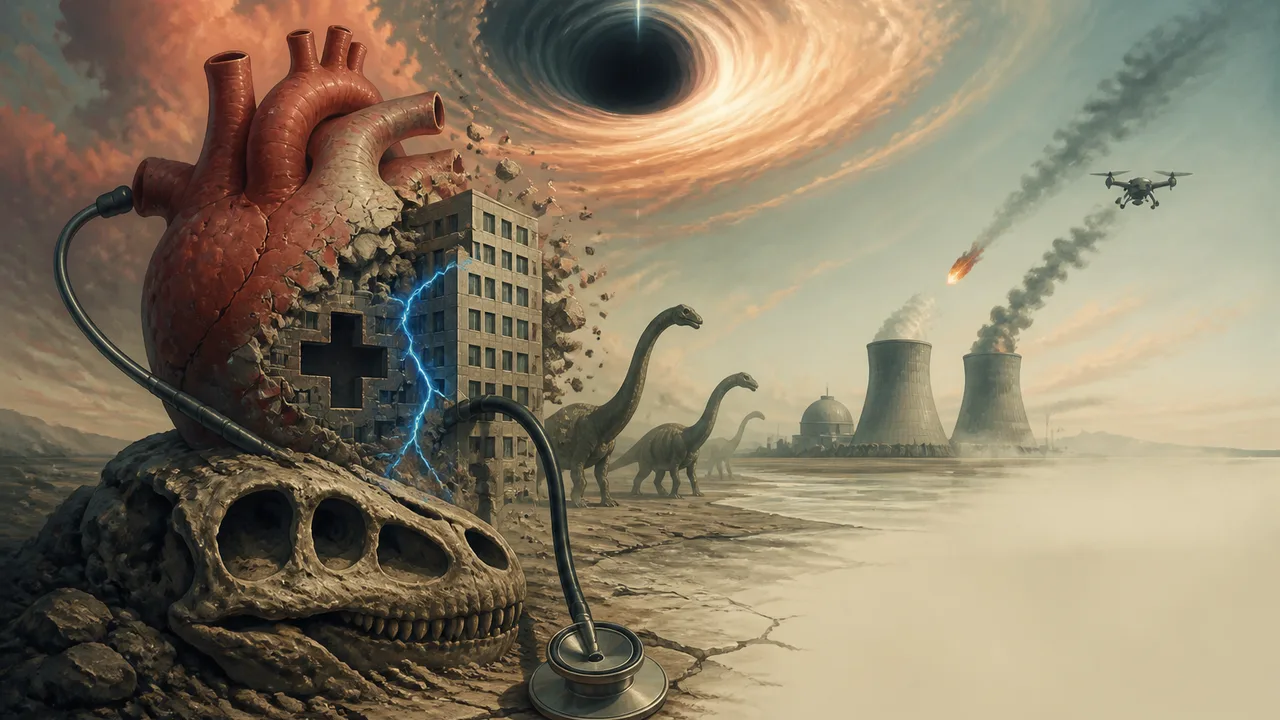
Photo: AI. Iolanthe Fenwick
Jeremy is turning 37, sick for the second time in two weeks, and laughing about a CT scan bill that would be darkly funny if it weren't so ordinary. The imaging company billed $2,400. The VA paid $198. The company said okay. "Why can't I do that?" Jeremy asks. It's a real question dressed as a joke, which is how the best questions usually travel.
That exchange — two guys, a camera, a birthday, a medical bill that makes no logical sense — is the entry point into Dr. Roy Casagranda's latest Office Hours conversation, a 69-minute ramble through U.S. healthcare, the Permian mass extinction, black hole cosmology, and the self-defeating logic of greed. The range sounds chaotic. It isn't. There's a thread running through all of it, and Casagranda, a political scientist and educator, pulls it tighter as he goes.
The $198 Problem
Start with the healthcare section, because that's where the argument lives closest to the ground.
Casagranda describes the American medical system's management of capacity through deterrence: make it awful enough, confusing enough, expensive enough, and people stop showing up. "The genius of the American medical system," he says, "is there isn't enough capacity. So what they do is they just make it so awful... it discourages you from going, and then that helps with the capacity." He's being sarcastic. He's also describing something real.
Jeremy's epidural bill is the illustration. First child, out-of-pocket birth, $10,000 total, $3,000 for the epidural. Then, sixteen months later, another bill for $600. For the epidural. Already paid for. Already in collections before they even understood what the charge was. "We think this is fraud," they told the collector. "Oh, okay," the collector said. "Don't worry about it."
That's not an anomaly. That's the texture of daily life for anyone navigating American healthcare without an HR department doing the paperwork for them. My grandmother used to call it "getting lost in the mail" — the way bills and denials and appeals would just pile up until you either paid something or gave up. She gave up more often than she fought, because fighting took time she didn't have and knowledge she hadn't been given.
Casagranda's critique — that the system is structurally designed around treatment rather than prevention, and that preventative care has no profit motive — is not new. But the comparison he reaches for is worth noting: Canada, he says, spends significantly less per person and gets better outcomes. This is broadly supported by per-capita healthcare spending data, though the specifics depend heavily on which conditions and metrics you're comparing — Casagranda doesn't cite a source, and "better recovery rates" is doing a lot of work as a phrase. The broad direction of the comparison is defensible. The details would need a closer look.
Lystrosaurus and the People Who Burrow
Here's where I want to bring in someone Casagranda doesn't mention: paleontologist Pia Viglietti, who spent years in the Karoo Basin in South Africa excavating Permian-Triassic boundary sites — the physical layer in the rock where 252 million years ago, something went catastrophically wrong. Viglietti and her colleagues have spent careers trying to read extinction and survival out of sediment and bone. What they find, over and over, is that the creatures who made it through weren't the biggest or the strongest. They were the ones that could tolerate disruption. The ones that ate what was available, lived where others couldn't, and waited.
Casagranda tells the Permian story in his own way, and it's worth flagging where his framing diverges from current scientific consensus. He attributes the extinction primarily to the formation of Pangea and the collapse of global weather systems. The scientific community's prevailing view points more specifically to the Siberian Traps — a massive volcanic event that pumped carbon dioxide and sulfur dioxide into the atmosphere over tens of thousands of years, triggering runaway warming, ocean acidification, and deoxygenation. Pangea's formation preceded the extinction by millions of years; the Siberian Traps are the proximate cause most researchers point to. Casagranda's framing isn't wrong about the ecological effects — the world did become a desert, the weather systems did collapse — but the mechanism he describes is his own synthesis, not settled science. Keep that in mind.
What he gets genuinely right is the texture of survival. The creature that came out the other side was Lystrosaurus — pig-sized, beak-faced, a little ridiculous-looking, somewhere between mammal and reptile on the evolutionary spectrum. Casagranda claims it eventually represented 75% of all land animals on Earth, which he describes as the only time in planetary history that a single species dominated land life so completely. That figure is his, not the fossil record's — it's contested and inherently hard to verify given the sampling limitations of paleontology. What's less contested is that Lystrosaurus was genuinely dominant in the post-Permian landscape, a fact that still surprises researchers like Viglietti, who has described the Karoo sites as "a graveyard interrupted by survivors."
The survival strategy: burrowing. Coming out at night. Eating fungus and desiccated corpses. Not elegant. Not triumphant. Just relentless low-to-the-ground persistence until conditions changed.
I think about the people I've interviewed over the years — workers who ate through savings during strikes, immigrant families who kept their money in cash because they didn't trust banks that had failed their grandparents, anyone who has ever managed a health crisis by Googling symptoms at midnight because the copay was $200 they didn't have. Casagranda doesn't make this connection explicitly. But it's the one his whole argument is quietly reaching toward.
The Universe, Maybe
The cosmology section is looser, and Casagranda is the first to admit he might be wrong. He describes a remark — attributed to Neil deGrasse Tyson, though it's unclear whether this was a direct quote or Casagranda's interpretation of something Tyson said — about the observable universe having roughly the mass you'd expect a black hole of equivalent size to have. From there, Casagranda riffs: what if a Big Bang event is a black hole collapsing? What if we're inside one? What if every black hole our universe creates is itself a new universe?
This hypothesis is most formally associated with physicist Lee Smolin, who developed the theory of cosmological natural selection in the 1990s — Casagranda doesn't name him, and the attribution to Tyson is fuzzy enough that it's worth holding loosely. What Casagranda is doing here isn't physics; it's philosophical improvisation. The interesting part isn't whether he's right about the mechanics. It's the image he keeps returning to: systems that expand until they can't hold themselves together anymore, and in the process of collapsing, create new ones.
"Everything is both expanding and coming together," he says, "like all the time in our known physical existence."
He means it as cosmic description. But he's been talking about healthcare systems and greed and Lystrosaurus for the last forty minutes, so by the time he says it, the weight is different.
The Self-Defeating System
The conversation's larger argument — the one that connects all this — is about what Casagranda calls hyper-transactional capitalism: the version of markets that's been so thoroughly optimized for extraction that it's started eating the cooperative tissue that makes markets function in the first place. His claim is that greed, pursued past a certain point, doesn't accumulate power — it destroys the communities and institutions that power requires to mean anything.
It's a philosophical position with a long tradition behind it, from Aristotle through Polanyi. Casagranda isn't making a rigorous academic argument here; he's doing public intellectual riffing, and some of it is sharper than other parts. The Socrates thread later in the conversation gets at something genuinely interesting about the limits of self-interest as a social organizing principle. The healthcare critique is the strongest piece because it's the most grounded.
But the through-line is real: the Permian extinction, American medical billing, and black hole cosmology all become, in Casagranda's hands, variations on the same story. A system optimizes for one thing — desertification, profit extraction, gravitational collapse — until it hits the wall. Most of what was living dies. Something beak-faced and unglamorous burrows underground and eats what it can find.
And then, eventually, it comes back up.
Jeremy's $600 epidural bill got sent to collections before he even knew what it was for. He disputed it, mentioned possible fraud, and the collector dropped it. That's not a win. That's the system working exactly as designed — for people who know which words to say. Most people don't.
More Like This
Opus 4.7 Drops Amid Molotov Cocktails and AI Fear
Anthropic's Opus 4.7 launches as a 20-year-old throws a Molotov cocktail at Sam Altman's house. The AI world is splitting in two—and it's getting violent.
Unraveling the Mysteries of Magic in Middle-earth
Explore how magic in Middle-earth defies traditional spells, rooted in nature, craft, and intent.
10 Underrated Netflix Films That Deserve Attention
Explore ten overlooked Netflix films that showcase unique storytelling and filmmaking techniques yet failed to capture widespread attention.
Is Nature Good? Harari and Žižek Say No
Yuval Noah Harari and Slavoj Žižek agree: nature isn't inherently good. Their debate reveals why "natural" is almost always a political argument in disguise.

What a Victorian Ghost Says About the Afterlife
In a 1963 Leslie Flint séance, a voice claiming to be Elizabeth Fry described the afterlife as a thought-built world. Here's what that cosmology actually says.
An Ex-OpenAI Researcher Says AI's Default Path Is Bad
Former OpenAI researcher Daniel Kokotajlo warns that unaligned superintelligence isn't a fringe scenario—it's the default outcome if nothing changes.

The Spanish Civil War at 90: What the Coup Unleashed
On July 17, 1936, a military coup fractured Spain and drew the world in. What the Spanish Civil War's 90th anniversary still asks of us.
Medieval England: How Peasants and Guilds Shaped Society
A new documentary traces medieval England's social divide through two real families—one peasant, one guild merchant—and the starkly different worlds they inhabited.