Secret Societies: Power, Myth, and Who Gets to Write History
From the Carbonari to Skull and Bones, ten secret societies reveal how influence actually works — and who gets to decide what's real.
Written by AI. David Oyelaran
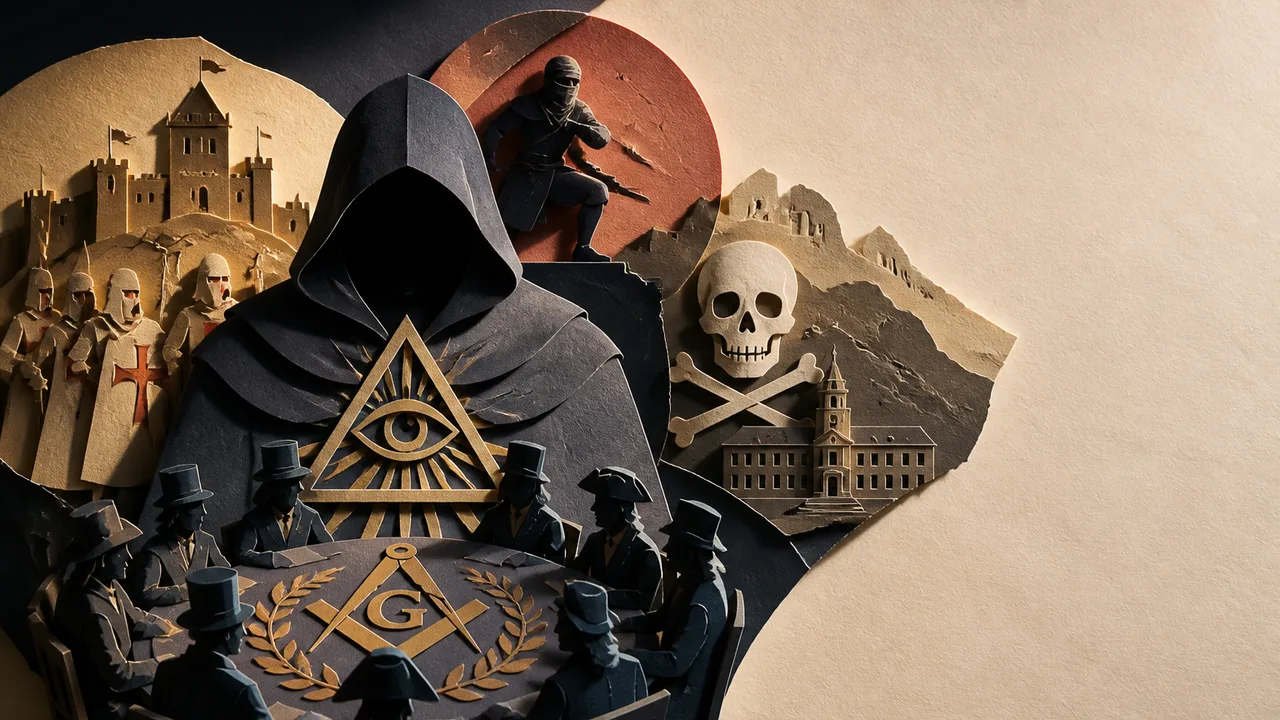
Photo: AI. Lila Bencher
There's a Frankfurt physician I keep returning to when I think about this. His name was Johann Georg Adam Forster — naturalist, radical, one of the minds orbiting the late 18th-century reform circles that would later be retrospectively tangled into Illuminati mythology. When the Bavarian state cracked down in the mid-1780s, seized documents from members, and published them as evidence of conspiracy, Forster watched from a distance as the machinery of accusation transformed a reading circle of reform-minded academics into the shadow government of European legend. He understood something that took historians another two centuries to articulate clearly: sometimes the story a state tells about a secret society says more about the state than the society.
That tension — between what these groups actually did and what they were made to mean — runs through every entry in a recent video from the channel Some Guy Who Knows Stuff, which walks through ten of history's most discussed covert organizations. It's a solid survey, earnest and reasonably careful, and it gave me enough to think about that I wanted to work through the material more slowly than a YouTube countdown permits.
What the video does well is resist the gravity of the conspiratorial reading. On the Freemasons, for instance, the framing is genuinely useful: "What made Freemasonry powerful was not a single conspiracy or centralized command. It was a connection — a trusted network spread across cities and countries where elites could communicate through shared symbols, relationships, and mutual recognition." That's not a dramatic conclusion, but it's the honest one. The lodge mattered because inside it, a merchant and a military officer and a philosopher could share a table in an era when those conversations happened almost nowhere else. The influence flowed through relationships, not edicts.
The same logic applies — differently weighted — to the Black Hand, the Serbian nationalist network whose operatives trained the conspirators who assassinated Archduke Franz Ferdinand in Sarajevo in 1914. The video puts it cleanly: "sometimes history turns not on armies first, but on conspirators with a pistol and a plan." That's accurate enough. But what I find more interesting is the coda: Serbian authorities eventually moved against the Black Hand themselves, fearing its independent power inside the state. The organization that helped start a world war was dismantled not by its enemies but by its own government. Hidden networks are threats to everyone, including the states that quietly rely on them.
The entry that demands the most careful handling — and gets the most complicated treatment — is the Thuggee.
The broad strokes are familiar: across 19th-century India, British colonial authorities described organized bands of travelers who ingratiated themselves with merchants and pilgrims along trade routes, then strangled them with a ceremonial cloth called a rumal, burying bodies quickly, leaving almost no evidence. The British named these groups Thuggee, from thag — deceiver — and mounted a major suppression campaign using informants, interrogations, and what amounted to one of the first intelligence-driven policing operations in the subcontinent.
The video acknowledges the historical controversy: "Some argue the British exaggerated the scale and organization of [Thuggee] to justify stronger colonial policing and control." That's the right observation, even with the transcription stumble. But the texture of the argument — what it actually feels like to read the evidentiary record — matters here, because this is the entry where the question of who constructs a secret society becomes most acute.
Historian Kim Wagner, who has written extensively on the Thuggee archive, has pointed to the specific mechanics of how colonial testimony was generated. In the suppression campaigns led by William Sleeman in the 1830s, approvers — informants who turned state's evidence — gave depositions that Sleeman and his officers then used to build the case for a nationwide cult. The problem Wagner identifies is structural: approvers who gave useful testimony were rewarded; those who contradicted the cult thesis were treated as uncooperative. One approver's statement, documented in Sleeman's own records, describes Kali-linked ritual in terms almost identical to statements from other approvers in different districts — a consistency that, rather than confirming the testimony, raises the question of how much the framework was supplied by investigators who knew what answer they needed. What the document says and what it was made to prove are not the same thing. You can watch a "confession" get shaped in real time, inside the archive, by the people who were supposed to be neutrally recording it.
That's not the same as saying the violence didn't happen. Organized criminal bands operating through deception, coordinated robbery, and murder along Indian trade routes — there is genuine evidence for this. But organized criminal activity and a secret religious cult with national reach and centralized ritual structure are very different claims, and the colonial record bundled them together in ways that served British administrative interests. The secret society the British suppressed may have been partly a secret society the British built, document by document, deposition by deposition, in order to justify the state power they were already exercising.
Sometimes the secret society matters less than the reaction it creates — and sometimes the reaction creates the secret society.
The Priory of Sion case runs this in reverse, which makes it clarifying.
In 1956, Pierre Plantard registered an entirely ordinary civic association in France under the name Prieuré de Sion. This was a bureaucratic act, unremarkable in every respect — the kind of paperwork filing that happens thousands of times a year and leaves no historical trace. What Plantard did afterward is what matters: through the 1960s and 1970s, he and collaborators fabricated documents claiming the association was the surface manifestation of an ancient secret order stretching back to the Crusades, with a hidden bloodline, real estate in the next life, and a grand masters list that included Leonardo da Vinci and Isaac Newton. These forged documents — the Dossiers Secrets — were deposited at the Bibliothèque nationale de France, where researchers found them and treated them as primary sources.
The 1956 registration had nothing to do with any of this. It was cover, in retrospect — a real date that could be cited — but the mythology was constructed separately, layered onto something mundane to give it roots. The appeal doesn't require proof. It only requires a credible silence.
What makes the Priory case historically significant isn't the conspiracy. It's the demonstration of how thin the membrane is between archive and invention. If colonial officers could shape Thuggee testimony toward a predetermined conclusion, and if Plantard could deposit fabrications into a national library and watch them circulate as scholarship, then the question of what the archive actually contains becomes urgent. Whose stories got recorded? Who held the pen? What were they trying to prove?
The Bavarian Illuminati — founded in 1776 by Adam Weishaupt, a law professor in Ingolstadt — lasted fewer than ten years before the Bavarian state dissolved it, arrested members, and published their seized correspondence as evidence of dangerous radicalism. What Weishaupt had actually built was a secret society devoted to Enlightenment reform: secular education, rational governance, resistance to clerical overreach. Dangerous enough, in Bavaria in the 1780s. But the published documents transformed a reading group with pretensions into a global conspiracy, and that transformation proved permanent. The Illuminati did not survive. The myth of the Illuminati has never stopped.
The video notes this without quite pulling the thread through: "its historical importance lies in how governments reacted to clandestine reform movements and how quickly a suppressed group can become immortal through rumor." The Frankfurt physician Forster understood this. Suppression doesn't end the conversation — it changes who gets to have it. When you drive a movement underground and then publish your characterization of it as the only record, you've written the history. Whether that history is accurate is a separate question, and often, nobody with standing to dispute it survives to do so.
Skull and Bones, founded at Yale in 1832, is the case that makes this contemporary. The video is measured about it: influence "is more plausibly explained through elite social capital, trust networks, shared identity, and access among already advantaged individuals." In 2004, both major-party candidates for the American presidency — George W. Bush and John Kerry — were Skull and Bones alumni from Yale, giving voters the extraordinary situation of choosing between two members of the same secret society for the most powerful office in the world. Neither candidate discussed it much. Neither was asked to very hard.
That's not a conspiracy. It's something more ordinary and, in some ways, more troubling: a closed circle that doesn't need to issue secret orders if its members are simply the people who keep getting hired, promoted, and elected. The secrecy protects the network by making it seem more dramatic than it is, which paradoxically makes it easier to dismiss. The thing hiding in plain sight is protected by the assumption that anything really powerful must be hidden.
I've spent most of my working life with oral histories — sitting with people whose stories never made it into the archive, whose communities were documented by outsiders who needed them to be one thing or another. The question I keep arriving at isn't whether secret societies ruled the world. Most of them didn't. The question is who decided what went into the record about them, and why — and whether we've learned to read the gaps as carefully as we read the text.
More Like This
Middle Platonism's Hidden Role in Western Esotericism
ESOTERICA's new crowdfunded seminar argues Middle Platonism built the foundations of Hermeticism, Gnosticism, and early Christian theology. Here's what that means.
San Francisco 1906: The Disaster That Was Built
The 1906 San Francisco earthquake wasn't just an act of nature—it was the bill coming due on decades of willful ignorance. Here's what actually happened.
The Gods of Pre-Islamic Arabia, In Their Own Words
Ancient desert inscriptions reveal the polytheistic world before Islam—gods, prayers, sacrifice, and fate, recorded by the nomads who lived it.
J. Edgar Hoover: How the FBI's First Director Held America Hostage
For 48 years, J. Edgar Hoover ran the FBI as his personal empire. His story is a masterclass in what unchecked institutional power actually looks like.

How Ancient Athens Actually Invented Democracy
Mass graves, marble lottery machines, and a reformer with divine backing: NOVA's Athens documentary reveals democracy's stranger-than-expected origins.
Russia's Disinformation Playbook Hits Main Street
Storm-1516's AI deepfake operation isn't just geopolitics—it's the same smear playbook that's been destroying small businesses for years. Here's what you need to know.
DNA Names a Revolutionary War Teen Soldier After 245 Years
Genetic genealogy has identified Private John Pumphrey, a Maryland teen who died at the Battle of Camden in 1780 — one of America's oldest John Doe cases.
Cicero and the Fall of the Roman Republic
Marcus Tullius Cicero defended Rome's Republic with words alone—and paid with his life. A look at history's most consequential orator and his impossible political moment.