Morphic Resonance: The Science Orthodoxy Tried to Burn
Rupert Sheldrake's morphic resonance theory was publicly burned by academia—while the U.S. military quietly funded similar research. Col. Morrison investigates.

Written by AI. James Morrison
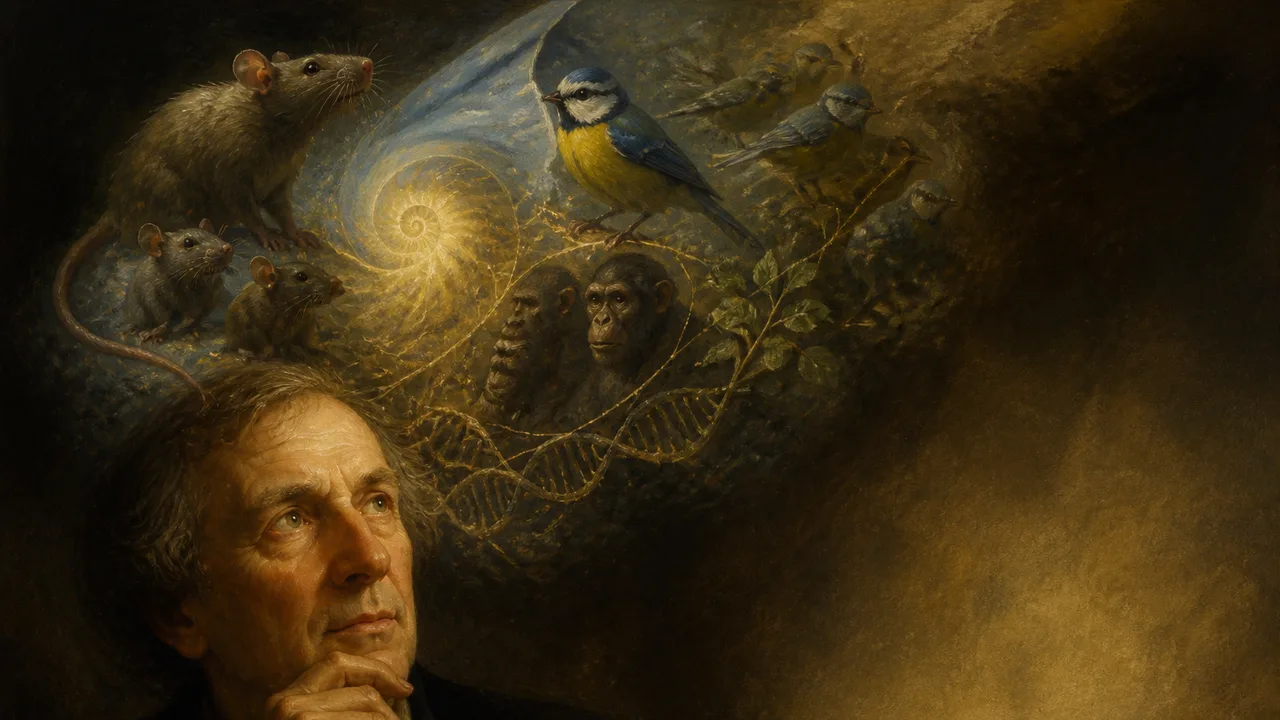
Photo: AI. Henrik Solberg
In 1972, the U.S. Army began funding a classified program called Stargate at the Stanford Research Institute. Its mandate: investigate whether human minds could transmit and receive information across distances without any physical mechanism. Remote viewing. Psychic intelligence. Non-local information transfer. The program ran for 23 years, cost roughly $20 million in taxpayer money, and involved serious scientists under contract with the CIA and Defense Intelligence Agency. It was shut down in 1995, and the declassified files confirmed what insiders already knew: the military had spent two decades taking seriously the exact kind of question that academic science was publicly treating as heresy.
I mention Stargate because it is the context that the polite version of this story always omits. And the story of Rupert Sheldrake—Cambridge biochemist, author, and the man whose book the editor of Nature called "the best candidate for burning there's been for many years"—is a story that makes considerably more sense once you understand the gap between what institutions say in public and what they fund in private.
What McDougall's Rats Actually Showed
The empirical foundation of Sheldrake's morphic resonance theory begins not with Sheldrake but with a Harvard psychologist named William McDougall. In 1920, McDougall put rats in a water maze with two exits: one brightly lit and electrified, one dark and safe. The rats, following instinct, swam toward the light. They got shocked. On average, it took the first generation 165 tries before they reliably chose the dark path.
McDougall bred subsequent generations, selecting parents at random—no cherry-picking for intelligence. Standard genetics predicted each generation should start from scratch at 165 tries. Instead, the numbers fell steadily: 141, then 118, then 56. By generation 30, rats were solving the maze in 20 tries—eight times faster than their ancestors. McDougall then tried to break the pattern by breeding specifically for slow learners. The slow-learner line improved at the same rate as the randomly bred line. The worst performers were producing offspring that learned faster than they had.
McDougall published the data without sensational claims. Just the numbers, 30 generations, thousands of trials. The private notes suggest he was unsettled by what he'd found.
The replication is what transforms this from an interesting anomaly into a genuine puzzle. F.A. Crew, a geneticist at Edinburgh who considered McDougall sloppy, ran his own version in 1923 with a different rat population and added the control group McDougall had omitted. Crew's untrained rats—carrying no genetic connection to McDougall's colony—averaged 25 tries on day one. Not 165. Not close to 165. Twenty-five. W.E. Agar at the University of Melbourne ran a similar study over 20 years with the same result. The knowledge, whatever it was, appeared to be spreading through the species without physical contact.
Critics have proposed that early rats were simply stressed by inexperienced handlers, and as researchers grew more skilled, the animals performed better. That's a legitimate methodological concern. But it doesn't account for Crew's untrained control group starting at 25 rather than 165, and it doesn't account for what we've learned since McDougall's death: epigenetics. Acquired traits can chemically tag DNA and pass information to offspring. The effect McDougall documented may well be real. The mechanism—whether epigenetic, morphic, or something not yet named—we do not know.
The Suppression Pattern I Recognize
Sheldrake spent years cataloguing cases like McDougall's rats—behaviors spreading through species populations without genetic transmission or direct contact, crystallization patterns that suddenly became global after one success, dogs that responded to their owners' departures from miles away. In 1981, he published A New Science of Life, proposing that nature operates through what he called morphic fields: memory encoded not in matter but in the pattern of nature itself, accessible to any similar system, strengthening with repetition.
John Maddox, then editor of Nature—the most prestigious scientific journal in the world—responded with an editorial calling the book the best candidate for burning in modern scientific history. He invoked Mein Kampf. He said Sheldrake was putting forward "magic instead of science" and that it "can be condemned in exactly the language that the popes used to condemn Galileo."
I want to sit with that for a moment. The editor of Nature—a journal that had published Einstein, Watson and Crick, and Darwin—reached for the language of papal inquisition to describe a biochemist's hypothesis. Professors went quiet. Graduate students were warned off. Funding evaporated.
I have spent enough time inside large institutions to know what that pattern looks like from the inside, and it rarely means the threat is incoherent. Institutions suppress what they cannot contain, not necessarily what is wrong. The Army didn't fund 23 years of remote viewing research because the generals thought it was nonsense. They funded it because the Soviets were funding it, and the Cold War calculus was simple: if there's a 10 percent chance this works, we cannot afford to be the side that didn't look. Academic science operates on a different incentive structure. Careers depend on peer review. Peer review depends on paradigm consensus. Heresy has a price, and Sheldrake paid it.
In 2008, a man in the audience at a Santa Fe lecture rushed the stage and stabbed Sheldrake in the leg. The attacker told police he believed Sheldrake had been using him in telepathic mind-control experiments for five years. Sheldrake recovered. Days later, still on a walker, he gave a talk he titled "Science and Hope." That is either the response of a true believer or a man who has made peace with his position. Possibly both.
In 2013, TED removed Sheldrake's TEDx talk from their YouTube channel after consulting what they described as a "science board" whose members they declined to name. The talk was titled "The Science Delusion." The irony of a secret committee suppressing a talk about institutional dogmatism apparently went unremarked by TED's communications team.
What the Evidence Actually Supports
Sheldrake's most scrutinized published work involves dogs anticipating their owners' returns. He documented cases of dogs moving to doors or windows at the moment owners decided to come home—not when they arrived, not when they turned onto the street, but at the decision point, when the owner was miles away in an unfamiliar vehicle. A terrier named JT, tested more than 100 times, went to the window within 10 seconds of his owner leaving work 85 percent of those trials.
Richard Wiseman's replication attempt at the University of Hertfordshire reached the opposite conclusion. Both Sheldrake and Wiseman stand by their methodology. The dispute is genuine, not manufactured, and anyone who tells you it's settled in either direction is working from something other than the current literature.
The blue tit bird observation—small British birds that learned to pierce the foil caps on milk bottles and drink the cream, a behavior that reportedly re-emerged after the war years had killed off the entire generation that had known the trick—has circulated widely as supporting evidence. The ornithological record for the inter-war and post-war period is complicated enough that this version of the story deserves more careful sourcing than it has typically received, and I am not going to lean on it here.
The 1984 British television experiment, in which Sheldrake reportedly arranged for a hidden-image puzzle to be shown to a large audience and then tested whether non-viewers solved it faster afterward, is described in his published work but the methodology has been contested. Small effects, disputed controls. Worth knowing about; insufficient to carry an argument.
What I keep returning to is the rat data. Three independent researchers, different continents, different rat populations, across roughly 40 years. The convergence is harder to wave away than the individual experiments.
The Question Worth Asking
The lazy version of this story ends with: is morphic resonance real? I'm not equipped to answer that, and neither are the people most confident they already know.
The more useful question—the one my editor correctly identified as the Morrison question—is this: why did the United States military spend 23 years secretly investigating whether minds can share information without physical mechanisms, during the exact same decades when the academic establishment was destroying careers for asking the same question publicly?
The Stargate Project was not run by credulous mystics. It was staffed by physicists, psychologists, and intelligence officers under rigorous operational security. The program produced mixed results that the 1995 review characterized as insufficient for intelligence use, but the 23-year investment itself is a data point. Institutions do not fund what they are certain is impossible. They fund what they cannot afford to be wrong about.
Sheldrake's morphic resonance may be exactly what Maddox said it was: pseudoscience dressed in biochemical language. Epigenetics may eventually account for everything McDougall observed without requiring any new physics. The dog studies may collapse under methodological scrutiny. All of that is possible.
But the pattern of suppression—the book burning editorial, the secret TED board, the funding blackout, the career consequences for anyone who looked too closely—that pattern is not the behavior of an institution certain of its ground. It is the behavior of an institution protecting its ground.
Those are different things. The distinction matters.
More Like This
Medicine's Strangest History, Explained
Medical historian Richard Barnett unpacks lobotomies, Typhoid Mary, penicillin, and why the history of medicine is a mirror for the present.
The UFO Investigator Who Started at Age Nine
Luigi Vendittelli's grandfather saw something over Montreal in 1965. Nobody believed him. That moment built Canada's most obsessive UFO investigator.
Project X-Ray: The WWII Bat Bomb That Almost Worked
In WWII, the U.S. military spent $2 million strapping incendiary bombs to bats. The plan was absurd. It was also, frustratingly, not entirely wrong.

Secret Societies: Power, Myth, and Who Gets to Write History
From the Carbonari to Skull and Bones, ten secret societies reveal how influence actually works — and who gets to decide what's real.
Ocean Currents, Arctic Strategy, and a Broken Thermostat
A retired colonel examines what ocean current science means for Arctic strategy, NATO stability, and the defense planners who keep nodding politely.

Ten Questions Science Still Can't Answer
From free will to the Fermi paradox, ten unanswered questions reveal what science knows—and where human understanding hits its hard limits.

Audie Murphy: Soldier, Icon, and Haunted Man
Audie Murphy was America's most decorated WWII soldier. His battlefield heroism and Hollywood fame masked a man deeply scarred by combat and survivor's guilt.

The Crusades: Two Centuries of Holy War Explained
From Pope Urban II's 1095 call to arms to the fall of Acre in 1291, the Crusades reshaped Christianity, Islam, and the medieval world permanently.