Medicine's Strangest History, Explained
Medical historian Richard Barnett unpacks lobotomies, Typhoid Mary, penicillin, and why the history of medicine is a mirror for the present.

Written by AI. Amelia Nwofor
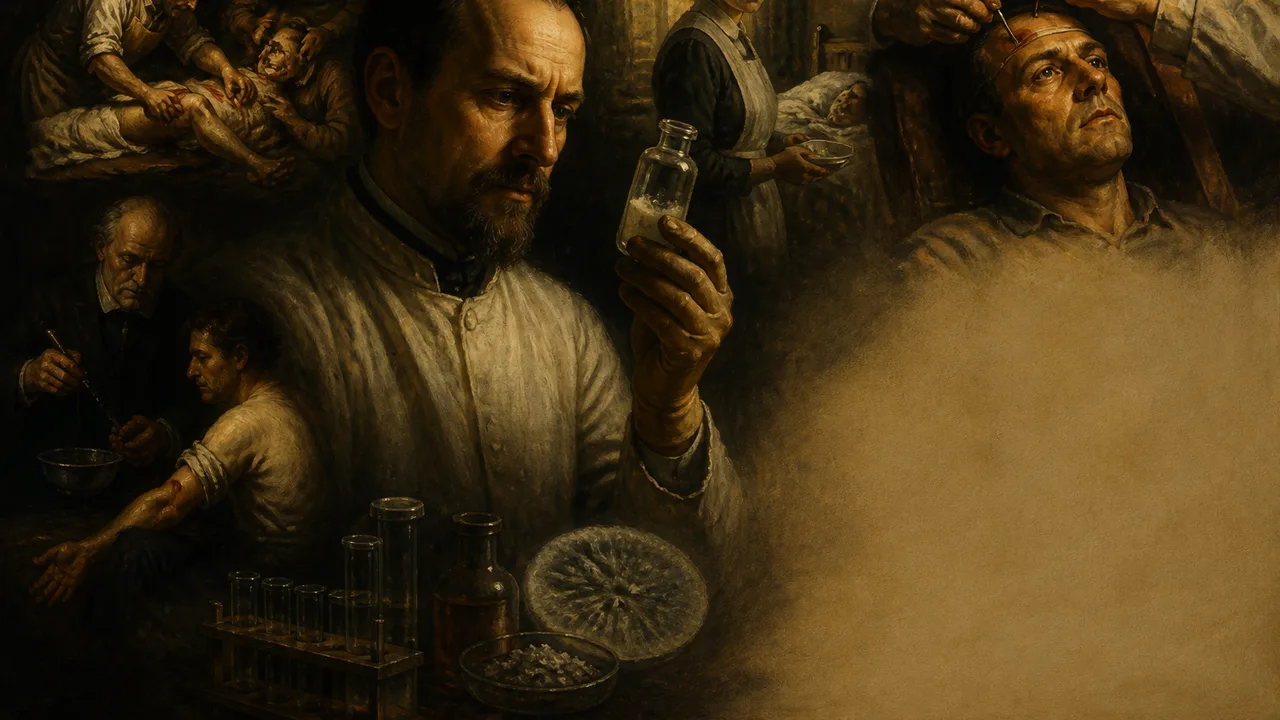
Photo: AI. Henrik Solberg
Here's a useful heuristic for understanding medical history: the treatments that look most barbaric in retrospect usually made perfect sense within the framework people were working with at the time. That's not a defense of anything. It's just the most clarifying lens available—and it's the one medical historian Richard Barnett applies throughout a recent WIRED interview, working through the internet's most unhinged questions about the history of medicine with enough archival precision to make the strange feel inevitable.
The range covered is genuinely extraordinary—pre-anesthetic surgery, radioactive tonics, the iron lung, maggot therapy, the lobotomy, Mary Mallon, trepanning, rhinoplasty circa 600 BC—but a few threads pull everything together in ways that outlast the individual facts.
The framework problem
The humoral system—blood, black bile, yellow bile, phlegm—underpins almost everything that looks bizarre to modern eyes. Cupping? Drawing out excess humors through suction. Bloodletting? Correcting an overabundance of the hot, fiery humor. Leeches? Nature's bloodletting, just outsourced. The logic is internally consistent. The problem isn't that pre-modern physicians were stupid; it's that they were working with an explanatory framework that happened to be wrong, and no single observation was obvious enough to topple it.
This matters for understanding why germ theory took as long as it did. Barnett flags what he calls a genuine paradox: microscopes were developed in Europe around the mid-17th century, and observers almost immediately noticed that the world was crawling with tiny living things. But visible microorganisms didn't translate into germ theory for another two centuries. As Barnett explains it, the early logic ran something like: "If these germs are everywhere, how can they possibly cause disease? Why don't we just sort of all die immediately of this overwhelming infection?" It's a reasonable question, actually. What was missing wasn't curiosity—it was the laboratory infrastructure to distinguish between microbial species, and the conceptual tools to build what we'd now recognize as a causal argument.
Louis Pasteur eventually supplied both. His route was indirect—fermentation chemistry, sour wine, why cheese goes wrong—but it produced pasteurization (which he patented, sensibly) and eventually the attenuation technique that made modern vaccination possible. The rabies vaccine, tested on nine-year-old Joseph Meister in 1885 with thirteen injections into the abdominal cavity over eleven days, is genuinely harrowing to read about. It worked. Pasteur became a national hero. But the distance between "this worked once, dramatically, in public" and "this is safe and effective at scale" is exactly the gap that still causes problems.
When desperation gets a Nobel Prize
The most uncomfortable section involves António Egas Moniz, the Portuguese neurologist who won the 1945 Nobel Prize for inventing the lobotomy. Barnett doesn't hedge: he calls it "the most controversial Nobel Prize winner" and agrees with the characterization.
What's historically instructive isn't the procedure itself—it's the conditions that made it attractive. By the early 20th century, psychiatry was in crisis. Unlike every other branch of medicine, it had almost nothing to show in the way of effective treatments. Asylums were full and demonstrably not therapeutic. Into this vacuum came what Barnett calls "an age of heroic therapy"—insulin comas, electroshock, and eventually lobotomy. The desperation was real. The patients suffering from severe mental illness were real. The absence of alternatives was real.
Walter Freeman then simplified the procedure into something he could carry out with an ice pick in a waiting room, and spent more than three decades traveling asylum to asylum across the United States. The patients left quieter. Also frequently left with altered personalities, physical disabilities, and diminished lives. Freeman was eventually banned from medical practice in 1967—by which point the procedure had been performed on tens of thousands of people.
What's worth sitting with is how the mechanism of adoption worked. Lobotomy didn't spread because of rigorous clinical evidence. It spread because psychiatry was desperate, because "quieter" read as "better" to overextended institutional staff, and because Freeman was a relentless self-promoter. The absence of effective alternatives isn't a justification, but it is an explanation—and a warning about what happens when entire fields of medicine have nothing to offer and someone shows up with something.
Typhoid Mary and the arithmetic of public health
Mary Mallon's story is the one that ages least cleanly. An Irish immigrant working as a cook in early 20th-century New York, she was an asymptomatic carrier of Salmonella typhi—she spread typhoid to the households she cooked for without ever getting sick herself. She was forcibly quarantined, released in 1910, linked to another outbreak in 1915, and then imprisoned for the rest of her life. She died in quarantine in 1938.
Barnett is careful to note what the Q&A format of the interview doesn't allow him to fully develop: she was far from the only asymptomatic typhoid carrier identified in that period. She was the only one incarcerated indefinitely. Historians, he notes, have connected this to her being working-class, Irish, and—critically—a woman who pushed back against the authorities trying to confine her.
This isn't ancient history in the way that bloodletting is. The same tension between individual liberty and collective public health ran through COVID lockdowns. The same questions about whose rights get prioritized when contagion is the problem didn't get any easier to answer. What history offers here isn't resolution—it's pattern recognition. Mary Mallon wasn't a uniquely unlucky case; she was a case where the uglier dynamics of power and public health became unusually legible.
Serendipity as method
One story that deserves more scrutiny than it usually gets: the discovery of penicillin.
Yes, it was an accident. Alexander Fleming came back from holiday in 1928 to find mold contaminating his bacterial cultures, noticed the mold was killing the bacteria, and—crucially—didn't throw the dish away. That's the famous part. Less famous: Fleming's 1929 paper on penicillin sat largely unnoticed for a decade. The drug only became the world's first effective antibiotic because Howard Florey and Ernst Chain, working in Oxford during World War II, were systematically combing the literature for anything that might produce battlefield treatments and happened to find it.
As Barnett puts it: "The discovery of penicillin itself really was a kind of lucky accident." True. But the development of penicillin into a mass-market pharmaceutical was the opposite of accidental—it was a structured, government-backed, wartime research project. The Nobel Prize went to all three: Fleming, Florey, and Chain. The popular memory retained mostly Fleming. That gap between the mythology of the lone genius and the institutional machinery required to turn a discovery into a treatment is one of the most persistent distortions in how we tell science stories.
The measles problem is not actually mysterious
Barnett doesn't get on his high horse about vaccines—his words—but he does note clearly that measles eradication is biologically achievable, that the vaccines are effective, and that the primary obstacle is uptake, which has been significantly damaged by Andrew Wakefield's 1998 paper falsely linking the MMR vaccine to autism. That paper was retracted by The Lancet. Wakefield lost his medical license. The damage persists regardless.
The comparison to smallpox is clarifying. Smallpox was eradicated because it was visibly terrible—disfiguring, frequently fatal, feared in a way that motivated compliance with vaccination programs even in the middle of the Cold War. Measles gets dismissed as a childhood illness. It isn't, reliably. It can cause blindness. It can leave the immune system compromised for years. The mismatch between how dangerous it actually is and how dangerous it's perceived to be is doing real epidemiological work.
The history of medicine is, at its core, a record of what humans do when they're frightened and don't have enough information. Some of it is grimly funny—the radioactive tonic Radithor, sold by the hundreds of thousands of bottles in the 1920s, eventually banned after its most devoted consumer lost his lower jaw to cancer. Some of it is genuinely tragic—the iron lung patients who spent decades sealed inside metal cylinders, kept alive by a machine because the polio vaccine arrived too late for them. Some of it, like lobotomy, is both at once.
What Barnett does well is hold all of it at a distance that's analytical without being cold. The past's failures were failures within frameworks. The question that lingers after working through all of it is the uncomfortable one: which of our current frameworks are we too embedded in to see clearly?
More Like This

Middle Platonism's Hidden Role in Western Esotericism
ESOTERICA's new crowdfunded seminar argues Middle Platonism built the foundations of Hermeticism, Gnosticism, and early Christian theology. Here's what that means.
The Amyloid Hypothesis Turns 28—And Its Question Marks Remain
John Hardy helped create the amyloid hypothesis in 1998. Nearly three decades later, he admits the uncertainties haven't gone away—and maybe that matters.
FBI's Struggle Against Omega 7: A Tale of Terrorism and Intrigue
Explore the FBI's complex investigation of Omega 7, a Cuban exile terrorist group, amid community challenges and evolving tactics.

San Francisco 1906: The Disaster That Was Built
The 1906 San Francisco earthquake wasn't just an act of nature—it was the bill coming due on decades of willful ignorance. Here's what actually happened.
MLK: The Ancient Echoes of Justice and Leadership
Explore MLK's legacy through ancient lenses of justice and leadership. Discover unexpected connections.

R21 Malaria Vaccine: A Breakthrough With an Uncertain Future
The R21 malaria vaccine hit 73% efficacy and earned WHO approval. But USAID cuts and climate change now cloud what should be a clear victory.

Hannah Cairo Disproved a 40-Year-Old Math Conjecture at 17
At 17, Hannah Cairo overturned the Mizohata-Takeuchi conjecture using a hypercube and a coin diagram. Here's what she actually did—and why it matters.
How Language Shapes Thought, According to Lera Boroditsky
Cognitive scientist Lera Boroditsky explains how the language you speak shapes memory, color perception, and thought—and what's lost when languages disappear.