California's "Don't Stop" Towns Have a Deeper Story
A viral video warns drivers not to stop in 12 California towns. The crime stats are real. So is everything the warning leaves out about the people who live there.

Written by AI. Sofia Ramirez
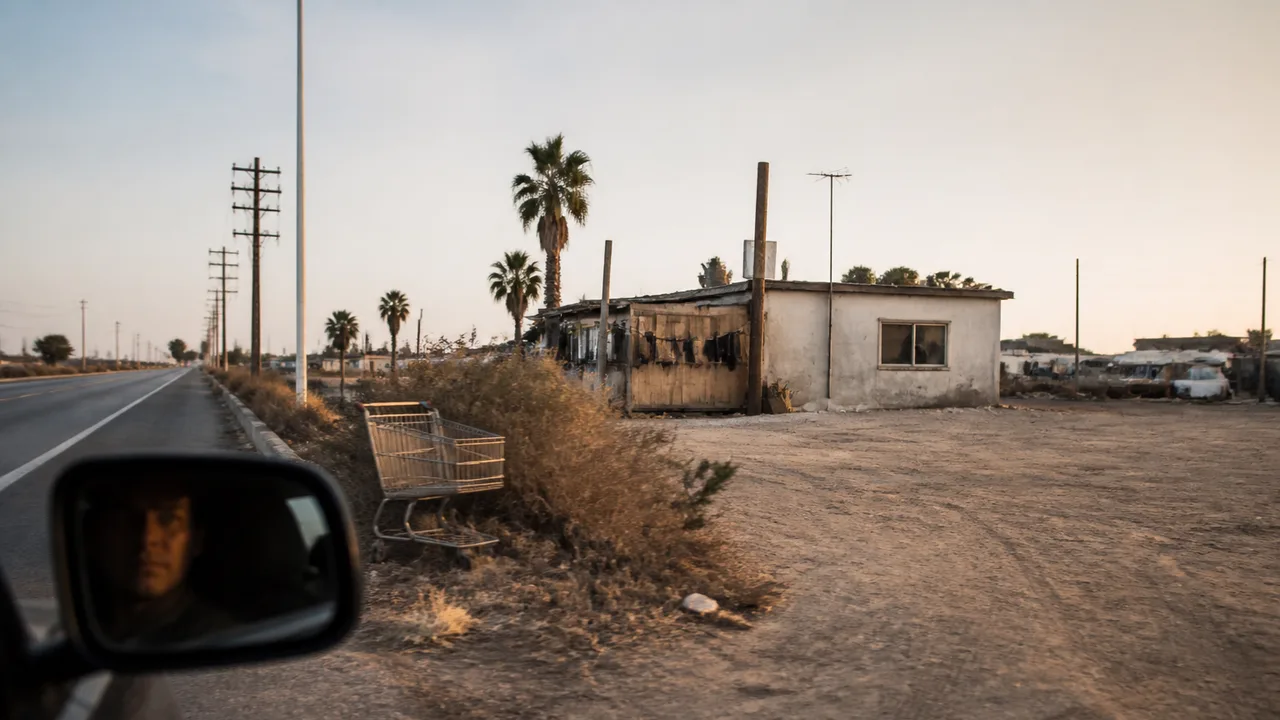
Photo: AI. Renzo Vargas
Somewhere on I-5, probably between the blur of Stockton and the blur of Bakersfield, you have felt it. The gas gauge dips, you pull off, and something about the exit—the boarded storefronts, the faces, the particular flatness of the air—makes you move faster than usual. You don't analyze it. You just fill the tank and go.
A recent YouTube video from the channel Loving Californian has built a 31-minute documentary around that instinct, profiling twelve California towns where locals reportedly warn travelers: don't even stop for gas. The video—which racks up crime statistics, poverty rates, and atmospheric detail with genuine craft—is a useful object to sit with. Not because it's wrong, exactly, but because of what happens when you take the instinct seriously and keep thinking past it.
What the video actually argues
To be fair to the source: this is not a simple fear-mongering exercise. The video's creators are at their strongest when they're describing structural conditions, not just vibes. Kettleman City, population 1,500, sits at the most common refueling stop on I-5 between LA and the Bay Area. A few miles west, out of sight behind a rise in the hills, is the Kettleman Hills Hazardous Waste Facility—the largest toxic waste dump in the Western United States. Between 2007 and 2010, eleven babies in this community of 1,500 were born with birth defects. Residents blamed the dump. The state investigated and said it could not identify a common cause. The dump is still operating.
The video describes Kettleman City as "the place where California dumps its toxic waste and its conscience at the same time." That line is doing real work. It's pointing at environmental racism—the well-documented pattern of hazardous facilities being sited near communities that are poor, non-white, and politically marginal. Kettleman City's population is predominantly Latino. Its poverty rate exceeds 40%. The people who live there did not choose to be downwind from hundreds of thousands of tons of hazardous waste. They cannot leave when their tank is full.
That's important context. And the video to its credit says so, repeatedly, in its closing minutes: "These towns are not just gas stops. They are communities where people live. People who cannot leave when the tank is full."
The tension the video doesn't resolve
Here's where it gets complicated. The video opens with the driver's instinct—lock the doors, fill the tank, leave—and explicitly validates it. "The instinct was correct," it says. "This video explains why." Then, at the end, it pivots to acknowledge that the people being warned against are human beings trapped by forces they didn't create.
Both things are in the video. The video just never works through the tension between them.
In Mendota—"the cantaloupe center of the world," per the cheerful sign at the city limits—the median household income is approximately $24,000, among the lowest of any incorporated city in California. During the drought years of 2012–2016, unemployment hit 40%, the highest rate in the entire United States. The cantaloupes came back when the rain returned. The prosperity did not. The video's own description is almost elegiac: "The unemployment dropped from catastrophic to merely devastating." And then the next beat is: would you stop for gas here?
The question is framed as if those are the same conversation. They're not.
In Parlier, a two-square-mile agricultural town southeast of Fresno, 16,000 people are packed into a density higher than the city of Los Angeles as a whole. The video describes it as a place where "you learn to read walls before you learn to read books"—graffiti marking gang territories that visitors can't decode. What the video doesn't dwell on: those 16,000 people are mostly farmworkers and their families, breathing some of the worst air in the nation (the American Lung Association grades it F), earning poverty wages harvesting produce that feeds the state. The gang problem is real. So is the question of what structural conditions produce it.
The genre's limitations
Videos like this one exist in a well-established genre: highway danger tourism, with a documentary veneer. The keyword list includes "#SmartInvesting," "#PassiveIncome," and "#RealEstateWealth" alongside "#DontStopForGas"—which tells you something about who the video is also talking to. The "danger" of these towns is simultaneously a warning for travelers and, implicitly, a property valuation signal for investors.
That's worth naming. When a town's poverty and crime become content, and that content is also tagged for real estate investment research, the community being documented becomes raw material for markets it has no control over.
The video's best moment is Calipatria, in Imperial County—its number one pick, and genuinely striking. The town sits 184 feet below sea level, the lowest elevation of any city in the Western Hemisphere. Summer temperatures regularly exceed 120°. The Salton Sea, California's largest inland body of water and one of its most catastrophic environmental disasters, is ten miles north and shrinking, sending toxic dust south across the valley. Calipatria State Prison, a Level 4 maximum-security facility, is the largest employer. The poverty rate exceeds 30%.
And then this: the town has a flagpole that is exactly 184 feet tall. The flag at the top flies at sea level. A community that exists entirely below the elevation most Americans take as a baseline built a structure tall enough to put one flag at that baseline.
That detail lands. It's not a travel warning. It's a monument to aspiration under conditions specifically designed to crush it.
What the data does and doesn't tell you
The video presents itself as "data-driven"—crime statistics, poverty rates, median incomes. Most of these numbers are real and verifiable. Banning's violent crime rate is approximately twice the national average. Taft's oil production has dropped roughly 70% from its 1985 peak. McFarland's poverty rate exceeds 35%—a fact that sits awkwardly next to the $44 million Disney grossed in 2015 on McFarland USA, a film about that same town's cross-country team overcoming adversity.
But data presented without causality is just atmosphere. The video tells you that Taft is dying—"the oil derricks are still pumping, but the economy stopped decades ago"—without spending much time on why the oil revenue that flows through Kern County doesn't return to the towns that sit on top of the wells. That's not a mystery. It's a policy question with documented answers involving extraction industry taxation, corporate structure, and the deliberate decoupling of resource revenue from host communities. The video gestures at the irony—you're buying gas surrounded by oil derricks in a town dying of oil—but doesn't follow the money.
Similarly, Thermal, an unincorporated community in the Coachella Valley where summer temperatures exceed 120° and residents live in mobile homes with no enforceable air conditioning standards, sits 30 miles from Palm Springs. The video notes this gap but frames it as geographic and atmospheric—"the fastest journey from wealth to poverty in California"—rather than as a product of specific land use policies, agricultural labor regulations, and the deliberate exclusion of unincorporated communities from municipal services.
What you're actually choosing when you "don't stop"
Here's the honest question the video raises without quite asking: when locals warn you not to stop, which locals?
In most of these towns, the majority of residents are Latino farmworkers and their families. They are, in the most literal sense, the locals. They're also the people the warning is implicitly warning against. The "locals" whose advice is being solicited tend to be long-haul truckers, commuters from surrounding areas, highway regulars—people passing through, not people living there.
That doesn't make the crime statistics false. Property crime is above the county average in Dos Palos. Gang suppression units operate in Guadalupe. These conditions are real and they affect residents most of all.
But there's a difference between understanding why a community has the conditions it has, and treating those conditions as a permanent characteristic of a place to be avoided. The first might lead you toward understanding what happened to agricultural California, or the history of environmental siting decisions, or what happens to a town when its single industry collapses. The second leads you to plan your gas stops differently.
Both are available to you. The video mostly offers the second while occasionally reaching for the first. The tension between those two things is where the more interesting conversation lives—and it's a conversation that the residents of these towns have been trying to have for decades, mostly without an audience.
The flagpole in Calipatria isn't just a quirky detail. It's a statement about what it means to build something that reaches for a level you were never placed at. A lot of these towns have been making that statement for a long time. Whether drivers on Highway 111 stop to read it is, apparently, still an open question.
More Like This

Tech Influencer Rap Video Satirizes Startup Culture's Illusions
A former Netflix engineer turned streamer releases a rap video mocking startup hustle culture, failed side projects, and the gap between tech ambition and reality.
Unraveling the Mysteries of Magic in Middle-earth
Explore how magic in Middle-earth defies traditional spells, rooted in nature, craft, and intent.
Is Nature Good? Harari and Žižek Say No
Yuval Noah Harari and Slavoj Žižek agree: nature isn't inherently good. Their debate reveals why "natural" is almost always a political argument in disguise.
California's Forgotten Places and What They Cost
From a Nazi compound in the Pacific Palisades to a toxic mercury mine, California's abandoned places reveal what the state built, forgot, and left behind.
Dinosaurs, Black Holes, and Why Greed Kills Systems
Dr. Roy Casagranda connects mass extinctions, black hole cosmology, and U.S. healthcare to one unsettling question: why do systems destroy themselves?
Lee Cronin's The Mummy Wears Egypt Like a Mask
Lee Cronin's The Mummy sells Egypt and delivers Evil Dead. The visual identity gap between what it promises and what it shows is where the film collapses.

The Spanish Civil War at 90: What the Coup Unleashed
On July 17, 1936, a military coup fractured Spain and drew the world in. What the Spanish Civil War's 90th anniversary still asks of us.
Medieval England: How Peasants and Guilds Shaped Society
A new documentary traces medieval England's social divide through two real families—one peasant, one guild merchant—and the starkly different worlds they inhabited.