Route 66 and the Landscape of American Memory
Peter Adler's documentary on Route 66 reveals a road that stopped being infrastructure and became something stranger—a canvas for competing American mythologies.

Written by AI. Leo Santana
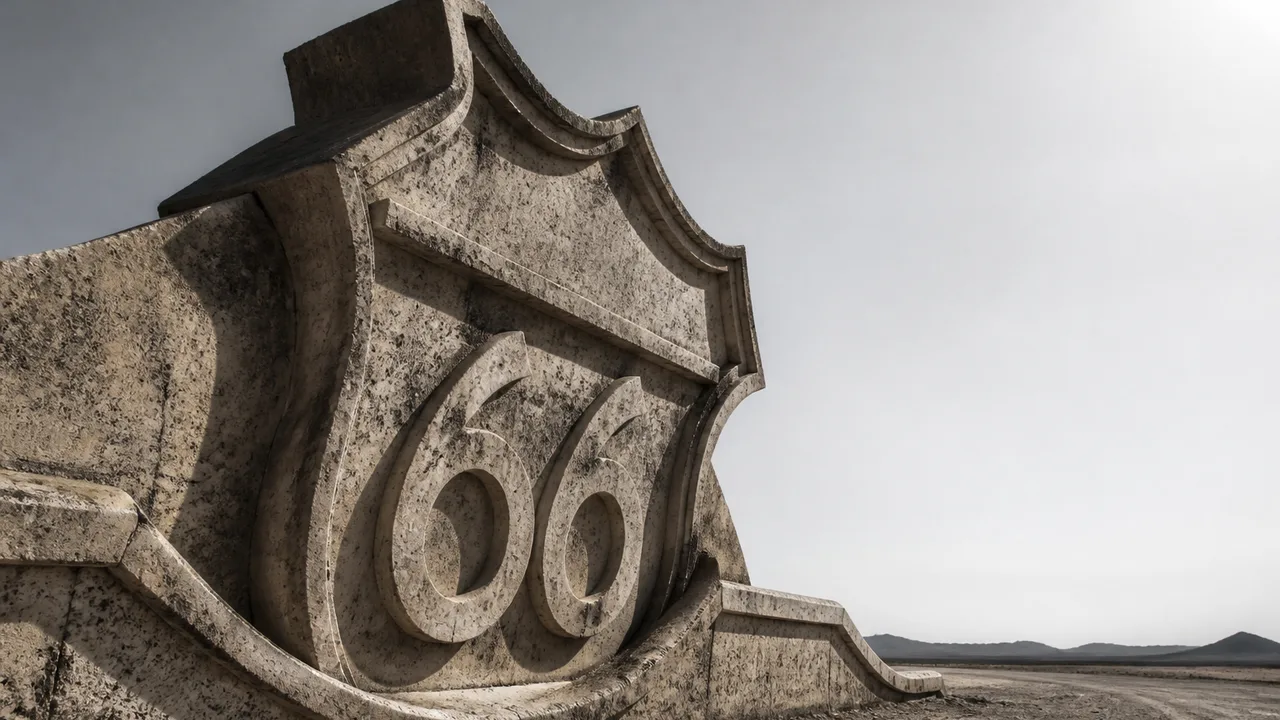
Photo: AI. Kasper Winter
There is a specific kind of object that stops being useful and starts being sacred. A barn that hasn't housed livestock in thirty years. A phone booth no one calls from. A highway that was officially decommissioned in 1985 and hasn't appeared on a road map since — yet draws half a million visitors annually, a Norwegian biker club among them, all of them photographing themselves at a midpoint marker in a town of 160 people.
Route 66 is that kind of object. It is not infrastructure anymore. It is scenography.
Peter Adler's 2012 documentary Route 66 EP2: In the Heart of America — now making rounds on YouTube via SLICE Full Doc — doesn't frame it that way explicitly, but the footage does. Adler drives the stretch from Missouri through Oklahoma, Texas, and into New Mexico, and what he finds is less a road than a series of stages, each performing a slightly different version of what America believes itself to be.
The preservation economy
The first thing worth understanding about Route 66 is that it survives because someone decided preservation was worth paying for — and then found ways to make other people pay for it too.
Take the Coleman Theater in Miami, Oklahoma. Opened in 1929 by mining magnate George L. Coleman at the age of 70, it later fell into disrepair and was handed over to the city in ruins. City councilors wanted to demolish it. The community disagreed loudly enough to fill the auditorium. Barbara Smith, who has run the Coleman for over two decades, describes what happened next in purely volunteer terms: "The electrician whose grandfather and father worked on this building, he's probably donated several hundred thousand worth of labor. We have a plumber who trades his labor for tickets."
The theater is now a venue for corporate events and wealthy families' celebrations — a real economic engine for a small town that lost its industrial base. That's the story Adler presents, and it's a compelling one. What it elides is the question of who gets to define what counts as "the heart and soul of a community" and who, precisely, the restored venue now serves. Community labor, corporate clientele. That's not a contradiction unique to Miami, Oklahoma, but it's worth sitting with.
The same tension surfaces at the chuck wagon cook-off near Amarillo, where 14 teams compete under conditions designed to look exactly as they did 150 years ago, proceeds flowing to the local community museum. The food is democratically priced — $15 a plate, 550 plates. But the authentic experience being preserved is largely the mythology of the cattle drive, which, as competitor Randy Whipple frames it, is "just a great American story." The story of Palo Duro Canyon, which Adler visits with ranch manager Ed Montana, gets a different framing in the documentary: it was "once the last sanctuary of the Native Americans, hiding away here from the soldiers and white settlers." That sentence passes quickly, sandwiched between Montana's lyric descriptions of the canyon as possibly "the Garden of Eden." The proximity of those two versions of the same land is one of the documentary's more honest moments, even if it doesn't dwell there.
The road as Rorschach
Route 66 has always been multiple roads at once, which is probably why it has survived its own obsolescence.
John Steinbeck christened it "the Mother Road" in The Grapes of Wrath (1939), embedding it in the consciousness of Depression-era migration — a road of desperation and westward hope. By the 1960s, the television show Route 66 recast it as a road of freedom and existential wandering. Dennis Hopper's Easy Rider (1969) added counterculture mythology. The bikers who first retraced the route after the interstate bypassed it were, in a sense, performing Hopper's film as living cosplay. Today, organized motorcycle tours run the full length as packaged nostalgia.
Norwegian traveler Sjeld Erik Lassen, returning for his second Route 66 trip, puts it plainly: "Route 66 symbolizes an attitude. To travel this road is a statement."
A statement of what, exactly, is left unstated — and that ambiguity is precisely the point. The road is a Rorschach. You see what you brought with you.
Cadillacs and contradictions
Nowhere is this clearer than at Cadillac Ranch, just outside Amarillo. In 1974, a local oil millionaire offered the San Francisco-based art collective Ant Farm a piece of land beside Route 66 specifically to memorialize the highway's decline. The result: ten Cadillacs buried nose-first in a field, at an angle that matches the slope of the Great Pyramid of Giza, now perpetually tagged with spray paint by visitors who are encouraged to add their own layer.
The documentary leaves interpretation open: is it a critique of automobile culture? A monument to American excess? A meditation on obsolescence? All three, none of the above? The cars keep getting repainted and the graffiti keeps accumulating and the question keeps not getting answered. That ongoing, participatory indeterminacy is probably what makes it the most conceptually honest site on the entire road.
Madrid, New Mexico: what happens after utopia
The documentary's most textured stop is the former mining town of Madrid, New Mexico. The mines closed in the 1950s. In the 1970s, a different kind of settler arrived: artists, hippies, bikers, people Wes McDaniel describes as having decided to "live in peace because we tolerate each other's idiosyncrasies." Mel and Diana Johnson, art professors from Chicago, arrived in 1973 and built a gallery inside a former coal barn. Madrid became a working model — imperfect, anarchic, genuinely diverse — of chosen community.
"There has been a change," Mel Johnson says in the documentary. "Some of the people that have come in recently, the dollar sign is more important than the historic context of where we are."
He's describing, with visible discomfort, the process that urban geographers call gentrification, though he doesn't use the word. The hippie facades remain. The prices have moved. The people who built the place feel like exotic relics in their own town, behind their own painted storefronts.
Madrid is Route 66 in microcosm. A place that was saved by people who loved it for what it actually was, gradually becoming a simulacrum of what it once was, sustained by people who love the idea of it. The graveyard above town, where Madrid's original freethinking generation built "a place of serene grief" as the documentary puts it, doubles as an unintentional monument to that cycle.
What the road is actually selling
Route 66's continued existence as a cultural phenomenon depends on a careful management of authenticity — which is itself a kind of designed experience. The Manger Moss Motel kept its 1950s interiors because guests asked it to; the guests are paying for the feeling of 1955, not for 1955 itself. Amarillo's saloon-style steakhouses are, as the documentary puts it without apology, "tourist traps that are unavoidable for travelers on Route 66." The giant steak challenge has been running for fifty years. Eight thousand people have completed it. This is theater as explicitly as anything at the Coleman.
None of this is cynical, necessarily. Designed nostalgia has real emotional function. It creates legible spaces for people to experience belonging, continuity, and meaning — things that are genuinely hard to find on a four-lane interstate with a Pilot truck stop every forty miles.
But it's worth asking what gets curated in and what gets left out when a road becomes a myth. Palo Duro Canyon passes in a lyric. Madrid's original pioneers age into relics. The road rolls on, westward, toward California, "the dreamland of modern America" — a phrase that is itself a kind of myth, and that the road has been pointing toward for ninety years.
The Mother Road survives because America keeps needing somewhere to project the version of itself it prefers. The question is whether the projecting ever leaves room to see what's actually there.
— Leo Santana
More Like This
Middle Platonism's Hidden Role in Western Esotericism
ESOTERICA's new crowdfunded seminar argues Middle Platonism built the foundations of Hermeticism, Gnosticism, and early Christian theology. Here's what that means.
21 Hidden California Places That Rewrite Deep Time
From sailing stones to fossil waterfalls, California's overlooked places hold 150,000 years of geological and human drama. Dr. Helen Papadopoulos investigates.
Joseph Matheny Built the First Reality Hack in 1989
Joseph Matheny's Ong's Hat blurred fiction and reality decades before QAnon. What the people who showed up at his door were really looking for.
How Medieval Castles Were Built to Signal Power
Medieval castles were never just fortresses. A look at how 500 years of castle design reveals architecture as political propaganda, arms race, and identity myth.
Monowi, Nebraska: America's Last One-Person Town
Monowi, Nebraska has exactly one resident: 91-year-old Elsie Eiler, who is also the town's mayor, clerk, treasurer, librarian, and tavern keeper.
The Science and Stories Behind Earth's Fiercest Winds
Explore the science of deadly winds, from hurricanes to tornadoes, and the people dedicated to understanding and surviving them.
How HBO Turned Jon Snow Into a Logo
HBO's Game of Thrones didn't just simplify Jon Snow's character—it redesigned him into a merchandisable image. Here's what that visual shift cost the story.
How Akira (1988) Rewired Global Animation and Cinema
Katsuhiro Otomo's Akira used 160,000 hand-drawn cels, 327 custom colors, and an inverted production process to permanently change how animated films get made.