Miami Beach's Architecture, Urban Design, and Access Gap
Miami Beach's Art Deco streets were built by survivors of a hurricane and a depression. But who gets to live inside that survival story today?

Written by AI. David Oyelaran
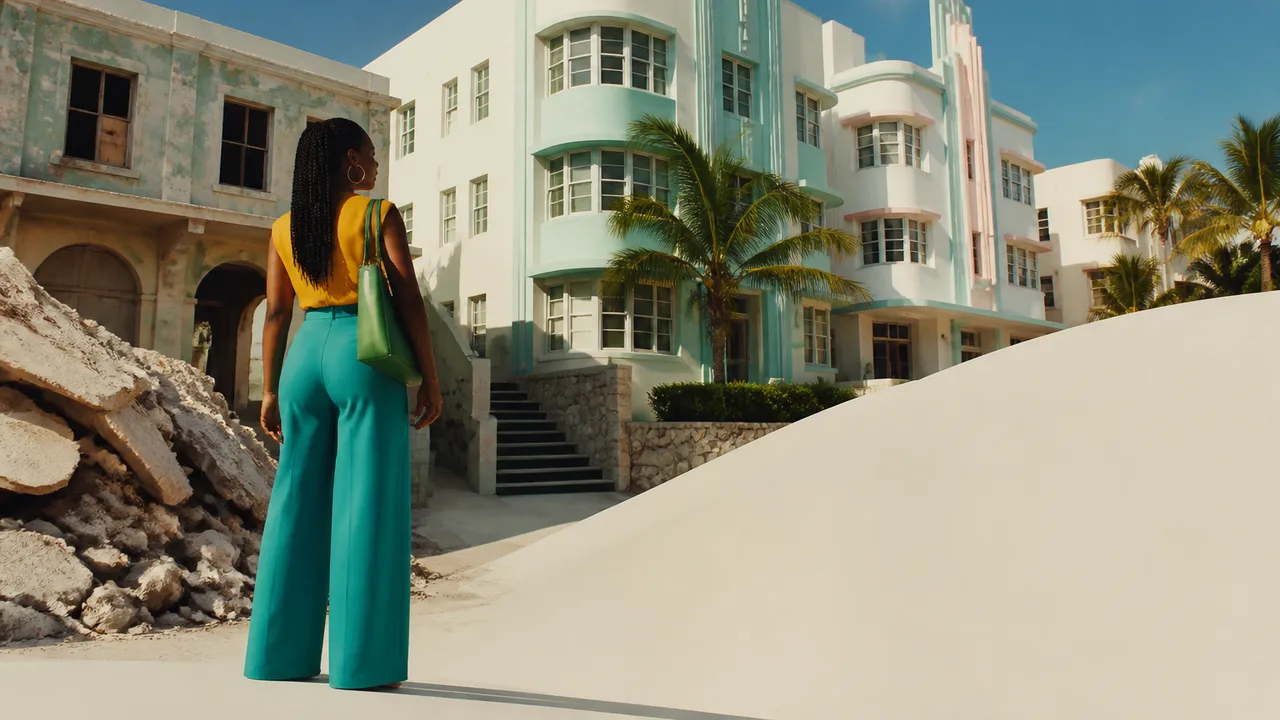
Photo: AI. Ines Cienfuegos
Picture a woman — call her Carmen, because she asked me to — who spent thirty years cleaning rooms in a Collins Avenue hotel she could have told you the entire history of, if anyone had thought to ask. She knew which buildings went up after the hurricane, which ones the preservationists fought to save in the '80s, which ones the developers tried to tear down three times before giving up. She commuted in from Hialeah. Every morning, forty minutes each way. The island was her workplace, not her neighborhood. The pastel walls and the porthole windows and the eyebrow shades — those were details she walked past, not into.
I keep thinking about Carmen when I watch Fourth Place's recent video essay on Miami Beach, which makes a compelling and largely accurate case that this city is something genuinely rare in America: a walkable, bikeable, architecturally coherent place built at human scale. The creator is right. It is those things. The question that hums underneath the whole piece — and that the creator gestures toward without quite landing on — is: human scale for whom?
But let's start where the buildings start: with the storm.
On the night of September 17–18, 1926 (historical records place the Great Miami Hurricane's primary landfall across that span), a Category 4 storm erased most of what Miami Beach had spent a decade building. The city's first boom — the 1910s and Roaring '20s, when developers marketed Florida as "America's Riviera" and sold it to wealthy northern industrialists as a place where "the air was cleaner, the fruit was fresher, and the sun shined brighter" — vanished almost entirely. One-third of Miami-Dade County's population was left homeless.
What got built in its place is what makes Miami Beach look the way it does. Architects couldn't afford ornament. They couldn't justify the opulent Mediterranean and Victorian styles that had defined the first boom. So they reached for Streamline Modern — a leaner variation of Art Deco that borrowed its vocabulary from cruise ships and locomotives and mass-produced cars. Smooth stucco. Minimal decoration. Porthole windows fitted with concrete "eyebrows" that blocked the South Florida sun. Pastels that reflected heat. The result was something the creator of the Fourth Place video calls "a regional subgenre of a subgenre of art deco" — Tropical Deco — and it is, genuinely, unlike any other architectural collection on the continent.
The Miami Beach Architectural District is frequently described as housing the world's largest concentration of Art Deco buildings, though that claim is contested by some architectural historians who point to collections elsewhere. What's harder to contest is the specific character of what's here: these weren't prestige buildings. They were built lean, fast, and cheap, by a city that needed to convince tourists it hadn't just been catastrophically destroyed. Browns Hotel on Ocean Drive — built in 1915 and sometimes cited as Miami Beach's oldest surviving hotel, though competing claims exist for other early properties — is one of the few remnants from before the storm. Everything else is aftermath.
Which is, if you sit with it, a strange kind of beauty. The whole ornate language of the place was born from what people couldn't afford to do.
The Fourth Place video moves through Miami Beach's historic districts with genuine enthusiasm and a sharp eye. Ocean Drive gets the most attention — one-way car traffic, two-way pedestrian and cyclist movement, boutique hotels over cafes and restaurants, all inside a nationally recognized architectural district. The creator describes it as functioning "more similar to a beachfront street in Lisbon" than anything you'd typically find in an American city. Flamingo Park, just west, offers Art Deco residential density: streamline modern duplexes and townhouses, bike share docks threaded into the grid, buffered lanes. Collins Avenue runs leaner and quieter, its neon spires — vertical fins hotels built in the '40s and '50s specifically to catch the eye of drivers — marking the evolution from Deco into mid-century modern.
And then there's Lincoln Road. Morris Lapidus — the same architect behind the Fontainebleau Hotel — was brought in during the late 1950s to transform what had been a declining luxury retail corridor into a European-style pedestrian promenade. The conversion was phased over several years (it's often simplified as a single 1960 opening, but the full realization was more gradual), and Lapidus delivered gardens, fountains, covered walkways, an outdoor amphitheater. It became one of the earliest and most ambitious pedestrian mall projects in the country.
Two blocks south, Española Way does something Lincoln Road doesn't quite manage. It's a narrow, faux-Spanish enclave built in the early 1920s, modeled loosely on Barcelona and the French Riviera, that ran through Al Capone's gambling operations, survived the hurricane, drifted into bohemian territory through the interwar years, and was eventually rehabbed by preservationists in the mid-1980s — a revival that got an unlikely boost from Miami Vice, which featured the street in over a dozen episodes. "It's intimate, layered, brightly colored, and alive in a way that Lincoln Road just isn't," the video's creator notes. That feels right to me. Lincoln Road has scale; Española Way has texture.
Here's where I want to stay for a moment, because this is where the video's argument gets interesting and also where it goes a little quiet.
The creator is unambiguous about what's broken: Washington Avenue, Alton Road, the stroads that wall in the Flamingo Park Historic District on three sides, the retail vacancies that cluster specifically on the car-centric corridors. "Streets built for cars are worse for the economy than streets built for people and bikes," the video states flatly — and the vacancy rates along Washington Avenue compared to Ocean Drive do seem to bear that out visually.
But the access question — who can actually live in this place — gets handled as policy rather than testimony. What the video observes is real: Miami Beach isn't building the middle-density housing that would let its workforce live anywhere near the island. The pedestrian infrastructure, the historic preservation, the bike lanes, the Española Way charm — all of it appreciates in value while the people who make the place function commute in from the mainland.
The preservation fights of the late 1970s and '80s are a particularly sharp version of this tension. The Miami Design Preservation League, founded in 1976, campaigned for years to have the South Beach Art Deco district listed on the National Register of Historic Places — a designation finally achieved in 1979. That fight almost certainly saved the buildings. It also, over time, made the neighborhood dramatically more desirable and dramatically less affordable. The people who fought for preservation were largely not the same people who got pushed out when it succeeded. That's not a reason not to have fought for the buildings. It is, however, a story worth naming.
Carmen — the woman commuting in from Hialeah — told me she was proud of the buildings. "I watched them fix those hotels up," she said. "They're beautiful. I'm glad they're still there." She paused. "I just don't live near them."
The Fourth Place video ends on a note of genuine affection: Miami Beach, the creator concludes, was the perfect place to do nothing — and "if I'm honest, that's a lot more impressive and no doubt very European." That's earned. The city's best quality might be exactly that: it slows you down without trying. The grid is small enough to walk, the boardwalk runs uninterrupted along the ocean, and the buildings — whatever the economics of their survival — are still paced for people on foot rather than people in cars.
The buildings remember a city built for people moving at human speed. What they can't tell you is who gets to move through them now — and who makes the beds, pours the coffee, and heads back across the causeway before the nightlife starts.
Fourth Place's video essay "Why Miami Beach Looks Like That" is available on YouTube.
David Oyelaran is Buzzrag's Oral History and Documentary Correspondent.
More Like This

Flood-Proofing Cities: Big Walls vs. Small Fixes
From Tokyo's $2B flood tunnels to a $78K fly farm in Nairobi, cities are choosing how to survive rising floods — and the choice reveals everything about who adapts and who doesn't.
What Amsterdam Remembers That New York Forgot
A YouTube urbanist's first trip to Amsterdam raises older questions: what does a city actually owe its citizens, and did American cities ever mean to answer them?
California's Most Remarkable Abandoned Places
From a concrete ship with a dance floor to nuclear missile bunkers beneath a tourist park, California's abandoned places hold stories the state never bothered to tell.
What Tourists Keep Getting Wrong About California
From Pacific Ocean temps to parking nightmares and budget shock, here's what first-time visitors consistently misunderstand about California travel.

Is Nature Good? Harari and Žižek Say No
Yuval Noah Harari and Slavoj Žižek agree: nature isn't inherently good. Their debate reveals why "natural" is almost always a political argument in disguise.

Remakes That Outshine the Originals
Exploring movie remakes that have surpassed their originals, offering fresh takes and captivating storytelling across genres.
Hagia Sophia's Race Against the Next Earthquake
Istanbul's 1,500-year-old Hagia Sophia is undergoing its most urgent restoration yet. Here's what's at stake—structurally, culturally, and politically.

Did the Minoans Inspire the Atlantis Legend?
Archaeological and geological evidence connects Plato's Atlantis to the Minoan civilization and the catastrophic Bronze Age eruption of Thera (Santorini).