New York City's Underground Infrastructure Explained
From gravity-fed water tunnels to steam pipes and subway lines, NYC's underground is a century-deep tangle of engineering decisions—brilliant, broken, and still evolving.

Written by AI. Leo Santana
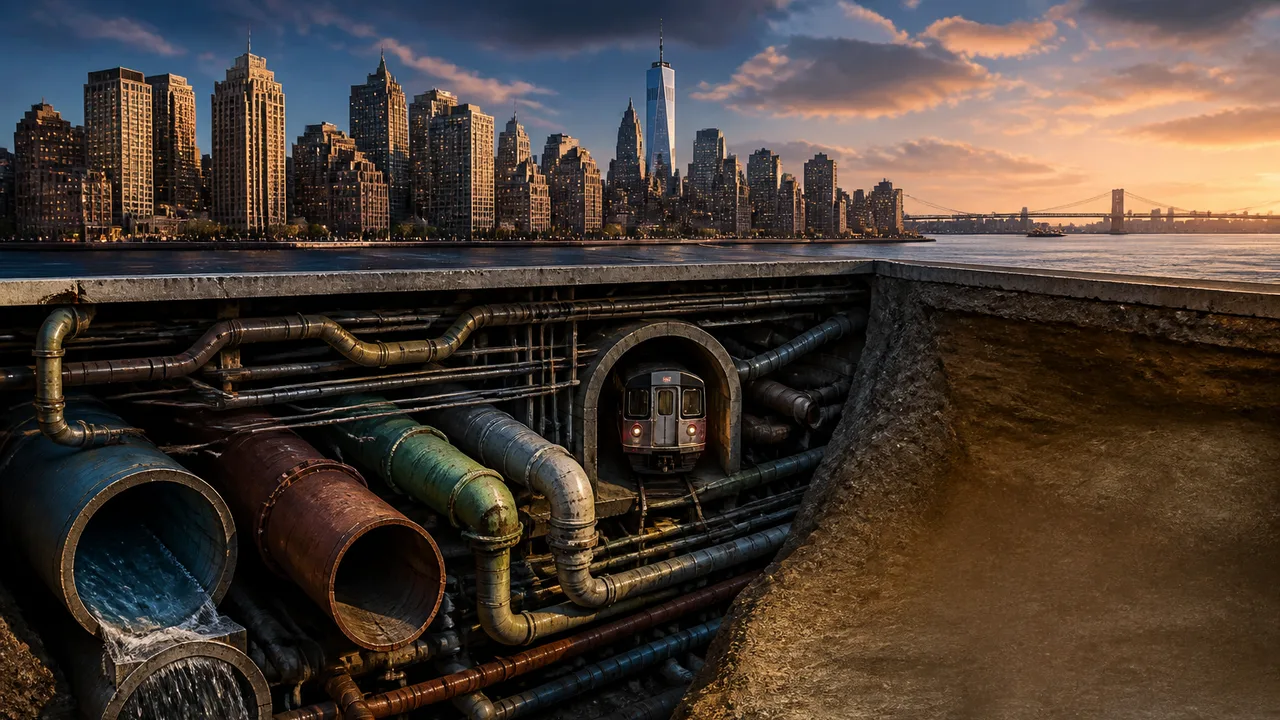
Photo: AI. Asha Kingsley
Stand at almost any Manhattan intersection and the design language of the street is familiar enough: asphalt, curb, fire hydrant, manhole cover. The manhole cover is the tell. It's a lid. And what's under a lid is, by definition, the more interesting part.
Grady Hillhouse, who runs the infrastructure-focused YouTube channel Practical Engineering, recently put out a 22-minute tour of what's actually beneath a generic New York City block—water mains, electrical vaults, steam pipes, sewers, subways, and then deeper still, water again. Watch it and you come away with a specific feeling: less like you've learned a list of facts, more like you've been handed a pair of X-ray glasses you can't take off. You'll never look at a puff of steam rising from an orange Con Edison chimney stack the same way.
The piece is worth sitting with, not just because the engineering is genuinely wild, but because it surfaces something that design critics and urban planners talk about a lot in the abstract—the gap between what a city looks like and what it takes. New York's underground is a masterclass in that gap.
The Root System
Hillhouse borrows a phrase from author David Macaulay—"the city's massive root system"—and it earns its keep. The analogy is precise. Like roots, this infrastructure is mostly invisible, structurally essential, chaotically distributed over time, and nearly impossible to fully reorganize once it's established.
Start at the top of the stack. Water mains run down nearly every street in a grid pattern, which is a deliberate choice. A branching, tree-like layout creates dead ends where water slows, stagnates, and becomes unsafe to drink. The grid keeps everything moving. NYC's system takes this further: it's gravity-fed from upstate watersheds at higher elevation, requiring no pumping energy for most of its operation, and the source watersheds are protected so aggressively that the water requires no filtration. Over 900 sampling stations are scattered throughout the street grid to verify quality at the distribution end.
That's an elegant system. It also happens to be a very old one, and the elegance is fragile at the edges—aging cast iron pipes, imperfect maps, and the perpetual challenge of digging around everything else to fix one thing.
The Electrical Grid That Isn't Really a Grid
The naming problem with New York's electrical system is worth pausing on. We call the power network "the grid," but Hillhouse points out that most cities don't actually use a grid architecture for distributing electricity. They use radial systems—each building connects to a feeder that traces back to a single substation, like a branch back to a trunk. Take out one segment and everything downstream goes dark.
New York is different. Con Edison operates roughly 70 separate "secondary networks" across the five boroughs, each fed by eight to twenty-eight redundant feeder lines from an area substation. Underground transformers in concrete vaults—rated, notably, to operate while completely submerged in water—step the voltage down to service level, where it fans out through an actual mesh of conductors with multiple redundant paths. This is a true grid in the technical sense, which is part of why about 85% of the city's electrical lines run underground and why New Yorkers have some of the most reliable power service in the country.
There's a catch, naturally. "Obviously that reliability comes at a price," Hillhouse notes. "The service network architecture is one of the reasons why New York City has some of the highest electricity prices in America." The infrastructure that makes the lights stay on through a hurricane is expensive to build, expensive to maintain, and the cost lands on every utility bill. That's a design tradeoff, and a politically uncomfortable one: the people with the least margin for high electricity costs live in the same city as the redundant underground vaults that keep prices elevated.
Steam as Public Utility
The detail that stops most people cold is the steam. Manhattan sits on top of the largest district heating network in the world—a system of pressurized steam pipes that serve about 1,500 customers including hospitals, restaurants, dry cleaners, and office buildings. Steam heats, provides hot water, sterilizes medical equipment, and—counterintuitively—runs compressors that provide air conditioning.
When groundwater contacts the hot pipes or a small leak develops, steam vents through manholes to the surface. Con Edison diverts it with those distinctive orange chimney stacks you see dotting Midtown sidewalks. Most pedestrians treat them as furniture. They're actually a diagnostic signal: something below the surface is losing containment.
The engineering challenge with steam is thermal expansion. Shut down one of those lines and it swings roughly 300°F in temperature. That kind of thermal stress requires expansion loops and slip joints throughout the system to absorb the physical movement—otherwise pipes buckle and crack. This is expensive, maintenance-intensive infrastructure, confined mainly to Manhattan, running alongside everything else in an already crowded underground.
The Spaghetti Problem
Hillhouse is good at finding the moments where an engineered system's logic starts to break down at the edges. The underground utility situation in older parts of New York is one of those moments. Because the systems were installed piecemeal over more than a century—water lines first, then gas, then electrical, then telecom, with each generation of workers finding space among whatever was already there—the result is what engineers apparently call, without irony, "the spaghetti."
"In many cases, especially older parts of the city, very little of this infrastructure was planned out comprehensively," Hillhouse explains. "Most streets are either imperfectly mapped or not mapped at all. Making repairs is its own kind of treasure hunt."
The city is building a comprehensive 3D database of underground utilities to address this, but assembling that database means reconciling records that are in some cases over a hundred years old, in formats that were never designed to be integrated. Vacuum excavation—using water or compressed air to break up soil, then vacuuming it away rather than scraping with a backhoe blade—has made exploratory digging safer and faster. But there's no technological fix for the fundamental fact that an old cast iron pipe doesn't know it needs to be on a map.
What Stays, What Leaks, What Gets Abandoned
One of the most clarifying threads in Hillhouse's tour is what happens to infrastructure when it stops being useful. The answer, mostly, is nothing—it stays where it is. Decommissioning buried utilities is expensive enough that abandonment in place is the default. Somewhere under the streets of Manhattan is a pneumatic mail delivery system that operated for decades, threading mail tubes through 27 miles of underground conduit, and was shut down in the 1950s when maintenance costs outran the benefits. It didn't go anywhere. It's still there.
Natural gas lines may be next. New York has placed limits on gas in new construction, which means the network could gradually become a system of live pipes surrounded by slowly accumulating dead ones. The design question that raises—what does a city do with obsolete underground infrastructure at scale?—doesn't have a clean answer yet.
The sewers present the most acute version of this problem. New York's combined sewer system—where stormwater and sanitary sewage share the same pipes—was built at a time when the goal was simply to move waste away from the city, not treat it. The system works as designed. The design is the problem. On heavy rain days, treatment plants can't handle the combined volume, and roughly 400 outflow points around the city discharge untreated sewage into waterways. The city operates under a consent decree with the state, funding rain gardens, underground retention tanks, and separated sewer projects in newer areas—chipping away at a structural problem that accumulated over a century.
Depth as a Strategy
At the very bottom of Hillhouse's vertical tour is City Water Tunnel No. 3, which has been under construction since 1970 and will continue for at least another decade. It runs approximately 650 feet below the surface—nearly half the height of the Empire State Building measured downward. At that depth, it clears the entire accumulated tangle of utilities above it and sits in bedrock hard enough to withstand the pressure of the water inside.
"The underground of New York is almost a city within a city," Hillhouse says. "We kind of get used to having all these utilities and services that it's easy to forget the physical space they all take up and the work that goes into installing and maintaining them."
That forgetting is, in some ways, a design success. Infrastructure that demands your attention has usually failed. The orange steam stacks, the construction closures, the burst water mains—those are the moments the underground makes itself visible. The goal is to stay hidden, humming below the city's awareness, keeping the pressure up and the lights on.
But cities that forget what's underneath them tend to underinvest in it. And underground infrastructure, it turns out, doesn't get better with neglect—it gets more expensive.
More Like This
California's Hidden Underground: Caves, Tunnels, and Buried History
From a buried Gold Rush city to survival tunnels built by Chinese immigrants, California's underground holds layers of geology, history, and forgotten infrastructure.

Can Unreal Engine 5 Run on a $500 MacBook? Sort Of.
Testing Unreal Engine 5.7 on the MacBook Neo reveals what happens when professional software meets budget hardware—and why friction matters.
The Electrical Grid Is Being Rebuilt for AI—Now What?
AI and EVs are forcing a complete grid overhaul. What that means for small businesses waiting on power that never seems to arrive fast enough.

This Tool Treats Your Home Lab Like Infrastructure Code
RackPeek documents home labs as YAML code in Git. Brandon Lee shows how this infrastructure-as-code approach beats static diagrams and spreadsheets.

The Invisible Inventions That Built Modern Life
From flush toilets to undersea fiber cables, the inventions that most shaped modern civilization are the ones we've stopped noticing entirely.

When Walmart Sells Last-Gen GPUs Cheaper Than Amazon
A PC build experiment reveals an uncomfortable truth about 2026 hardware markets: sometimes the discount bin beats the cutting edge.
Route 66 and the Landscape of American Memory
Peter Adler's documentary on Route 66 reveals a road that stopped being infrastructure and became something stranger—a canvas for competing American mythologies.

How HBO Turned Jon Snow Into a Logo
HBO's Game of Thrones didn't just simplify Jon Snow's character—it redesigned him into a merchandisable image. Here's what that visual shift cost the story.