The Invisible Inventions That Built Modern Life
From flush toilets to undersea fiber cables, the inventions that most shaped modern civilization are the ones we've stopped noticing entirely.

Written by AI. Margaret "Maggie" Holloway
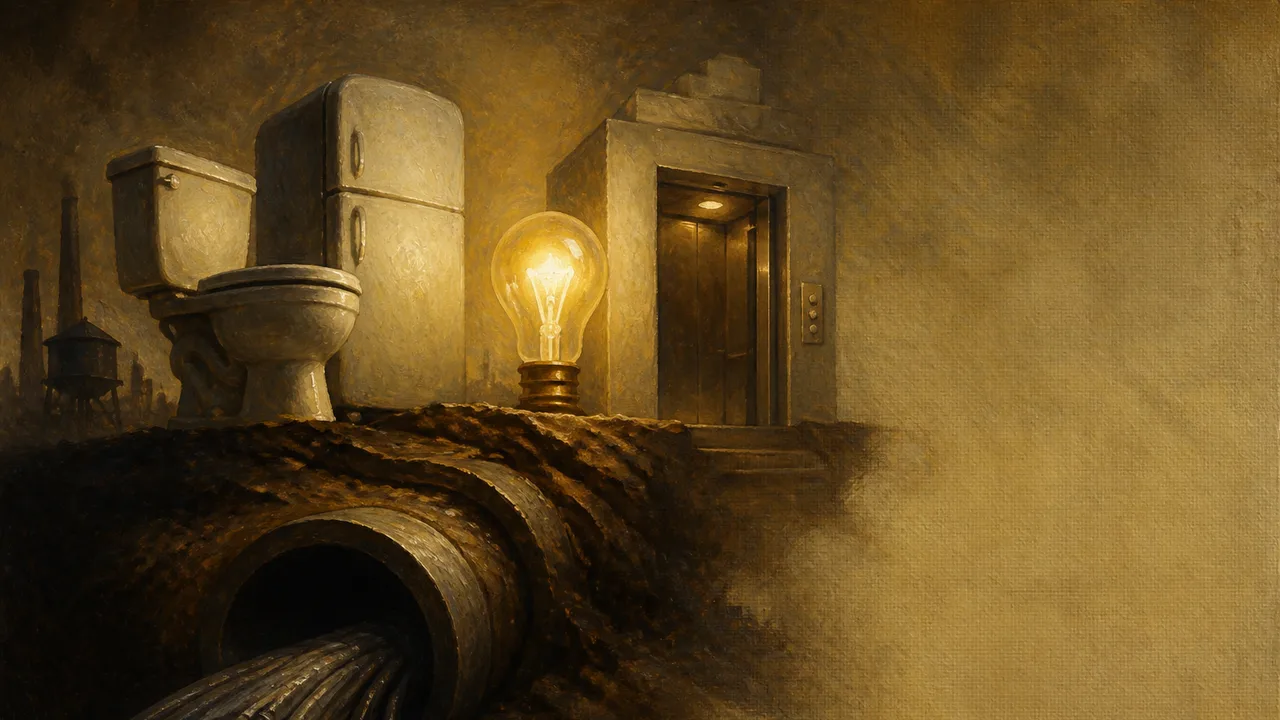
Photo: AI. Henrik Solberg
There is a particular category of important thing that succeeds so completely it disappears. Not into obsolescence — into assumption. You stop seeing it the way you stop seeing the hum of a refrigerator, not because it has gone quiet, but because your brain has decided it is simply the texture of the world.
A recent video from the YouTube channel Some Guy Who Knows Stuff runs through nine such inventions — flush toilets, refrigerators, light bulbs, elevators, barbed wire, shipping containers, air conditioners, GPS, and undersea internet cables — in about sixteen minutes. The format is brisk and the channel is cheerfully unpretentious. But the list itself is worth sitting with longer than sixteen minutes allows, because what unites these inventions is not just their usefulness. It is how thoroughly they have hidden themselves inside everything else we do.
The infrastructure beneath the infrastructure
The video opens with the flush toilet, which is the correct place to start. Not because it is the most glamorous invention — it is famously not — but because it forces an immediate confrontation with what infrastructure actually means.
"One of the most important changes was not just the toilet itself," the video notes, "but the infrastructure beneath it." This is the move worth paying attention to. The toilet is visible. The sewer network is not. The toilet gets the credit. The sewer network did the work.
When civil engineer Joseph Bazalgette designed London's sewer system in the mid-19th century — a project the London Museum documents as comprising hundreds of miles of interconnected tunnels — he was not building a single invention. He was building the precondition for a city of millions of people to survive their own proximity to each other. Cholera and typhoid, which the video correctly identifies as the diseases that flush sanitation helped eliminate from urban populations, were not defeated by a porcelain fixture. They were defeated by the unglamorous, invisible system behind it.
This pattern — visible invention, invisible system — repeats across every item on the list.
The box that remade the world
The shipping container is perhaps the purest example. According to a profile documented on Scribd examining his career, a trucking entrepreneur named Malcolm McLean pioneered commercial containerization in 1956, and the logic he introduced was almost insultingly simple: what if you never unpacked the cargo?
Before standardization, ports were organized around labor — armies of longshoremen loading and unloading goods piece by piece. "This process was slow, expensive, and required large amounts of labor at every port," the video explains. "Goods often had to be handled multiple times during a single journey, increasing costs and the risk of damage." McLean's standardized steel box eliminated most of those handlings. A container packed in a factory in one country could be transferred from ship to train to truck without anyone opening it until it reached its destination.
The consequence was not incremental. Entire global supply chains became viable because the cost and time of moving things across oceans collapsed. The phone in your pocket, the shirt on your back, the coffee in your cup — all of them exist in their current form partly because of a standard-sized metal box that almost no one can picture when they try.
What gets counted as an invention
The video's list rewards scrutiny for what it includes and what those inclusions imply. Barbed wire sits alongside GPS and fiber optic cables, which might seem incongruous until you think about what all three have in common: they are systems of control over territory and movement.
Barbed wire, patented in the United States in 1874, allowed farmers and ranchers to enclose land that previously existed as open range. The agricultural efficiencies were real — livestock could be managed without constant labor, property boundaries became enforceable at scale. But the video is careful to note that "large open areas that were once shared or loosely defined became divided into clearly marked private sections," and that barbed wire "became widely used in military settings and border control due to its ability to restrict movement effectively."
That sentence carries a lot of weight lightly. For Indigenous communities across the American West, the enclosure of open land by wire was not a neutral agricultural improvement — it was the physical mechanism by which a way of life organized around movement across shared territory was foreclosed. For soldiers in the trenches of World War I, it was the thing that turned the ground between two armies into a killing field. The same object. Radically different stakes.
This is the tension that any honest account of transformative technology has to hold: the invention does not determine its consequences. The social and political context does.
The comfort question
Air conditioning is where this tension becomes most visible in the present tense. The video traces cooling technology from its industrial origins — early systems designed to control humidity for printing and manufacturing, not human comfort — to its eventual spread into homes, offices, and cars.
The demographic consequence was significant: cities in hot climates that once had natural limits on dense habitation could expand rapidly once indoor temperatures could be controlled year-round. "Hot regions that were previously limited in population growth became more attractive for large-scale settlement," the video notes.
This is accurate as far as it goes. What it leaves unexamined — reasonably, given the format — is the energy cost of that settlement pattern, and the recursive problem that burning more fossil fuels to power more air conditioning contributes to the atmospheric warming that makes air conditioning more necessary. The invention that allowed people to live comfortably in extreme heat is, at sufficient scale, implicated in making extreme heat more extreme.
That is not an argument against air conditioning. It is an argument for taking seriously what it means when a technology reshapes where and how people live. The consequences compound.
The illusion of wireless
The video ends with undersea internet cables, which is the right place to end. The internet is the ultimate invisible infrastructure — experienced as immaterial, wireless, somehow ambient — and the reality is the opposite. Most global internet traffic travels not through the air but through hair-thin strands of glass fiber laid across ocean floors by specialized ships, carefully routed around underwater mountains and trenches, buried in shallower waters to protect against anchor damage.
"The internet feels like something that exists in the air," the video observes, "but most of it actually depends on physical infrastructure hidden far beneath the ocean."
How physical, and how fragile? In January 2008, according to the Wikipedia article on the 2008 submarine cable disruption, ship anchors severed multiple undersea cables in the Mediterranean, disrupting internet connectivity across parts of the Middle East and South Asia. The cloud turned out to be made of glass. The glass turned out to sit on the ocean floor. The ocean floor turned out to be less secure than anyone had quite reckoned with.
What connects all nine inventions on this list is not that they are unappreciated — they get their moment in documentaries and listicles regularly enough. It is that they are misread. We treat them as finished facts rather than ongoing systems, as objects rather than as choices that were made and can be made differently. The flush toilet did not end the sanitation problem; it reorganized it. The shipping container did not end the labor of moving goods; it relocated and concentrated it. The internet cable did not eliminate the vulnerability of global communication; it moved that vulnerability somewhere harder to see.
That might be the most important thing these inventions have in common: not what they solved, but what they obscured.
More Like This
How Maxwell Unified Electricity and Magnetism
A compass needle twitched in 1820 and set off a chain of discoveries that now powers every wireless signal in your life. Here's the physics behind it.

Unveiling Rome's Gladiator Underworld
Explore the hidden world beneath ancient Rome's arenas, unveiling gladiator training, underground tunnels, and cultural practices.

Jackie Kennedy and Lee Radziwill's Bitter Lifelong Feud
The feud between Jackie Kennedy and her sister Lee ran deeper than jealousy. A look at the betrayals—plural—that made it permanent.
The Electrical Grid Is Being Rebuilt for AI—Now What?
AI and EVs are forcing a complete grid overhaul. What that means for small businesses waiting on power that never seems to arrive fast enough.

The Science and Stories Behind Earth's Fiercest Winds
Explore the science of deadly winds, from hurricanes to tornadoes, and the people dedicated to understanding and surviving them.
Video Call Glitches Have Real Psychological Costs
A 2025 study finds video call glitches reduce trust, hurt hiring odds, and may influence parole decisions—with unequal consequences for those with poor internet access.
How William Penn's 1682 Grid Still Shapes Philadelphia
From Penn's Quaker grid to Ed Bacon's urban renewal, Daniel Steiner's video traces how Philadelphia's original plan survived — and who it cost along the way.
Rockefeller, Morgan, and Ford: Who Really Built America
How Rockefeller, Morgan, Ford, and immigrant entrepreneurs shaped American capitalism — and who paid the price along the way.