What Ancient Engineering Actually Tells Us
From Sacsayhuamán to Roman harbors, ancient construction raises real questions about lost knowledge—and what we assume about pre-industrial capability.

Written by AI. Margaret "Maggie" Holloway
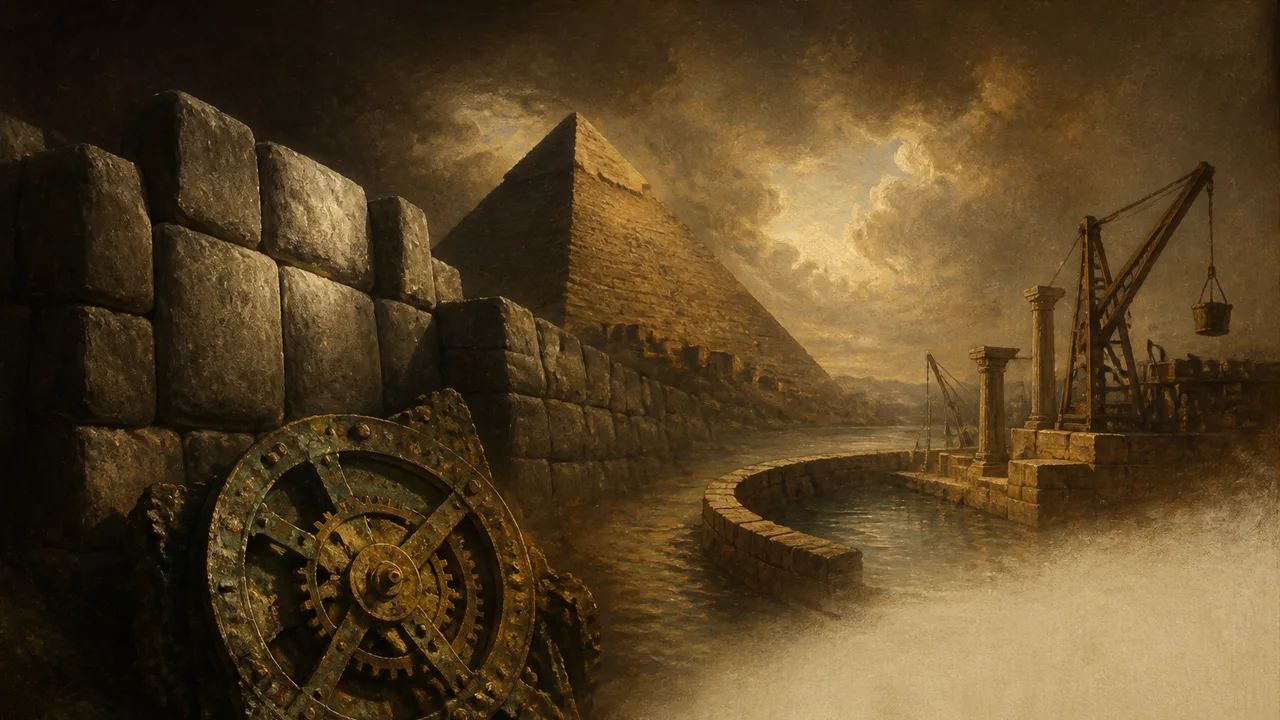
Photo: AI. Henrik Solberg
There is a particular kind of intellectual vertigo that strikes when you stand in front of a wall at Sacsayhuamán and try to work out how it was built. The stones — some exceeding 100 tons — are shaped in irregular, multi-angled polygons that lock together so tightly that, as a recent video from the channel Some Guy Who Knows Stuff puts it, "even a thin blade cannot fit between them." The Inca had no iron tools. No wheeled vehicles. What they had was time, bronze, stone hammers, rope, and an organizational capacity that we have spent the better part of a century trying to understand without fully succeeding.
That gap — between what survives and what we can explain — is the actual subject of the video, even if its framing occasionally gestures toward mystery for mystery's sake. Strip away the dramatic chapter titles and what you have is a genuinely interesting problem in the history of knowledge: human civilizations repeatedly achieved things that, on paper, their available technology should not have allowed. And then, with some regularity, they stopped.
The structures themselves
The catalog of puzzling sites that ancient megastructures researchers keep returning to shares a common profile. Large stones. Precise fits. Long-term structural resilience. And a conspicuous absence of written technical records explaining how any of it was done.
Sacsayhuamán is one entry. Baalbeck in Lebanon is another — arguably more vertiginous. The platform there is built from stones known as the Trilithon, each weighing around 800 tons. In the nearby quarry sits an unfinished block that exceeds 1,000 tons. The video is right to locate the real mystery not in alignment but in movement: "These stones had to be transported from quarries and lifted into position at a height that would be extremely challenging even for modern engineering equipment without cranes designed for extreme loads." Common proposals — sledges, rollers, coordinated labor — run into the basic physics of moving an 800-ton object across uneven ground without a single thing going catastrophically wrong.
At Puma Punku in Bolivia, the puzzle shifts from scale to precision. The blocks there, cut from hard andesite and granite, feature perfectly straight edges, uniform drill holes, and repeating geometric forms that suggest something closer to standardized manufacturing than hand-finishing. The Tiwanaku culture is believed to have worked with bronze tools and stone abrasives — materials that, for granite, are theoretically adequate but practically laborious in ways the finished surfaces don't obviously reflect.
What the video handles well is the structural logic embedded in these choices. The irregular interlocking polygons at Sacsayhuamán are not aesthetic. They are seismic engineering: force distributed across multiple contact points rather than concentrated along straight mortar lines. This is why those walls have absorbed centuries of Andean earthquakes while later, more "sophisticated" colonial construction beside them has cracked and crumbled. The ancient builders knew something, even if we can't name the knowledge.
The knowledge problem
Here is where the conversation gets more interesting than the structures themselves.
In 1901, sponge divers off the Greek island of Antikythera recovered what looked like a corroded lump of bronze from a Roman-era shipwreck. It took decades of analysis — and eventually X-ray imaging — to establish what it actually was: a geared mechanical computer, built over 2,000 years ago, capable of tracking astronomical cycles, predicting eclipses, and modeling the positions of the sun and moon. Its internal gearing is comparable in principle to medieval European clockwork. It predates that clockwork by more than a thousand years.
The Antikythera Mechanism is remarkable not just as an object but as evidence. Ancient texts from the same period describe other mechanical instruments. None have been found. The video draws the reasonable inference: "This raises the possibility that the anti-therra mechanism was not unique, but instead a surviving example of a broader technological tradition that was later lost or interrupted." That inference is well-supported. Heron of Alexandria, writing in roughly the first century CE, described coin-operated holy water dispensers, steam-powered rotating devices, and temple doors that opened automatically via heated-air pressure systems — mechanisms that wouldn't look out of place in an 18th-century automaton collection. Very few physical examples of any of it survive.
The Library of Alexandria is the conventional explanation for why so much ancient technical knowledge disappeared — and the video leans on it, reasonably. What's worth adding is that the Library's decline was not a single catastrophic event but a long institutional erosion: funding cuts, political instability, shifting power, gradual neglect. Knowledge centers fail the way hemlines change — slowly, then all at once. And when they fail, what's lost first is often the most specialized and practical material, the kind that wasn't being read for pleasure but referenced by practitioners who were themselves dying out.
Roman concrete and the limits of the "lost knowledge" frame
The Roman concrete example is the most instructive case in the video because it shows what "lost technology" actually looks like in practice — and why it's rarely as mysterious as the framing suggests.
Opus caementicium, the hydraulic concrete used in Roman harbors, aqueducts, and public buildings, is genuinely remarkable. Structures submerged in seawater for two millennia have not simply survived — they've gotten stronger, as seawater reacts with the volcanic ash (pozzolana) in the mix to form new mineral crystals that reinforce the material from within. Modern Portland cement doesn't do this. It degrades.
The video notes that "ancient texts describe general recipes" but that "exact methods varied depending on local materials." This is the key detail. Roman concrete wasn't a secret formula — it was a regionally adapted practice, embedded in the knowledge of engineers, quarrymen, and laborers who adjusted their mix ratios based on what volcanic material was locally available. When the infrastructure that sustained that professional class collapsed — when the Roman state stopped commissioning giant harbor works — the knowledge didn't get locked in a vault. It simply stopped being practiced, and the practitioners died without training successors.
That's not a mystery. That's how practical knowledge works. The same dynamic explains Polynesian deep-ocean navigation: a system of extraordinary sophistication — star compasses, wave-pattern reading, bird migration routes, cloud formations over invisible islands — transmitted entirely through apprenticeship and oral tradition, across generations of professional navigators. When colonial disruption broke the chain of transmission, the knowledge didn't evaporate; it became partial, fragmentary, harder to use. Modern experimental voyages have demonstrated the method works. What can't be fully recovered is the full depth of the training system that made it routine.
What we're actually arguing about
The video's final section gestures at two competing explanatory frameworks for why geographically separated ancient civilizations produced structurally similar megalithic construction: independent development from shared physical constraints, or knowledge transfer through trade and migration. Both are live hypotheses. Both have supporting evidence. Neither fully accounts for all the sites in question.
What experimental archaeology has established — through attempts to move large stones using historically available materials — is that these structures were physically achievable without invoking anything supernatural or anachronistically advanced. They required, as the video puts it, "extremely long timelines and precise coordination." What they required, in other words, was institutional commitment: states willing to organize and sustain enormous labor forces across years or decades, with the planning capacity to solve problems incrementally rather than all at once.
The real puzzle isn't capability. It's continuity. Humans figured out interlocking polygonal masonry, precision stone cutting, geared astronomical computers, self-strengthening hydraulic concrete, and open-ocean celestial navigation — and then, under various pressures, stopped. Some of what was lost got reinvented elsewhere, later. Some of it is still being reconstructed from ruins and fragments.
Every standing wall at Sacsayhuamán is both an answer and a question. An answer about what humans can organize themselves to build. A question about what it costs to keep that knowledge alive once the building is done.
More Like This
Unveiling Rome's Gladiator Underworld
Explore the hidden world beneath ancient Rome's arenas, unveiling gladiator training, underground tunnels, and cultural practices.

Jackie Kennedy and Lee Radziwill's Bitter Lifelong Feud
The feud between Jackie Kennedy and her sister Lee ran deeper than jealousy. A look at the betrayals—plural—that made it permanent.
California's Most Remarkable Abandoned Places
From a concrete ship with a dance floor to nuclear missile bunkers beneath a tourist park, California's abandoned places hold stories the state never bothered to tell.

Amsterdam's Gable Stones: History Hiding in Plain Sight
Before street addresses, Amsterdam used carved stone tablets to navigate the city. Fourth Place explores what gable stones reveal about the people history forgot.

The Science and Stories Behind Earth's Fiercest Winds
Explore the science of deadly winds, from hurricanes to tornadoes, and the people dedicated to understanding and surviving them.
A Stonehenge Precursor Found Under a Housing Estate
A 5,000-year-old solar structure found near Stonehenge raises sharp questions about prehistoric astronomy—and how Britain treats unprotected heritage sites.
Qin Shi Huang: Unifier, Tyrant, and Founding Legend
Qin Shi Huang built China's imperial system, standardized its laws, and buried 460 scholars alive. Two millennia later, we still can't agree on what that adds up to.

George Washington: The Man Behind the Monument
From battlefield defeats to a death made worse by his own doctors, Washington's life is more complicated than the marble monument version suggests.