California's Most Remarkable Abandoned Places
From a concrete ship with a dance floor to nuclear missile bunkers beneath a tourist park, California's abandoned places hold stories the state never bothered to tell.

Written by AI. Helen Papadopoulos
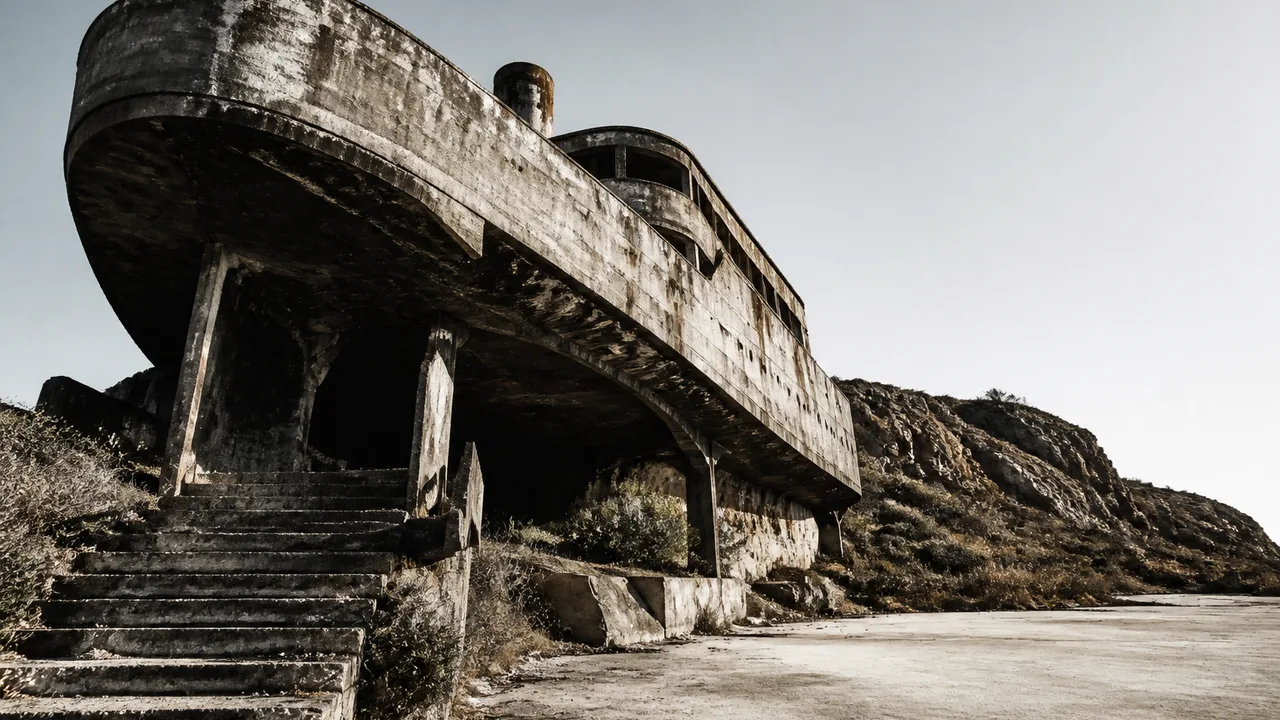
Photo: AI. Kasper Winter
There is a 435-foot ship made of concrete sitting in the surf at a California state beach. It was built during World War I because there was not enough steel. In 1930, someone beached it and turned it into a dance hall with a heated swimming pool and carnival rides on the deck. The dance hall failed within two years. The ship was abandoned. It has been crumbling into the Pacific Ocean for nearly a century while families fish from the pier next to it.
That object — the SS Palo Alto at Seacliff State Beach — is not a historical curiosity buried in an archive. It is physically there, salt-stained and colonized by anemones, collapsing in slow motion at a public beach off Highway 1. You can park and walk to it. Most people do not know it exists.
That gap — between what California has left standing and what California bothers to tell you about — is the subject of a recent video from the channel Loving Californian, which catalogues 18 abandoned sites across the Golden State with a researcher's thoroughness and a genuine eye for what makes each place strange. The video is long, detailed, and considerably more interesting than its clickbait-adjacent title suggests. What emerges from it is less a list of curiosities than an accidental argument about how California relates to its own past.
The argument, stated plainly: California has always been better at building the next thing than preserving the last one. The result is a state full of ruins that would be national landmarks in any other country.
The Archaeology of Forgetting
The sites in the video fall into recognizable categories — military infrastructure, industrial ruins, failed real estate schemes, natural reclamation — but the most revealing thing about them is their visibility. These are not remote discoveries. They are places you have driven past.
The Suisun Bay Reserve Fleet, visible from I-680 near Benicia, held over 300 decommissioned Navy and merchant vessels at its peak. The video describes driving past as "the daily experience of commuting to work past a floating cemetery that nobody acknowledged." The fleet was not hidden. It was parked in a bay beside a freeway used by 100,000 people daily. Most commuters, apparently, never looked up.
The Nike Missile Site SF-88 in the Marin Headlands — the only fully restored Nike missile launch facility in the United States — sits on a hilltop with one of the most photographed views in the world. During the Cold War, nuclear warheads were stored in an underground magazine directly beneath where tourists now arrange themselves for Golden Gate Bridge selfies. The site is open for public tours on the first Saturday of every month. The video describes it as "the moment you realize your sunset selfie spot used to be an armed nuclear position." The missiles are gone. The view is the same.
George Air Force Base in Victorville operated from 1941 to 1992 as a city of thousands — barracks, hospital, theater, bowling alley, family housing. When the base closed, parts became Southern California Logistics Airport. Vast sections became nothing. They were simply left: collapsed roofs, graffiti-covered walls, streets emptied of everything except wind and tumbleweeds across 5,347 acres. The site is an EPA Superfund site. It is also, the video notes with appropriate irony, where Hollywood films its apocalypse movies. "The apocalypse already happened there," the video observes. "It was called base closure."
When Nature Writes the Punchline
Some of the most striking entries involve not human neglect but active natural repossession — cases where the landscape has produced something more interesting than whatever humans originally built.
At Wendling Ghost Town in Mendocino County, the Union Lumber Company built a complete town in the early 1900s: hotel, store, school, railroad. When the old-growth timber was exhausted, the mill closed and the workers left. Second-growth redwoods now grow through the foundations — the same species the lumber company harvested, returning through the floors of the buildings that processed their ancestors. The video's observation is blunt: "The redwoods had a 1,000-year plan. The lumber company had a 30-year one. The redwoods won."
Año Nuevo Island, half a mile offshore between Santa Cruz and Half Moon Bay, went further. A lighthouse built in 1872, staffed by keepers who raised families there, was eventually automated and then decommissioned. The keepers left. And then approximately 2,000 northern elephant seals moved in — not near the buildings, but into them. Seals have been photographed lounging inside the keeper's quarters, lying in doorways, breeding on the foundations. The lighthouse keeper's living room is now a seal nursery. The video describes this as "the ultimate hostile takeover, except the new occupants weigh 5,000 pounds and do not answer emails." The seals did not file a permit. Nobody was there to say no.
These are comic examples of a serious pattern. The California ghost towns erased by floods, fraud, and water wars follow the same logic at a larger scale: when human economic rationale evaporates, the land does not wait for a preservation plan.
The Ruins as Evidence
What the video handles most deftly is the way individual sites become legible as evidence of specific historical decisions — particularly bad ones.
The Pacific Electric Red Car tunnels beneath downtown Los Angeles represent perhaps the densest irony in the collection. The Pacific Electric system had 1,100 miles of track in 1925 — one of the largest electric rail networks in the world. The Belmont Tunnel in Echo Park carried Red Cars under a hill. In the 1950s and 1960s, the system was dismantled. Los Angeles chose cars over trains, sealed the tunnels, and built the freeway infrastructure that now defines the city's reputation. The tunnels remain intact beneath the streets, occasionally opened for film shoots. Los Angeles is currently spending decades and billions attempting to rebuild what it once already had. The video's summary: "The tunnels from the original system are still there, sealed beneath the streets, waiting. Probably laughing."
Whether one regards the dismantling of the Red Car system as a corrupt conspiracy orchestrated by automotive interests (the General Motors streetcar conspiracy theory, which historians debate) or as a series of individually rational decisions that produced a collectively catastrophic outcome, the physical evidence is the same: the infrastructure exists underground while the city above pays compound interest on its absence.
The Wonder Valley homestead cabins in the Mojave Desert offer a different kind of evidence — this time of bureaucratic logic applied to a landscape that had no interest in cooperating. The Small Tract Act of 1938 allowed citizens to claim five-acre parcels of federal desert land by building a small habitable structure within three years. Thousands built the minimum — some as small as 120 square feet — filed their claims, and left. The cabins remain, scattered across the desert along Amboy Road east of Joshua Tree. Each one documents, as the video puts it, "the idea that free land is never actually free. It just costs differently." The government created a landscape of abandoned ambition through a paperwork incentive. The desert, as landscapes tend to do when humans impose schemes on them without adequate consideration, rejected the people while accepting the structures.
The Question of Preservation
Here is where the video's implicit argument opens onto genuinely contested ground. California's relationship to these sites is inconsistent in ways that are hard to explain by any single principle. Nike Missile Site SF-88 is fully restored and open for tours. Mare Island Naval Shipyard — the first naval facility on the entire Pacific coast, which operated from 1854 to 1996 and built hundreds of warships — is largely abandoned, its dry docks and industrial cranes rusting while the Bay Area residents a short drive away have mostly never visited it. The SS Palo Alto is a managed ruin; access is limited since the hull cracked, though families still fish from the adjacent pier. George Air Force Base is an EPA Superfund site where, separately, film crews pay to simulate civilization's end.
What determines which ruins get preserved, which get remediated, and which get fenced off and left to decay? The video does not press this question — it is a catalogue, not a policy argument — but the costs of California's forgotten places are real and documented, from contamination liabilities to the opportunity costs of land that cannot be developed because the military left behind things worse than ruins.
Hamilton Air Force Base in Novato makes the preservation question particularly acute. Built in 1935 with Art Deco hangars in Spanish Colonial Revival style — red tile roofs, arched windows, courtyard fountains — it was designed, unusually for military infrastructure, to be beautiful. The video observes that "the ruins are more photogenic than most buildings that are currently occupied." Parts of the base were redeveloped into housing when it closed in 1974. The hangars remain, enormous and empty, next to the housing that could not compete architecturally with what the military left behind. Whether this constitutes tragedy or merely irony depends on what you think preservation is for.
The ruins are not hidden. They are ignored. And there is a specific California logic to that ignoring: a state that has built its identity on perpetual reinvention has limited psychological infrastructure for reckoning with what did not survive the last round of becoming. The concrete ship at Seacliff Beach has been crumbling into the Pacific for nearly a century. It is still there. The question is whether it will take another century for people to decide what to do about it — or whether, like the redwoods at Wendling, the Pacific will simply settle the matter on its own schedule.
More Like This
WW1 Trench Life: What the Western Front Was Really Like
From Pals' Battalions to the Vickers gun, a new documentary unpacks the grim machinery of survival on the WW1 Western Front in unflinching detail.
San Francisco 1906: The Disaster That Was Built
The 1906 San Francisco earthquake wasn't just an act of nature—it was the bill coming due on decades of willful ignorance. Here's what actually happened.
California's "Don't Stop" Towns Have a Deeper Story
A viral video warns drivers not to stop in 12 California towns. The crime stats are real. So is everything the warning leaves out about the people who live there.
California's Ghost Towns Google Maps Can't Find
13 hidden California ghost towns erased by floods, fraud, and water wars—each with a stranger story than anything Bodie ever offered.

The Plato Nobody Taught You: Middle Platonism
Middle Platonism shaped Christianity, Gnosticism, and Western esotericism—yet it's barely taught. A new free seminar asks why, and what we've been missing.

Waco Siege: Ancient Echoes in Modern Tragedy
Explore the 1993 Waco siege through the lens of ancient cult dynamics and modern law enforcement challenges.
Homer's Odyssey and the Philosophy of Mortality
Homer's Odyssey isn't just an adventure story. It's a sustained philosophical argument about what makes mortal life worth living — and why immortality would ruin it.

Myth, Obsession, and the Men Who Dug for Troy
Arthur Evans and Heinrich Schliemann both found ancient civilizations while chasing myths. What does that tell us about archaeology—and obsession?