The Plato Nobody Taught You: Middle Platonism
Middle Platonism shaped Christianity, Gnosticism, and Western esotericism—yet it's barely taught. A new free seminar asks why, and what we've been missing.

Written by AI. Helen Papadopoulos
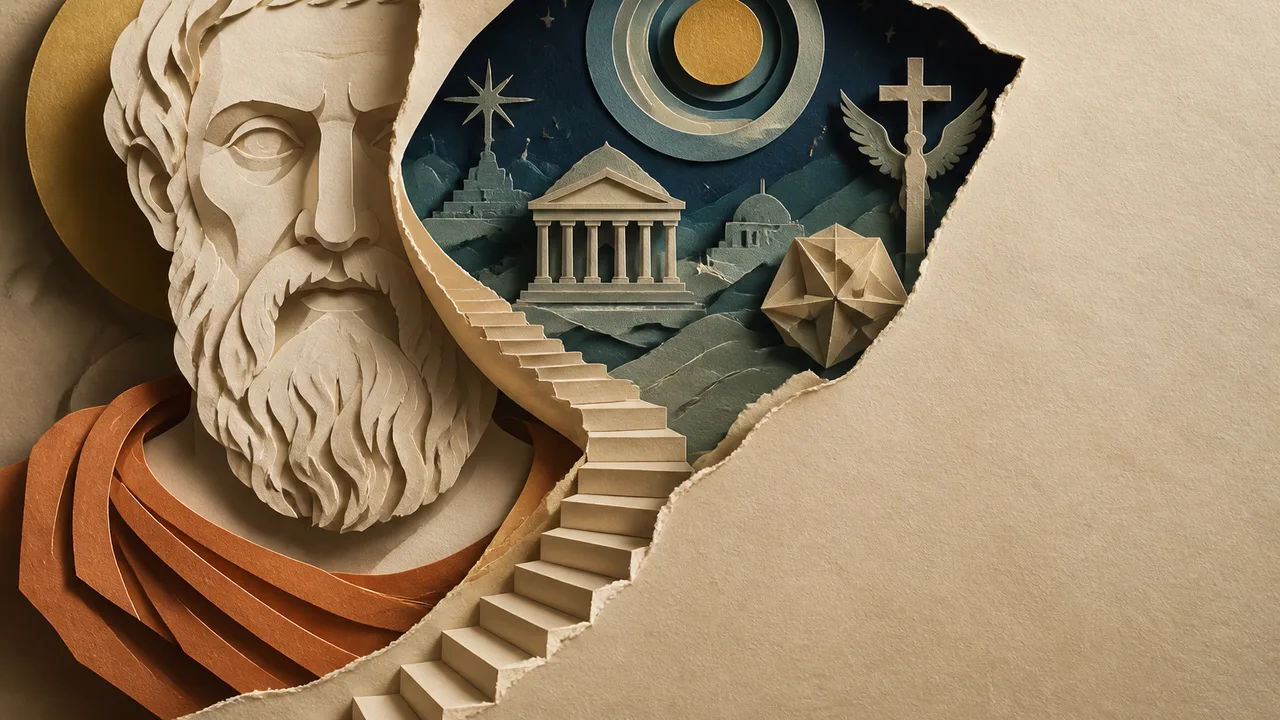
Photo: AI. Lila Bencher
Alfred North Whitehead's famous line — that European philosophy is "a series of footnotes to Plato" — gets repeated so often it has stopped provoking thought and started producing it in a kind of philosophical autopilot. Dr. Justin Sledge, in the opening lecture of his new free seminar Being and Logos: An Introduction to Middle Platonism on the YouTube channel ESOTERICA, wants to restore the provocation. His question is pointed: footnotes to which Plato, exactly?
It's a better question than it sounds. The Plato most of us know — the man of the Republic, the Theory of Forms, the Allegory of the Cave — may be the exoteric Plato. The public-facing Plato. The one designed, according to Sledge's reading of the evidence, for general consumption. The actual teachings of the Academy, the ones that shaped every major intellectual movement between 100 BCE and 200 CE — Hermeticism, Gnosticism, early Christianity, Hellenistic astrology and magic, Alexandrian Judaism — those may have come from somewhere quite different. From what Aristotle, in the Physics and Metaphysics, calls the agrapha dogmata: the unwritten doctrines.
This is the terrain Sledge is mapping, and it is genuinely strange territory.
The Gap We Don't Talk About
Middle Platonism — roughly 100 BCE to 200 CE — sits in a historiographical dead zone. Neoplatonism, which follows it, gets the mysticism crowd. The Old Academy gets the classicists. Middle Platonism gets neither, and Sledge argues this neglect is not accidental. The period is so thoroughly entangled with what scholar Wouter Hanegraaff has called the "Platonic underworld" — alchemy, demonology, theurgic ritual, Hermetic cosmology — that academic philosophy has historically preferred to look away. The result is a significant gap in the intellectual genealogy of Western thought.
The practical stakes are considerable. If you want to understand why early Christian thinkers like Origen wrote the way they did, why the Gnostic Timaeus-inflected mythology of a bungling Demiurge felt philosophically coherent to its authors, why the Hermetic corpus assumes a cosmos structured the way it does — you need Middle Platonism. Neoplatonism, which tends to get the credit, doesn't even emerge until the third century CE. Most of the religious and esoteric movements scholars associate with it were already formed, shaped by the philosophical milieu that Middle Platonism created. The causality runs backward from how it is usually told.
Sledge's seminar is offered free, crowdfunded through Patreon, and explicitly framed as an experiment in accessible university-level education. The pedagogical move is itself a statement: this material should not remain confined to specialists.
Was Plato a Platonist?
The provocation Sledge returns to throughout the lecture is whether the dialogues we all read actually represent what Plato believed. The evidence he marshals is cumulative and genuinely unsettling to those with a tidy picture of the tradition.
First: Plato's own Seventh Letter (disputed in authenticity, though Sledge finds the stylometric evidence broadly persuasive) argues that true metaphysical knowledge cannot be written down. Not merely that writing is a poor medium — that any written metaphysics is inherently wrong, because knowledge of a thing's pure being transcends both discursive analysis and sensory perception. There is a "fifth" mode of knowing, nameless in the letter, which arrives only in flashes — what Sledge describes as "a bolt of gnostic bliss." The Phaedrus says something structurally similar: that real truth comes only through mania, through inspired states that Western philosophy has quietly bracketed as embarrassments.
Second: the Seventh Letter's epistemological hierarchy — sense perception, belief (doxa), discursive knowledge (episteme), direct apprehension (nous) — matches with striking precision what Aristotle reports as Plato's esoteric first principles. This convergence, Sledge argues, is not coincidental.
Third: Speusippus, Plato's own nephew and the first scholarch of the Academy after 347 BCE, simply rejected the Theory of Forms. Not quietly — he found it either useless or redundant. This is the man who sat at Plato's feet and inherited his school. If the Forms were Platonism, the first Platonist after Plato didn't believe in Platonism. Something is clearly wrong with the conventional account.
The Unwritten Doctrines and Their Problem
The agrapha dogmata — the phrase is Aristotle's — refers to teachings that Plato apparently gave in the Academy but never committed to writing. What Aristotle reports in his Physics and Metaphysics is a system that looks nothing like the dialogues and a great deal like Pythagoreanism: two fundamental principles, the One and the Indefinite Dyad (what Aristotle says Plato called "the Great and the Small"), from which formal numbers emerge, then geometry, then the physical cosmos. The One is a limiting principle; the Dyad is the principle of extension, variation, magnitude. Together they generate the conditions for both individuation and change — which is precisely the problem Heraclitus and Parmenides bequeathed to Plato, and which the Forms alone never quite solved.
The hierarchy runs: from the One and the Dyad come formal numbers; from formal numbers come the geometrical primitives (point, line, plane, solid); from geometry comes the cosmos. This is why Plato's famous public lecture on the Good was, by contemporary report, a lecture on mathematics. Not evasion. Logical consequence.
"There is no Platonism," Sledge says. "There is only Pythagoreanism. That seems to be perhaps an argument that can be made."
It's a provocative claim, and he's aware of it. The evidence is genuinely fragmentary: Aristotle is a hostile witness, a rival who spent thirty years in the Academy and had every reason to misrepresent his teacher. And yet, Sledge points out, when later Platonists defend these doctrines against Aristotle, they never say he invented them. They argue about their interpretation — not their attribution. The doctrine, they seem to agree, was Plato's.
What Aristotle Built on What He Wouldn't Admit
The axiological corollary is equally disruptive. The Nicomachean Ethics, Aristotle's great treatise on the good life as navigation between extremes, the doctrine of the mean — this, Sledge argues, is simply Plato's Academy ethics, repackaged without attribution. If the One and the Dyad produce the cosmos by limiting the great and the small, and if the human soul is a microcosm of that cosmic process (as the unwritten doctrines suggest), then ethics is the practice of the same operation at the human scale: limit excess, avoid deficiency, sail through the middle.
"We should not say that Aristotle's theories of ethics was this," Sledge says. "We should simply say this was what Plato taught in the academy and Aristotle simply took it over."
The same axiological theory appears in Speusippus, Xenocrates, and Polemon — Plato's immediate heirs. Aristotle gets the credit because the hidden doctrines remained hidden. The apple, as Sledge puts it, did not fall far from the tree. We just stopped looking at the tree.
The Mosaic in the Corner
There is a famous mosaic, recovered from Pompeii, which depicts what appears to be the Academy in session. Plato sits at the center, looking down at a celestial sphere in a posture Sledge reads as deliberately demiurgic — the philosopher imitating the cosmic craftsman of the Timaeus. To his left, his successors. And in the corner, back turned, still clutching his scroll, one foot already out the door: Aristotle.
The ancient representation is almost too clean — the loyal heirs discussing the master's lecture, and the brilliant dissenter who spent three decades inside the institution and left to found a rival school that would spend centuries arguing with a Plato he never quite admitted teaching him everything he knew.
Middle Platonism is the history of those who stayed. The figures of the Old Academy — Speusippus, Xenocrates, Polemon — are Sledge's next subject, followed eventually by Antiochus of Ascalon, who will be, in Sledge's account, the first person to say unambiguously: I am a Platonist, these are the doctrines, now argue with me.
Whether Western philosophy has been writing footnotes to the real Plato, or to an elegant public performance designed to keep the metaphysics out of reach of the hoi polloi, is not a question Sledge settles in one lecture. He might not settle it in any number of them. But it is the kind of question that, once asked properly, makes the history of thought look considerably stranger — and considerably more interesting — than it did before.
More Like This
Middle Platonism's Hidden Role in Western Esotericism
ESOTERICA's new crowdfunded seminar argues Middle Platonism built the foundations of Hermeticism, Gnosticism, and early Christian theology. Here's what that means.

LIDAR Is Rewriting What We Know of Ancient Cities
Anthropologist Luke Caverns is planning the largest LIDAR scan ever done in the Amazon. What the technology finds may force a rewrite of ancient history.
WW1 Trench Life: What the Western Front Was Really Like
From Pals' Battalions to the Vickers gun, a new documentary unpacks the grim machinery of survival on the WW1 Western Front in unflinching detail.
MLK: The Ancient Echoes of Justice and Leadership
Explore MLK's legacy through ancient lenses of justice and leadership. Discover unexpected connections.

Did Rome's Elite Destroy It From Within?
A viral video argues Rome was "auctioned off" by its ruling class. The history is real—but the argument deserves a harder look than it gets.

Your Intuitions Are Built for the Wrong Universe
Astrophysicist Hakeem Oluseyi explains quantum fields, spacetime, and why the mental models we rely on daily are macroscopic approximations of a stranger reality.
Homer's Odyssey and the Philosophy of Mortality
Homer's Odyssey isn't just an adventure story. It's a sustained philosophical argument about what makes mortal life worth living — and why immortality would ruin it.
Myth, Obsession, and the Men Who Dug for Troy
Arthur Evans and Heinrich Schliemann both found ancient civilizations while chasing myths. What does that tell us about archaeology—and obsession?