A Stonehenge Precursor Found Under a Housing Estate
A 5,000-year-old solar structure found near Stonehenge raises sharp questions about prehistoric astronomy—and how Britain treats unprotected heritage sites.

Written by AI. Fatima Al-Hassan
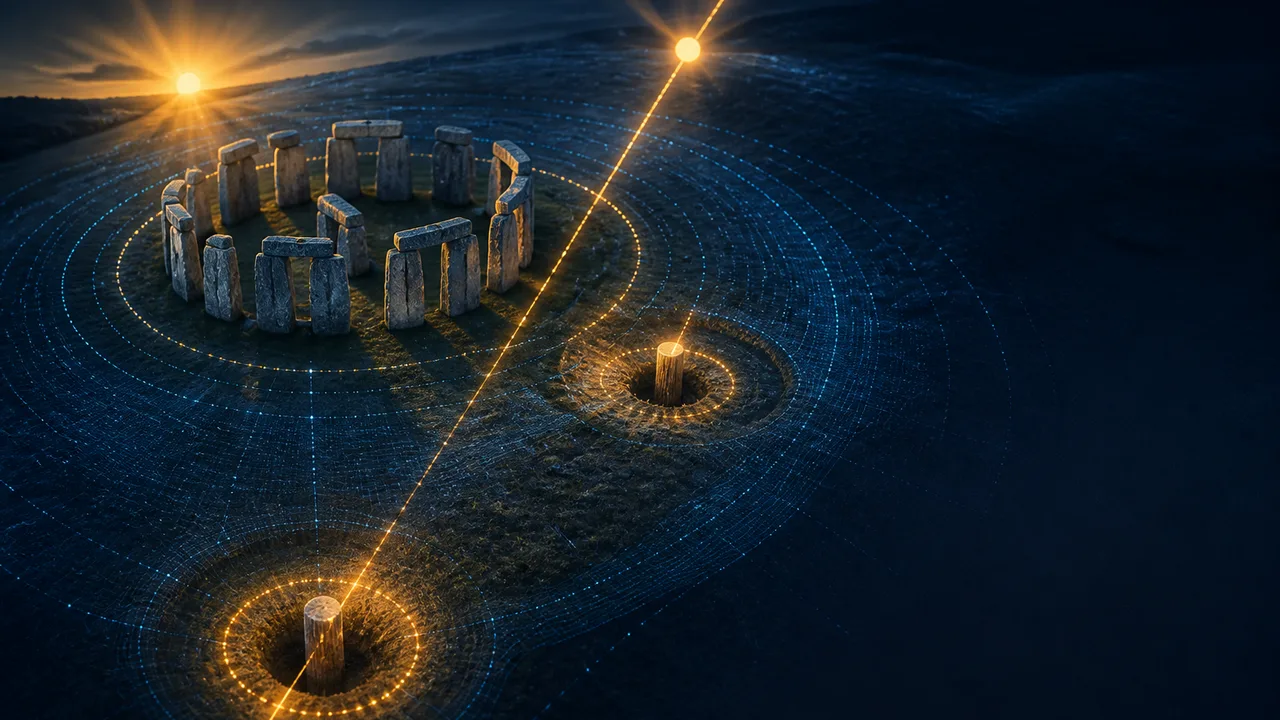
Photo: AI. Dante Nwosu
Two holes in the ground. That's what's left of what archaeologists are calling a potential precursor to Stonehenge — a 5,000-year-old structure in the village of Bulford, roughly three miles from the famous monument, whose wooden posts appear to have been precisely oriented toward the summer solstice sunrise and winter solstice sunset. Archaeologist Phil Harding, who discovered the site, describes connecting the two post pits with a pencil and ruler and realising the line was exactly parallel to Stonehenge's own solstitial alignment. "Then, the alignment is exactly exactly right," he says in BBC News's reporting on the find.
That double "exactly" is doing work. It signals the kind of precision that separates a compelling hypothesis from a confirmed finding. And it's worth sitting with, because the evidentiary picture here is more nuanced than the headline "Stonehenge prototype discovered" implies.
What we actually know — and what we're inferring
The Bulford post pits were first excavated a decade ago. What's new is the astronomical confirmation: researchers have now reconstructed the ancient sky using computational models of how stellar and solar positions shift over millennia, and determined that 5,000 years ago, the sight-line between the two pits would have captured summer solstice sunrise at one end and winter solstice sunset at the other.
The artifacts recovered at the site — now stored at Wessex Archaeology's conservation lab — include decorated pottery, flint tools, animal bone, and an antler likely used as a digging tool for the post pits themselves. These have helped date the site. A disc-shaped flint knife drew particular attention; its maker's workmanship prompted one researcher to speculate, carefully, that "maybe that discoidal shape is some sort of reference to the sun. Who knows?" That last phrase is the right epistemic register. The knife is beautiful. Its solar symbolism is possible. It is not established.
The wooden posts themselves are long gone — wood rots. Estimates suggest they stood between two and four metres high, though this range is inferred from the dimensions of the pits rather than direct evidence, and the methodology behind that inference hasn't been made public in the available reporting. The 120-metre span between pits is stated as fact in the BBC coverage; what isn't quantified is whether that specific distance carries independent significance for the alignment, or whether the pits are meaningful purely as directional markers. That's not a pedantic distinction — it matters for understanding how deliberately the structure was engineered versus how much is pattern-recognition applied retrospectively.
On the question of Stonehenge's own timeline: the monument wasn't built in one go. Construction unfolded across multiple phases between roughly 3000 BCE and 1500 BCE. The iconic sarsen stone circle — the one most people picture — dates to approximately 2500 BCE, which is where the "4,500 years ago" figure comes from. But Stonehenge's earliest phase is closer to 5,000 years old, which complicates the framing of Bulford as a "500-year precursor." The two sites may not be separated by quite the clean interval the headline implies. The comparison is still meaningful; it just requires more precision than a single number can carry.
One interpretation of Stonehenge — that it functioned as a site of healing pilgrimage, drawing the sick and injured from across Britain — draws on excavation work by Geoffrey Wainwright and Timothy Darvill and has received significant academic attention. It remains contested, however, and sits alongside other serious interpretations: a monument to the dead, a site of seasonal feasting, an astronomical instrument with ritual significance. The Bulford discovery doesn't resolve that debate. It does add texture to the agricultural and cosmological dimension — early farmers tracking the light's return in winter, building something simple first, iterating toward something monumental.
The thing buried under someone's garden
Here's the detail I can't move past: one of the two post pits is believed to lie beneath a current resident's backyard. The site is now a housing estate, built for army families. The archaeology is "all on the ground," as Harding puts it — meaning below the surface, inaccessible, partially built over.
The pits were found ten years ago. The astronomical significance has only now been confirmed. That gap raises a question no one in the BBC coverage asks directly: what heritage assessment, if any, was conducted before the housing estate was built? In England, developers are required under the National Planning Policy Framework to assess and, where possible, preserve archaeological remains. Whether that process happened at Bulford, what it concluded, and who signed off on building over the site — these are public record questions that the current coverage doesn't answer.
I'm not arguing the development was necessarily wrong; housing estates on military land serve real needs, and not every scrap of prehistoric ground can be preserved in perpetuity. But the framing that treats this as simply poignant — "the other one would be 120 m that way, which is probably now in someone's backyard" — sidesteps the institutional question. We protect Stonehenge because it's famous. We protect famous sites because they're already known. The Bulford site wasn't famous when the diggers moved in. That's exactly the problem. Sites get famous after they've been assessed, reported on, and given cultural weight. The ones we lose are the ones we haven't recognized yet. Who bears responsibility for that recognition gap — and who bore it in Bulford, specifically — is a question worth asking.
This impulse was not invented in Wiltshire
Something else the coverage elides: the human drive to mark the solstice in built form is not a British innovation, and treating Bulford as a "prototype for Stonehenge" risks collapsing a global conversation into a local one.
Göbekli Tepe in what is now southeastern Turkey — dated to roughly 9500 BCE, more than four millennia before Bulford — includes structures whose astronomical orientations have been studied extensively, though interpretation remains active and debated. The Mnajdra temple complex in Malta, circa 3600 BCE, aligns with both equinoxes and solstices. Wurdi Youang, a stone arrangement in Victoria, Australia, created by the Wathaurong people, is potentially among the oldest astronomical observatories in the world, with alignments to the solstices and equinoxes that some researchers date to more than 10,000 years ago — though dating methods for this site remain a subject of scholarly discussion.
These aren't footnotes. They're evidence that agricultural and semi-nomadic peoples across multiple continents were independently solving the same problem: how do you mark the moment the light turns, reliably, in stone and wood, so that the community can organize itself around it? The answer was, apparently, with considerable sophistication — and often long before the British Isles were in the picture.
This matters for how we read Bulford. If the site is a precursor to Stonehenge, that's a compelling local story about iteration and ambition. But if it's one more data point in a global pattern of prehistoric astronomical practice, the story is about something larger: the universality of the impulse to look up, to record what you see, and to build something that outlasts you. Those are not identical framings. The first makes Stonehenge the destination. The second asks what it means that humans kept arriving at the same destination, from different starting points, across every inhabited continent.
What Harding's career-best find actually tells us
Phil Harding calls this the best discovery of his long career — and he's precise about why. "Two post pits tell me more about the people 5,000 years ago," he says. "This tells me about the whole community. This tells me about how they were thinking, how they were behaving, how they were revering the heavens."
What he's describing isn't the discovery of an object. It's the recovery of a social act: people gathered at Bulford, we know this from the pottery and animal bone, probably across multiple seasons. They dug pits for posts. They oriented those posts toward the light at its most extreme moments of the year. Then, or their descendants, went three miles east and did it again — in stone, at a scale that required organised labour across generations.
Who governed that labour is genuinely unknown. The social structures that mobilised Neolithic communities to quarry, transport, and erect multi-tonne standing stones are debated among archaeologists — whether they reflect hierarchy, collective decision-making, or something we don't have a clean modern concept for. The Bulford gathering evidence doesn't settle that question, but it does push it earlier and make it more interesting. Something was being organized here — repeatedly, ritually, across centuries. That's not a small observation.
The housing estate, sitting on top of one chapter of that story, is not an accident. It's a policy outcome. And the fact that we're only now confirming what was there — a decade after the pits were found, some of them under tarmac and turf — is a reminder that heritage protection in Britain, as elsewhere, is better at guarding what's already famous than at recognizing what hasn't been famous yet.
The solstice doesn't care about our filing systems. Five thousand years ago, the sun rose over Bulford in exactly the line that Harding drew with his pencil and ruler. Someone built something to mark that. We built a housing estate over it. What we choose to protect, and what we choose to pave, is not a technical question. It's a values question. And right now, the answers are mostly buried.
More Like This
Bodmin Moor's Bronze Age Village and Its Neolithic Cairn
Archaeologists confirm a Bronze Age village on Bodmin Moor—and find a 6,000-year-old cairn that may have outlasted the community that built it.

UK Doctors Say Social Media Harms Kids. Now What?
UK's top doctors say social media harms kids like smoking harmed adults. Here's what that actually means for schools, clinics, and parents right now.

NASA Names Artemis III Crew for 2027 Moon Mission
NASA has named the four-person crew for Artemis III, a complex multi-launch test mission targeting 2027 that will rehearse docking with both Blue Origin and SpaceX landers in low Earth orbit.

Pavlopetri: Inside the World's Oldest Sunken City
A Bronze Age city has sat submerged off southern Greece for 3,500 years. New technology is finally letting archaeologists read what it says about us.

Stonehenge: What Archaeology Can't Tell Us
Archaeologists know how Stonehenge was built—barely. Why it was built remains genuinely, stubbornly unknown. Here's what the evidence actually says.

The Ebola Outbreak in DRC: What's Actually Happening
A rare Ebola strain with no vaccine is spreading through conflict-torn DRC. Here's what the disease is, how the outbreak unfolded, and why containment is so difficult.

Destiny 2 Ends: A Community Bungie Built and Switched Off
Bungie ends Destiny 2 content updates in June. Three creators reflect on careers, community, and what happens when a corporation owns your third place.

War, Visas, and the 2026 World Cup's Political Storm
Iran plays in the US while at war with it. Haiti fans can't get visas. ICE will be at stadiums. The 2026 World Cup's politics are already extraordinary.