Hagia Sophia's Race Against the Next Earthquake
Istanbul's 1,500-year-old Hagia Sophia is undergoing its most urgent restoration yet. Here's what's at stake—structurally, culturally, and politically.

Written by AI. David Oyelaran
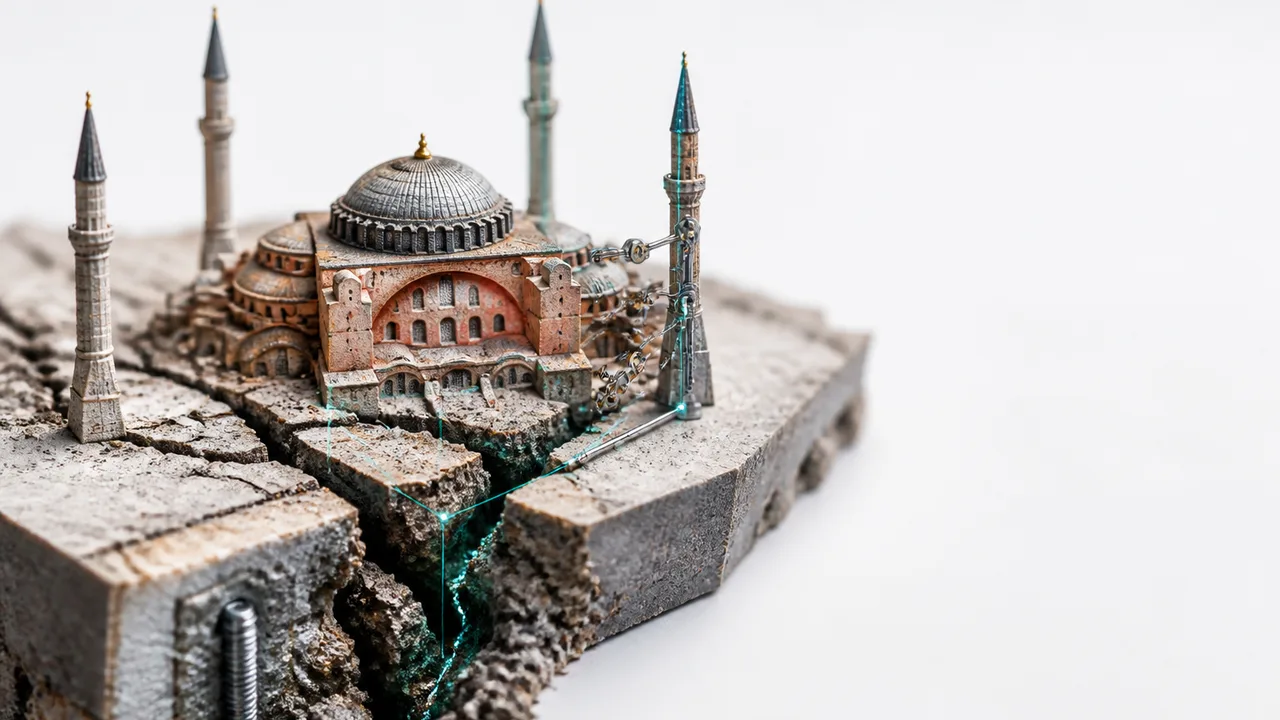
Photo: AI. Pippa Whitfield
There is a particular kind of vertigo that comes from standing inside a building that was already ancient when the Vikings were young. The Hagia Sophia completed in 537 AD predates Angkor Wat, the Tower of London, the Notre-Dame de Paris. Empires rose around it, converted it, claimed it, lost it. Fifteen centuries of that — wars, fires, looting, and the slow patient violence of earthquakes — have left their mark in ways that are only now becoming fully legible.
Today, the Hagia Sophia is wrapped in scaffolding so extensive that first-time visitors standing outside might genuinely wonder whether there's a building in there at all. There is. And the question the restoration team is racing to answer is whether it will still be there after the next major earthquake — not if one comes, but when.
"We know sooner or later it will happen," one of the engineers working on the project told The B1M in a recent documentary. "That's why many institutions, governments, and ministries are preparing for the earthquake."
That is not fatalism. That is engineering.
What the Dome Has Been Hiding
When the current restoration team first got access to the dome, they did something the structure hadn't experienced in centuries: they opened 24 symmetrical inspection spaces and looked inside. What they found was a record of improvisation — layers from different centuries that don't quite meet each other, gaps filled with soil and wooden beams to maintain the dome's rounded appearance, extra mass accumulated from successive repairs to successive collapses.
The dome you see today has been there since roughly the 15th century. Before that, it had collapsed in 558 AD — just over twenty years after completion — and suffered partial collapses again in the 10th and 14th centuries. Each time, it was repaired. Each time, the repairs added weight. The dome is now heavier than it should be, and heavier means more vulnerable when the ground starts to move.
One of the restoration's primary goals is to remove that accumulated load. The team is also replacing damaged lead coverings on the main and semi-domes — work that requires opening parts of the roof, which is precisely why a large steel shroud now encases the dome from the outside, protecting centuries of interior mosaics from a single hour of rain.
"A rain of half an hour can damage not only the dome itself," an engineer explained. "We also need to preserve the mosaics beneath it. So we had to be very careful."
That level of care extends to the floor. To bring in the heavy machinery needed for the restoration, trucks and cranes were driven inside the building for the first time ever — onto a surface that was laid centuries before the internal combustion engine existed. The team spent months beforehand testing soil, commissioning radar scans, running load calculations, and constructing a multi-layered temporary platform: membranes, wooden floors, concrete ten centimetres thick. When the truck finally drove in, all those calculations became real in a way that no simulation can fully prepare you for.
The Hammering Problem
The most technically urgent issue the restoration must address is something engineers call the "hammering case." The main dome and the semi-domes that flank it to the east and west were built at different times and are not properly connected. In a major earthquake, they move independently — and the semi-domes, which were designed to support the central dome, could instead strike against it, causing the very damage they were built to prevent.
The restoration intends to connect these weak points, forcing the domes to work as a unified structure rather than as individual components that happen to be adjacent. The specific engineering details are still being worked out — the project is in its early stages — but the principle is clear: what was built in pieces must now be made to act as a whole.
This is not a small ambition. The original architects did not design for modern seismic standards because modern seismic standards didn't exist. They were working without knowledge of the fault zones beneath them — and yet what they built has survived this long partly through structural ingenuity. The pendentive, the curved triangular segment that allows a circular dome to sit on a square base, was invented here. The system of semi-domes, buttresses, arches, and piers that channels the dome's enormous lateral thrust downward into the foundations — all of it was improvised under a five-year deadline by an emperor who reportedly compared himself to Solomon upon completion.
"Justin tried to show his power to the public," an expert notes in the documentary. "It's all politics, you know, as today."
The politics have never really left the building.
A Structure That Belongs to Everyone and No One
The 2020 decision by President Erdoğan to reconvert the Hagia Sophia from a museum back into an active mosque reignited a debate that had been simmering since Atatürk made it a museum in 1934. The building had served as a Christian cathedral for roughly nine centuries, a mosque for another five, and a secular museum for eighty-six years in between. The 2020 reversal meant the main floor returned to exclusive use for Islamic worship, with the upper galleries remaining open to non-Muslim visitors.
The reaction was predictably split. Some Turks were unequivocal: "The best and biggest decision ever made for Turkey," one person said on camera. Others were not so sure. "A thousand years it served as a church. Then let's say a thousand years served as a mosque," another observed. "I think it should have stayed as a museum."
What the documentary doesn't fully settle — and what genuinely hasn't been settled — is whether a building that functions as an active mosque can also be preserved and accessed in the way a UNESCO World Heritage Site demands. The restoration is proceeding under the watchful eye of UNESCO, which designated the site as part of the Historic Areas of Istanbul in 1985. The current government is both custodian of the structure and a party with strong ideological interests in its use. That's not unique to Turkey — heritage governance everywhere involves institutions with their own agendas — but here the stakes are unusually high and unusually visible.
The mosaics themselves hold this tension in stone. For centuries under the Ottomans, the Christian iconography was plastered over. Under the museum era, it was uncovered. Today, during prayers, some of it is covered again by curtains. The building's interior is a kind of layered palimpsest — each era writing over the last, nothing ever fully erased.
What Was Found Underground
Underneath all of this — literally — workers excavating the western garden and northern facade uncovered a tunnel network dating to approximately 400 AD, roughly a century before the Hagia Sophia itself was built. The discovery was unexpected. It means the site holds significant ancient structures both above and below ground, and that the restoration team is working within a far larger and more complex archaeological context than the building's footprint suggests.
There is a particular resonance to that image: a 1,600-year-old tunnel discovered in the foundations of a 1,500-year-old building that is itself being reinforced against a future earthquake. Every layer of this project is a conversation between centuries that never spoke to each other directly.
"Whenever I go into Hagia Sophia," one of the engineers said quietly at the end of the documentary, "I feel every inch of the building is precious. It is humankind's heritage. It is the heritage of two very important religions. That's why we have to handle it carefully — very carefully."
The phrase "humankind's heritage" is the kind of language that can slide into abstraction quickly. But in this case it has a precise meaning. The columns inside the Hagia Sophia came from the Temple of Artemis, one of the Seven Wonders of the Ancient World. The red stone in the floor came from Egypt's eastern desert. Marble was shipped from what is now Tunisia and Algeria. Syria contributed the yellow decorative stone. The building was assembled from the known world's most precious materials, brought to one place by the force of an empire that is now itself historical.
What survives is what was built to last — and what has been maintained. The question that sits at the center of the current restoration is whether maintaining it well enough, in time, is still possible.
More Like This

Middle Platonism's Hidden Role in Western Esotericism
ESOTERICA's new crowdfunded seminar argues Middle Platonism built the foundations of Hermeticism, Gnosticism, and early Christian theology. Here's what that means.
San Francisco 1906: The Disaster That Was Built
The 1906 San Francisco earthquake wasn't just an act of nature—it was the bill coming due on decades of willful ignorance. Here's what actually happened.
Pavlopetri: Inside the World's Oldest Sunken City
A Bronze Age city has sat submerged off southern Greece for 3,500 years. New technology is finally letting archaeologists read what it says about us.
How Medieval Castles Were Built to Signal Power
Medieval castles were never just fortresses. A look at how 500 years of castle design reveals architecture as political propaganda, arms race, and identity myth.
Amsterdam's Gable Stones: History Hiding in Plain Sight
Before street addresses, Amsterdam used carved stone tablets to navigate the city. Fourth Place explores what gable stones reveal about the people history forgot.
Did the Minoans Inspire the Atlantis Legend?
Archaeological and geological evidence connects Plato's Atlantis to the Minoan civilization and the catastrophic Bronze Age eruption of Thera (Santorini).

How the KGB Shaped Soviet Russia and Putin's Rise
From Lenin's Cheka to Putin's FSB, the KGB's century-long grip on Russia shaped purges, Cold War espionage, and modern authoritarian politics.
Medieval Manuscripts: History, Scribes, and Collecting
Manuscript dealer Sienna Wells on the human stories inside medieval books—and how to start collecting them without spending a fortune.