Amsterdam's Gable Stones: History Hiding in Plain Sight
Before street addresses, Amsterdam used carved stone tablets to navigate the city. Fourth Place explores what gable stones reveal about the people history forgot.

Written by AI. David Oyelaran
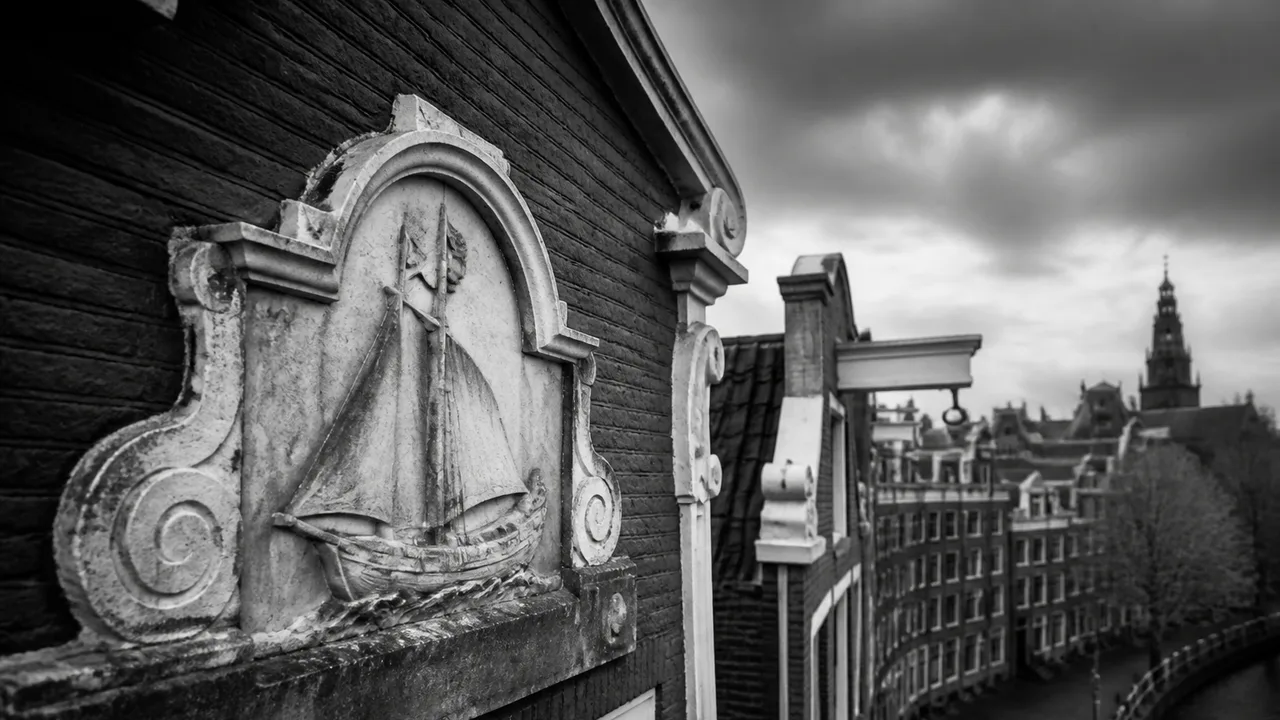
Photo: AI. Atticus Ferenczi
There's a particular kind of archive that doesn't live in a library. It doesn't have a catalog number or a finding aid. It's not climate-controlled. It's built into the front of a building at eye level — or just above it, if you know to look up.
In Amsterdam, these archives are called gable stones: small carved stone tablets embedded into the facades of old buildings, each one a compressed biography of whoever once lived or worked inside. A stork meant a midwife. A barrel meant a pub or a cooper. A rabbit paired with the inscription Das was a visual pun on a homeowner's surname — Das meaning "hare," one of the more common family names in 16th-century Amsterdam. The city's residents navigated by these images the way we navigate by GPS coordinates now: fluently, automatically, without thinking twice about the system underneath.
A recent video by the YouTube channel Fourth Place traces the full arc of Amsterdam's gable stone tradition — from its origins as a fire-prevention byproduct to its near-erasure under Napoleon's brother, to the quieter, more grinding losses of 20th-century urban renewal. It's a ten-minute video about small stone tablets, and it's quietly one of the more compelling pieces of urban history I've come across recently.
Born From Disaster
The gable stone story starts, as so many things in Amsterdam do, with water — or in this case, its absence when it was needed most. During the 15th century, a series of catastrophic fires destroyed roughly three-quarters of the city. The buildings were predominantly wood. The fires did what fires do.
In 1521, Holy Roman Emperor Charles V issued a decree banning new wooden construction and ordering existing wooden structures to be rebuilt in brick. This slow, city-wide transformation became known as "the great rebuilding." And as wooden signs gave way to stone facades, homeowners and merchants needed a new way to mark their properties. Gable stones filled that function — first out of necessity, then out of something more personal.
"A homeowner would commission a stone depicting a symbol or a motto that was meaningful to them," the Fourth Place video explains. "A trade, an animal, a biblical scene, a family name or crest, an important turn of phrase. That image effectively became the property's identifier."
What's worth sitting with here is what that system actually was: a city navigated by collective memory and shared visual vocabulary. Not numbers. Not an abstraction. A baker's stone showed you a baker. A shipbuilder's stone showed you shipbuilding tools. The city communicated in images, and its residents were fluent readers.
Some of the stones that have survived carry a particular wit. A gable stone at a pharmacy depicted a man with his tongue out — not yawning, as the inscription "the eternal yawner" suggested, but taking medicine. The image and the text were deliberately at odds with each other, a small joke mortared into a wall for anyone paying close enough attention. The paper mill stone from 1649 includes a worker on the top floor visibly napping on the job while paper dries around him. Whoever commissioned that stone had opinions about their employees. Or maybe they just had a sense of humor. The stone doesn't say.
The Commoner's Archive
This is where the Fourth Place video makes its sharpest point, and it's one that cuts past architecture straight into the question of whose stories get preserved.
"Go to a museum and you'll be inundated with information and detail about the most well-known figures of the era," the video observes. "Explorers, colonists, captains, kings, and queens. But you'll rarely find any information about the life or the home of a commoner."
Gable stones are — almost uniquely — a record of the middle. The Amsterdam cooper who carved a barrel into his wall. The fisherman in the Jordaan neighborhood who dated his stone 1734 and signed it with a name-pun on De Jonge Visser — the young fisherman. These aren't the people the Rijksmuseum was built to celebrate. Their names don't appear in the histories of the Dutch Golden Age, even though they were the ones running the local economy while the VOC captains got their portraits painted.
It's worth noting the complication that sits inside that framing, though. The Dutch Golden Age — roughly 1588 to 1672 — was also the era of Dutch colonial expansion. The Age of Discovery ran concurrently. Gable stones commissioned during this period sometimes celebrated that history: naval fleets, "exotic" lands and animals, the Amsterdam coat of arms rendered in stone. The everyday Amsterdammer whose house carried one of those stones was also a participant in, and occasionally a beneficiary of, a brutal colonial project. The gable stone as a democratic archive and the gable stone as a record of imperial culture aren't mutually exclusive. They're the same stone.
That tension doesn't diminish the preservation argument. It complicates it productively — which is usually a sign that the history is worth looking at closely.
Napoleon's Accountants
The decline of gable stones as functional infrastructure came from a familiar source: standardization imposed from above.
In the early 19th century, the Dutch Republic became a client state of the French Empire. Amsterdam was absorbed into the Kingdom of Holland, ruled by Louis Bonaparte — Napoleon's brother. With French administration came French bureaucratic logic: a new tax system, a civil registry, a land registry, and eventually a standardized street address system designed by a local professor and mathematician named Jean Henry Van Swinden.
The system was sequential — house numbers tied to specific streets, ordered along a block. It wasn't perfect, and Amsterdam has restructured its addressing several times since. But it did what it was designed to do: it gave the municipal government a legible, trackable grid. The city stopped needing to be read by its residents and started being managed by its administrators.
Gable stones didn't disappear immediately. They became tradition rather than infrastructure — still made, still commissioned, still embedded in facades, but no longer doing the navigational work they once did. That shift from necessity to ornament is its own kind of story about how cities change and what gets left behind when they do.
The Slower Erasure
If Napoleon's address system demoted gable stones, it was the 20th century that came close to finishing the job — and by less dramatic means.
Amsterdam's mid-century urban decay hit working-class neighborhoods like the Jordaan and De Pijp hardest. The 1960s through the 1980s brought slum clearance programs, road expansion projects, highway construction, and public housing development. Buildings in heavy decay were torn down. The stones embedded in their facades went with them. By the time the most destructive projects were scaled back — pushed by community resistance and a shift toward people-centered urban planning — thousands of gable stones had already been lost.
The ones that survived often did so because someone moved fast enough to rescue them. Historians and urban advocates pulled stones from demolition sites and embedded them in new buildings, neighboring walls, or museum exteriors. The Amsterdam Museum and the Rijksmuseum both have exterior walls lined with what the Fourth Place video calls "orphan gablestones" — stones separated from their original buildings, preserved without full context, waiting for someone to look them up.
That effort has been formalized since 1991 by the Association of Friends of Amsterdam Facade Stones, a preservation organization with a name long enough in Dutch that the Fourth Place creator declines to attempt pronouncing it. The association has documented and restored hundreds of gable stones over 35 years and built a publicly accessible database cataloging what remains. Estimates put the surviving count at roughly 2,000 stones still in place across the city.
Two thousand sounds like a lot until you remember that thousands more are already gone — and that the ones still standing have survived fires, French bureaucrats, 20th-century highway planners, and the general indifference of people who didn't know what they were walking past.
That last one might be the most recoverable, at least. "Gablestones are like a combination of some of the most protected pieces of Dutch culture," the video notes — part painting, part sculpture, part building, all of it embedded in the street-level fabric of a living city.
The question worth sitting with isn't whether they're worth preserving. That case makes itself. It's what else might already be on the wall — in whatever city you're in — that you've been walking past without looking up.
More Like This

Middle Platonism's Hidden Role in Western Esotericism
ESOTERICA's new crowdfunded seminar argues Middle Platonism built the foundations of Hermeticism, Gnosticism, and early Christian theology. Here's what that means.

LIDAR Is Rewriting What We Know of Ancient Cities
Anthropologist Luke Caverns is planning the largest LIDAR scan ever done in the Amazon. What the technology finds may force a rewrite of ancient history.
San Francisco 1906: The Disaster That Was Built
The 1906 San Francisco earthquake wasn't just an act of nature—it was the bill coming due on decades of willful ignorance. Here's what actually happened.

The Gods of Pre-Islamic Arabia, In Their Own Words
Ancient desert inscriptions reveal the polytheistic world before Islam—gods, prayers, sacrifice, and fate, recorded by the nomads who lived it.
What Amsterdam Remembers That New York Forgot
A YouTube urbanist's first trip to Amsterdam raises older questions: what does a city actually owe its citizens, and did American cities ever mean to answer them?

How Ancient Athens Actually Invented Democracy
Mass graves, marble lottery machines, and a reformer with divine backing: NOVA's Athens documentary reveals democracy's stranger-than-expected origins.

Homer's Odyssey and What Mortality Means Today
Homer's Odyssey is more than epic adventure — it's a philosophical argument for why a finite life matters, and why immortality might be the real curse.

DNA Names a Revolutionary War Teen Soldier After 245 Years
Genetic genealogy has identified Private John Pumphrey, a Maryland teen who died at the Battle of Camden in 1780 — one of America's oldest John Doe cases.