The Nefertiti Bust's Disputed Past and Present
The Nefertiti bust raises two unresolved questions: is it genuinely ancient, and was it legally taken from Egypt? The evidence on both is more complicated than Berlin admits.

Written by AI. Margaret "Maggie" Holloway
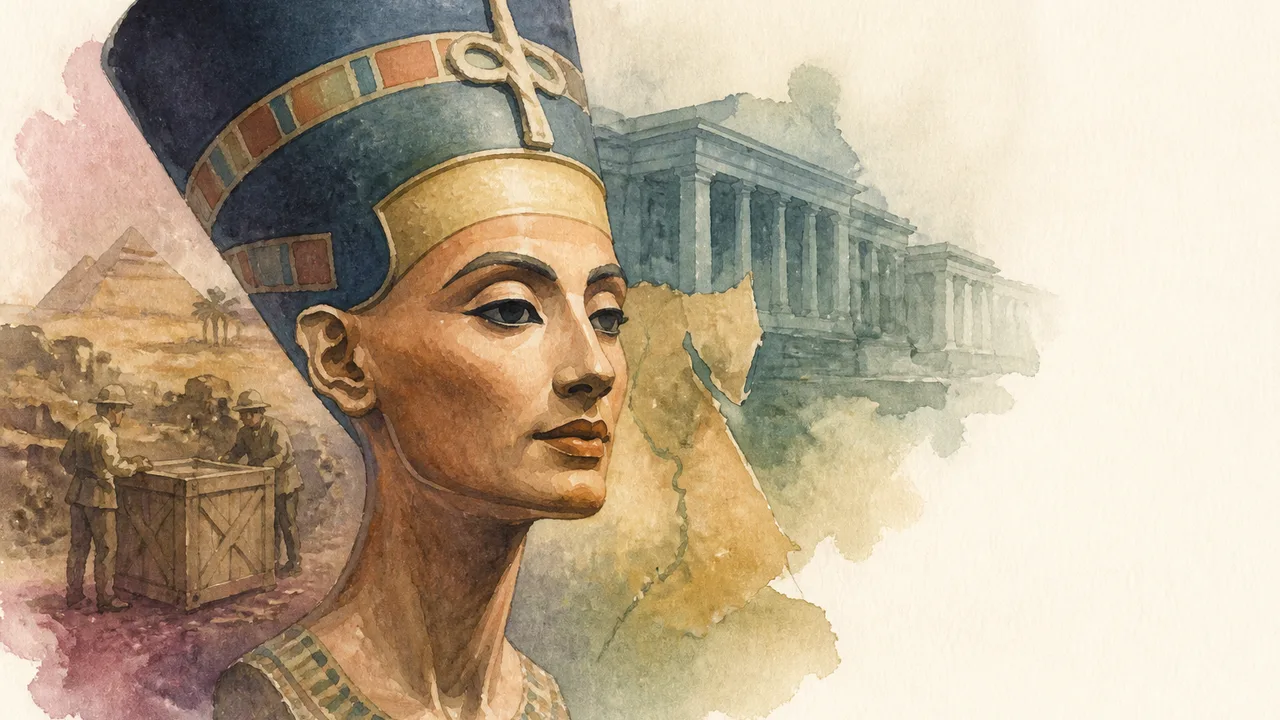
Photo: AI. Júlia Almeida
On the 16th of October, 2009, the Neues Museum in Berlin reopened after years of restoration — and its star attraction arrived with it. The bust of Nefertiti, 50 centimeters tall, painted limestone over plaster, one eye present and one deliberately absent, was carried through the institution with the kind of care reserved for things the world has agreed are irreplaceable. Thousands came to see her. Critics called her Germany's Mona Lisa. Museum director Friederike Seyfried, asked whether the bust could possibly be a fake, gave the answer institutional confidence always gives: "When you stand before the bust, the question never even enters your mind."
It entered someone's mind. It had been entering minds for decades.
A Queen Nobody Quite Knows
Before the controversy, there is the woman herself — and she is, in a foundational way, unknowable. Nefertiti was the principal wife of the 18th dynasty pharaoh Akhenaten, the ruler who abolished Egypt's polytheistic pantheon and imposed a single solar deity, Aten, with himself as its earthly conduit. She was, by every account the historical record allows, central to that project. Images carved into temple walls at Karnak show her and Akhenaten as teenagers — their ages given as 14 on some statuaries — holding hands, depicted in moments of domesticity extraordinary for royal iconography of the period. He kisses her on a royal chariot. She drapes a necklace around his neck.
We know the names of her sisters. We know the name of her nurse. We know nothing about her parents or her origins. She is, as one expert puts it in the documentary, "the queen of Egypt of whom we have the most representations and documents, but also the one of whom we know the least."
After Akhenaten's death, his successors — possibly including a young man named Tutankhamun — systematically erased the couple from history. The capital city they built together at Tell el-Amarna, a purpose-built metropolis of 50,000 people in the middle of the desert, was dismantled brick by brick. Within thirty years, it had returned to sand. The bust of Nefertiti sat somewhere in that sand for thirty-three centuries, in the studio of Thutmose, the royal sculptor.
Or so the story goes.
What Borchardt Found — and What He Did With It
Ludwig Borchardt arrived at Tell el-Amarna in 1906 under explicit pressure. Prussia had lagged behind Britain and France in the colonial scramble for antiquities. Kaiser Wilhelm wanted a trophy. Borchardt, a Berlin-born architect and archaeologist who had already made Egypt his life's work, knew the site better than almost anyone; he had drawn floor plans for the unexcavated southeast sector before he ever broke ground. When he identified the house of Thutmose, Akhenaten's chief sculptor, he understood what he might be standing on top of.
On December 6th, 1912, his team uncovered the bust. It was found, according to Borchardt's own field notes, on a shelf in a corner of the sculptor's studio, just 50 centimeters below the surface. Alongside it, on the floor near the entrance, lay a second bust — of Akhenaten himself, found in several pieces, its face destroyed. Two busts from the same studio, the same dig, the same morning. One shattered. One perfect.
That disparity is where Swiss historian Henri Stierlin planted his flag, after twenty years of investigation. His argument, laid out publicly in 2009, is that the bust of Nefertiti is a sophisticated 20th-century copy — made by Borchardt himself, or at his direction, as an experimental study in ancient Egyptian sculpting and pigment techniques. Stierlin's scenario: Borchardt had authentic source materials on site, period-accurate limestone, period-accurate pigments found in abundance in the studio, and an unfinished but genuine model of Nefertiti also excavated at Tell el-Amarna. What he lacked was the intention to deceive — until a German princely family showed up unannounced on December 6th, and one of the dig foremen presented the copy to the delighted visitors before Borchardt could explain what it was.
"You couldn't just tell the royal visitors who are enthusing over the object, listen, you're mistaken," Stierlin argues. Telling the royals they'd been admiring a practice piece would have constituted something close to lèse-majesté. So the copy, by accident or necessity, became the find of the century.
The Evidence, Such As It Is
The scientific case for authenticity is real but frustratingly incomplete. CT scanning at a Berlin hospital confirmed the bust is limestone at its core, covered in layers of plaster — a method consistent with workshop practice at Amarna. Chemical analysis of the plaster revealed compounds used specifically during the Amarna period, formulations that weren't understood by modern science until the 1950s and that a forger in 1912 could not have engineered deliberately. The pigments match those used by 18th dynasty Egyptian artists; their preparation technique was abandoned after Akhenaten's reign.
Egyptologist Ralph Krauss added a further argument: the bust's proportions are calibrated precisely to the Egyptian "finger," a unit of 1.875 centimeters, with cross-sections corresponding exactly to facial anatomical landmarks. A forger in the early 20th century, Krauss contends, would not have known to build the piece around this measurement system.
But Stierlin has a response to all of it, and it doesn't require malice or genius to work. Borchardt had period-accurate plaster, left behind when the artisans fled the city. He had period-accurate pigments — his own field notes record "large quantities, all still quite usable." He had authentic source material to copy from. If you use ancient materials to make a copy, you get ancient-material test results. The one thing science cannot do — still cannot do, with any technology currently available — is date the stone itself. There is no radiometric clock running in limestone. As one researcher states plainly: "I can't tell using this method that the bust is 3,300 years old."
Then there is the vertical shoulder cut. Egyptian busts are almost universally cut horizontally at the shoulder line; the Nefertiti bust is cut vertically, which is, in Egyptian art, essentially without precedent. Museum director Seyfried produced one comparable piece from storage — also excavated by Borchardt in 1912, never previously displayed — which at least establishes that vertical-cut busts existed at Amarna. Whether one example constitutes a pattern is a question the evidence leaves open.
The Partition, and What It Left Out
The authenticity debate runs parallel to a second controversy, one with cleaner documentation and higher political stakes. Egypt, represented most forcefully in recent years by former Minister of Antiquities Zahi Hawass, argues the bust was taken illegally. "For almost two years, we studied everything until we have proof that the bust of Nefertiti in Berlin was taken illegally out of Egypt," Hawass told documentary filmmakers. "The bust of Nefertiti should be in this museum and not in Berlin."
The legal framework of 1912 required that objects found during excavations be divided equally between the excavating party and the Egyptian state. There was also, Hawass maintains, a specific protocol: objects belonging to kings or queens discovered at Amarna could not leave the country at all.
What happened on January 17th, 1913, when French official Gustave Lefebvre arrived at Tell el-Amarna to supervise the division, is known primarily through a letter written by Bruno Gunn, one of Borchardt's colleagues who witnessed the proceedings. According to Gunn, Borchardt showed Lefebvre a painted stone tablet — a piece rich in hieroglyphic inscriptions — as his headline find, knowing Lefebvre's expertise was in ancient writing rather than sculpture. The photographs Borchardt produced of the bust were dark, partial, showing only part of the face, without the royal headdress or necklace that would have identified the figure as a queen rather than a princess. Lefebvre, according to the account, never asked for the packing cases to be opened.
The official partition document, recovered and examined by former Egyptian Museum curator Ralph Krauss, makes the gap explicit. The bust listed as leaving for Berlin is described not as a queen but as a royal princess in painted plaster. "Queen Nefertiti therefore never officially existed in the most infamous sharing out of spoils in Egypt's long history," as the documentary puts it. Krauss's conclusion: "Borchardt tried his best to hide the beauty of the statue, and he took it out of Egypt illegally."
Germany contests this reading, and has consistently declined return requests. The bust remained on James Simon's coffee table for roughly a decade after excavation; Borchardt refused to show it publicly until 1924. A German archaeological colleague of Stierlin's, Dietrich Wildung, wrote privately in the 1980s that the authenticity questions were "convincing and coherent" — then, upon being appointed curator of the bust, reversed his position entirely and later declined to be interviewed on the subject at all, telling a documentary crew by phone: "I absolutely refuse to talk about that object, otherwise I might have serious difficulties."
What the Silence Tells Us
The topology of this dispute is worth sitting with for a moment. You have a scientific record that authenticates the materials but cannot date the object. You have a partition document that omits the most famous thing in the shipment. You have a senior German archaeologist formally prohibited from discussing the piece. You have multiple international scholars — American, Italian, French — who have expressed private doubts but, as one researcher notes, "none of them have made their doubts official."
None of this, taken individually, constitutes proof of forgery or proof of theft. Taken together, it maps the shape of an institution protecting something it cannot afford to lose. The Neues Museum draws hundreds of thousands of visitors to see Nefertiti. She is, by any measure, Germany's most valuable cultural asset from the ancient world. The incentive structure for official silence is not hard to identify.
What's harder to identify — and what no amount of CT scanning can resolve — is whether the woman behind the blue crown was ever in that Berlin museum at all, or whether she remains, as she always has been, somewhere in the desert, still keeping her own counsel.
More Like This

Bodmin Moor's Bronze Age Village and Its Neolithic Cairn
Archaeologists confirm a Bronze Age village on Bodmin Moor—and find a 6,000-year-old cairn that may have outlasted the community that built it.

FBI's Struggle Against Omega 7: A Tale of Terrorism and Intrigue
Explore the FBI's complex investigation of Omega 7, a Cuban exile terrorist group, amid community challenges and evolving tactics.

Unveiling Rome's Gladiator Underworld
Explore the hidden world beneath ancient Rome's arenas, unveiling gladiator training, underground tunnels, and cultural practices.

Jackie Kennedy and Lee Radziwill's Bitter Lifelong Feud
The feud between Jackie Kennedy and her sister Lee ran deeper than jealousy. A look at the betrayals—plural—that made it permanent.

The Bari Disaster: Mustard Gas, Secrecy, and 1943
On December 2, 1943, a German raid on Bari killed over a thousand people—and released mustard gas that officials spent decades trying to erase from history.
Pavlopetri: Inside the World's Oldest Sunken City
A Bronze Age city has sat submerged off southern Greece for 3,500 years. New technology is finally letting archaeologists read what it says about us.

Venice Is Sinking and Emptying at the Same Time
Venice faces two accelerating crises: rising seas and a vanishing population. Neither MOSE nor a €5 tourist fee comes close to solving either one.

Savannah's Urban Grid: A Utopia Built on Slavery
Savannah, Georgia was designed as an egalitarian utopia in 1733. What it became reveals how idealism and slavery shaped one of America's most walkable cities.