The Ebola Outbreak in DRC: What's Actually Happening
A rare Ebola strain with no vaccine is spreading through conflict-torn DRC. Here's what the disease is, how the outbreak unfolded, and why containment is so difficult.

Written by AI. Aminata Diallo
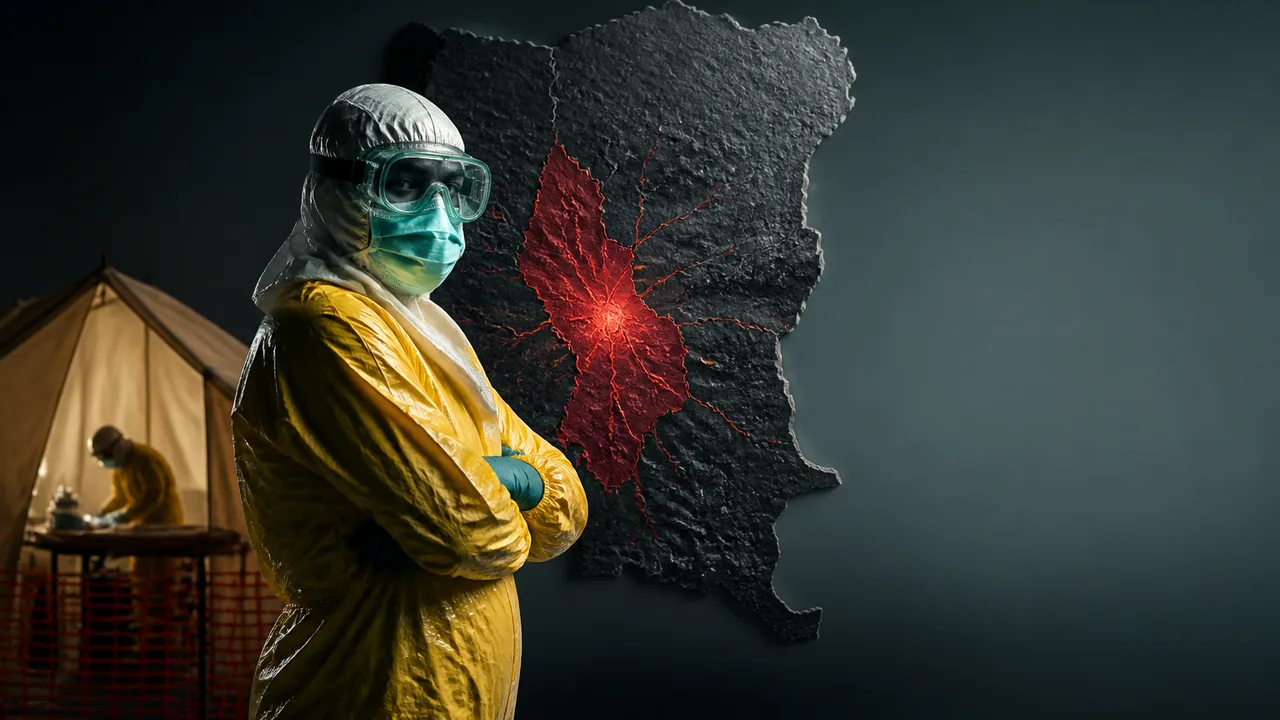
Photo: AI. Ines Cienfuegos
The Democratic Republic of Congo is a country roughly the size of Western Europe. It has endured more than a dozen Ebola outbreaks. It is currently fighting an active war, with the M23 militia controlling significant territory in the east. Hundreds of thousands of its people are displaced. And right now, somewhere in that terrain, a strain of Ebola for which there is no approved vaccine is spreading faster than anyone has been able to count.
That is the actual situation. What follows is an attempt to map it clearly.
The virus itself
Ebola is not one disease. There are six species of Ebola virus, three of which are known to cause illness in humans. Most people's mental image of Ebola—the 2014-2016 West Africa outbreak that killed more than 11,000 people—was caused by the Zaire species. That is the strain for which scientists have developed both a vaccine and targeted therapeutics. That is not what we are dealing with now.
The current outbreak involves Bundibugyo virus, a species that has only caused two documented outbreaks before this one: Uganda in 2007, South Sudan in 2012. It is rare enough that the global health infrastructure was, in a practical sense, not calibrated for it. The standard rapid diagnostic tests used in the field are designed to detect Zaire. When Congolese doctors in the early weeks of this outbreak suspected Ebola and ran tests, those tests came back negative. Patients continued to move through facilities. Contacts continued to go untraced.
BBC Health and Science correspondent James Gallagher, speaking on the BBC's Global Story, put the consequence plainly: "The Bundibugyo species not coming up positive in test results has clearly blinded the response a little bit in the early stages."
That is a significant admission. It means the weeks between the first probable human infection and the formal declaration of an outbreak were not simply lost to bureaucratic delay—they were lost, in part, because the system was looking for the wrong thing.
The timeline of a slow recognition
The WHO now estimates, based on current case modeling, that the first spillover event—a human coming into contact with an infected animal, most likely a fruit bat—occurred roughly two months before the outbreak was formally identified. The first confirmed death the health system can trace back is April 24th: a nurse presenting with fever, vomiting, bleeding, and severe malaise. She died.
The working assumption is that she was not the index case—the first human infected. A healthcare worker contracting Ebola typically does so from a patient, not from an animal. Which means the virus had already been circulating in the community by the time it arrived at that hospital.
May 5th: the WHO is alerted to a high-mortality outbreak of unknown cause in DRC. May 15th: blood samples sent to Kinshasa return results—eight of thirteen positive for Bundibugyo. An outbreak is officially declared that same day, with Uganda also confirming cases. The following day, May 16th, WHO Director-General Dr. Tedros Adhanom Ghebreyesus declared a Public Health Emergency of International Concern (PHEIC).
By the time of that declaration, there were already 246 suspected cases and 80 deaths. The contact tracing job was already enormous.
What "public health emergency" actually means
The PHEIC designation is frequently misread in two directions simultaneously—some outlets treat it as a global pandemic alarm, others dismiss it as bureaucratic formality. It is neither.
What it means, concretely, is that the outbreak has crossed the threshold of what a single country can contain with its own resources. DRC's outbreak has already spread to Uganda. There is a confirmed case involving an American physician. The WHO's risk assessment now stands at "very high" within DRC, "high" in the broader region, and "low" globally—distinctions that matter and should not be flattened into a single headline.
What the PHEIC triggers is a coordinated international mobilization: funding, personnel, logistics. It also places every country's border and health authorities on formal alert. The tools for containing Ebola are, as Gallagher noted, "fairly simple and obvious"—find the infected, trace their contacts, isolate those contacts before they become infectious themselves. The difficulty is not the concept. It is the execution, in a geography where you do not fully control the territory.
The conflict variable
The Ebola outbreak is concentrated in eastern DRC, where the M23 armed group controls significant ground. There has already been at least one confirmed Ebola death in M23-held territory. This matters enormously for containment, because contact tracing requires freedom of movement, community trust, and functioning local governance—none of which can be assumed when armed non-state actors control access to communities.
Gallagher framed this with the kind of ground-level clarity that often gets lost in outbreak coverage: "If you are struggling to find clean water that day, or you are fleeing your home, Ebola is not your number one priority."
That sentence deserves to sit with readers for a moment. Public health messaging assumes a population with bandwidth to receive it. In eastern DRC, that assumption fails. This is not a failure of public health strategy; it is a description of reality that strategy must accommodate.
The question that will not go away
US Secretary of State Marco Rubio publicly alleged that the WHO was "a little late" in identifying the outbreak. James Gallagher's response on the BBC was notably calibrated: "I think everybody was late is the honest answer to this."
He is right that blame is diffuse and complicated. The Bundibugyo diagnostic gap, the two-month pre-identification window, the conflict environment—none of these are attributable to any single institution's failure.
But the conversation cannot stop there, and Gallagher did not let it. The harder question is about trajectory: what happens to an outbreak that has already been detected late, in a country that has been cut off from a significant portion of its international health infrastructure?
In January, the Trump administration initiated proceedings to withdraw the United States from the WHO. USAID, which funded health surveillance systems, emergency stockpiles, and the training of local health workers across central Africa, has been largely dismantled. The CDC has undergone significant cuts. Organizations like the International Rescue Committee, which have historically bridged the gap between international funding and on-the-ground capacity, have seen their US funding reduced or eliminated.
The Washington Post has reported that aid groups and health officials say they currently lack the staff, surveillance systems, emergency supplies, and—critically—the personal protective equipment needed to respond adequately to this outbreak.
Gallagher was careful here, and the care is worth noting: "I don't think you can necessarily blame the start on cuts but the trajectory and what happens next—that will be something people will be arguing over."
That is a distinction with real analytical weight. Large Ebola outbreaks predate the current US policy environment. The 2014-2016 West Africa epidemic killed more than 11,000 people before those cuts existed. Bundibugyo's diagnostic opacity would have created delays under any funding scenario. These are fair points.
And yet: the capacity to respond to what comes next—to run contact tracing operations across conflict zones, to supply PPE to health workers in Kinshasa and Goma, to maintain the laboratory infrastructure that eventually caught this outbreak—that capacity is demonstrably thinner than it was two years ago. Whether that thinness shapes the trajectory of this specific outbreak, or the next one, or the one after that, is a question no one can currently answer with certainty. But it is the right question.
What can actually be done
One detail from this outbreak coverage that deserves more attention: the absence of a vaccine does not mean the absence of treatment. "Optimized supportive care"—aggressive fluid replacement, nutritional support, early intervention to stabilize patients while their bodies fight the virus—can substantially reduce fatality rates. Across Ebola outbreaks, case fatality rates have ranged from 25% to 90%. That spread is not random. It tracks the quality and timeliness of care available.
In a functional hospital with adequate supplies and trained staff, your odds improve significantly. In an isolation ward with no IV fluids, no PPE, and healthcare workers who are themselves terrified of contracting the disease, they do not.
Ebola in DRC in 2025 will be contained or not contained largely by people whose names will not appear in any Western newspaper—local healthcare workers, community health volunteers, laboratory technicians in Kinshasa, contact tracers working in territory partly controlled by M23. The international architecture that was supposed to support them is visibly under strain. Whether what remains is enough is not a question anyone can honestly answer today.
More Like This
Crafting Supercars: The Science Behind Speed and Style
Explore how supercars like Alfa Romeo 4C and Aston Martin Vanquish are meticulously crafted using cutting-edge materials and precision engineering.
Exploring the Enigma of Antimatter at CERN
CERN's antimatter factory reveals mysteries of the universe's matter-antimatter asymmetry and the quest for new physics.
R21 Malaria Vaccine: A Breakthrough With an Uncertain Future
The R21 malaria vaccine hit 73% efficacy and earned WHO approval. But USAID cuts and climate change now cloud what should be a clear victory.
Yellowstone Supervolcano: What the Ash Record Tells Us
The Yellowstone supervolcano's past eruptions left a record written in bone and ash. What that record says about our future is harder to read than it looks.

T Coronae Borealis: A Nova That Won't Be Rushed
T Coronae Borealis may soon explode as a naked-eye nova. Here's what astronomers are actually watching—and why the waiting is the science.
Understanding the Real Risk of Brain-Eating Amoebas
Explore the facts and myths surrounding brain-eating amoebas. How real is the threat, and can climate change affect its spread?

World Cup 2026's Heat, Cost, and Political Fault Lines
From $11,000 tickets to denied visas and doubled emissions, the 2026 World Cup's off-pitch challenges may define the tournament as much as the football.

Did a Catholic Priest's Faith Corrupt the Big Bang?
Three cosmologists unpack whether Georges Lemaître's faith compromised his science—and why the real threat to cosmology is political, not theological.