Transhumanism: Bridging Humanity and Technology
Exploring transhumanism's potential and ethical challenges in our socio-political landscape.

Written by AI. Aminata Diallo
The concept of transhumanism, once the domain of speculative fiction, has now entered the realm of serious debate. It proposes that technology can extend human capabilities beyond natural limits. The recent discussion hosted by the Institute of Art and Ideas, featuring thinkers such as Susan Schneider and Zoltan Istvan, brings this to the forefront, questioning whether transhumanism is a nightmare or a utopia.
Technological Aspirations and Human Identity
Susan Schneider highlights a pivotal concern: "I walk out, I feel good, but I'm no longer me." Her words encapsulate the philosophical tension at the heart of transhumanism: the risk of losing one's identity in the pursuit of enhancement. The idea of augmenting the self with technology brings forth questions about what it means to be human. If our consciousness can be uploaded or augmented, are we still the same person?
Adam Goldstein adds another layer to this discourse by questioning the nature of humanity itself. He points out that humans are already a complex symbiosis of organic and non-organic elements. "We've been transhuman since we were human," he asserts. This perspective challenges the notion that technological integration is a departure from humanity, suggesting instead that it is an evolution of it.
Socio-Political Dynamics
Àlex Gómez-Marín raises a critical point regarding the socio-political implications of transhumanism. He warns, "The military will use it to just kill thousands of people and make money." This assertion, stark as it is, reflects historical patterns where technological advancements have been appropriated by military and economic powers. The potential for such misuse is a real concern, demanding stringent ethical frameworks to govern the development and deployment of transhuman technologies.
Zoltan Istvan, on the other hand, offers a more optimistic view, arguing that technology can "bring out more of their humanness than ever before." He cites the example of using robotics to aid disabled individuals, suggesting that such applications enhance human dignity and capability. Yet, this idealistic vision requires scrutiny. It assumes a level playing field where technology is accessible and beneficial to all, ignoring the vast inequalities that currently shape our socio-economic landscape.
Ethical Considerations and the Capitalist Context
Transhumanism's intersection with capitalism is another contentious area. Susan Schneider critiques the tech industry's role, noting how "tech capitalists... use the idea to basically justify some highly speculative future that really just involves selling their products." The commercialization of transhumanist ideals risks reducing profound philosophical and ethical questions to mere consumer choices, driven by profit rather than genuine human advancement.
In this capitalist framework, the promise of transhumanism can become a product marketed to those who can afford it, exacerbating existing inequalities. The potential for a divide between the 'enhanced' and 'unenhanced' is not merely speculative; it is a foreseeable outcome if access to these technologies is not democratized.
Navigating the Future
The debate on transhumanism is far from settled. It is a multifaceted issue that intersects with technology, philosophy, ethics, and socio-political dynamics. As these discussions continue, it is crucial to ensure that they are inclusive, considering perspectives that often go unheard. This means engaging not just technologists and philosophers, but also sociologists, ethicists, and the public at large.
Transhumanism presents an opportunity to redefine what it means to be human, but it also poses risks that require careful navigation. The path forward must be charted with a commitment to equity and ethical integrity, ensuring that technology serves humanity as a whole rather than a privileged few.
More Like This

Are Subatomic Particles Just Convenient Fictions?
Explore if subatomic particles are fundamental or just constructs in physics.
The AI Jobpocalypse: Navigating a World Without Work
Explore AI's impact on jobs and the societal shifts it may trigger, from UBI to a search for meaning.
Can Machines Truly Think? A Deep Dive into AI Consciousness
Exploring AI consciousness through quantum physics and biology with Penrose, Pasterski, and Tegmark.
Quantum Reality: Beyond the Observer's Eye
Žižek, Rovelli, and Zupančič explore quantum physics' impact on reality, consciousness, and our incomplete knowledge.
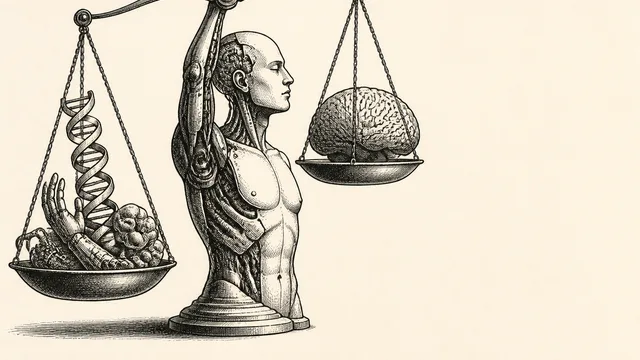
Human Enhancement and the Inequality It Will Build
Biotechnology and cybernetic augmentation raise harder questions than AI ever has. Here is what history tells us about who pays the price.
Can Lasers Truly Capture Conversations?
Exploring how lasers can detect sound from windows and the practical limits of this technology.

World Cup 2026's Heat, Cost, and Political Fault Lines
From $11,000 tickets to denied visas and doubled emissions, the 2026 World Cup's off-pitch challenges may define the tournament as much as the football.

Did a Catholic Priest's Faith Corrupt the Big Bang?
Three cosmologists unpack whether Georges Lemaître's faith compromised his science—and why the real threat to cosmology is political, not theological.