Homer's Odyssey and Mycenaean Religion: Fact vs. Myth
Homer set the Odyssey in the Bronze Age but wrote it 500 years later. How accurate is his religion? Linear B tablets reveal a startling gap.

Written by AI. Margaret "Maggie" Holloway
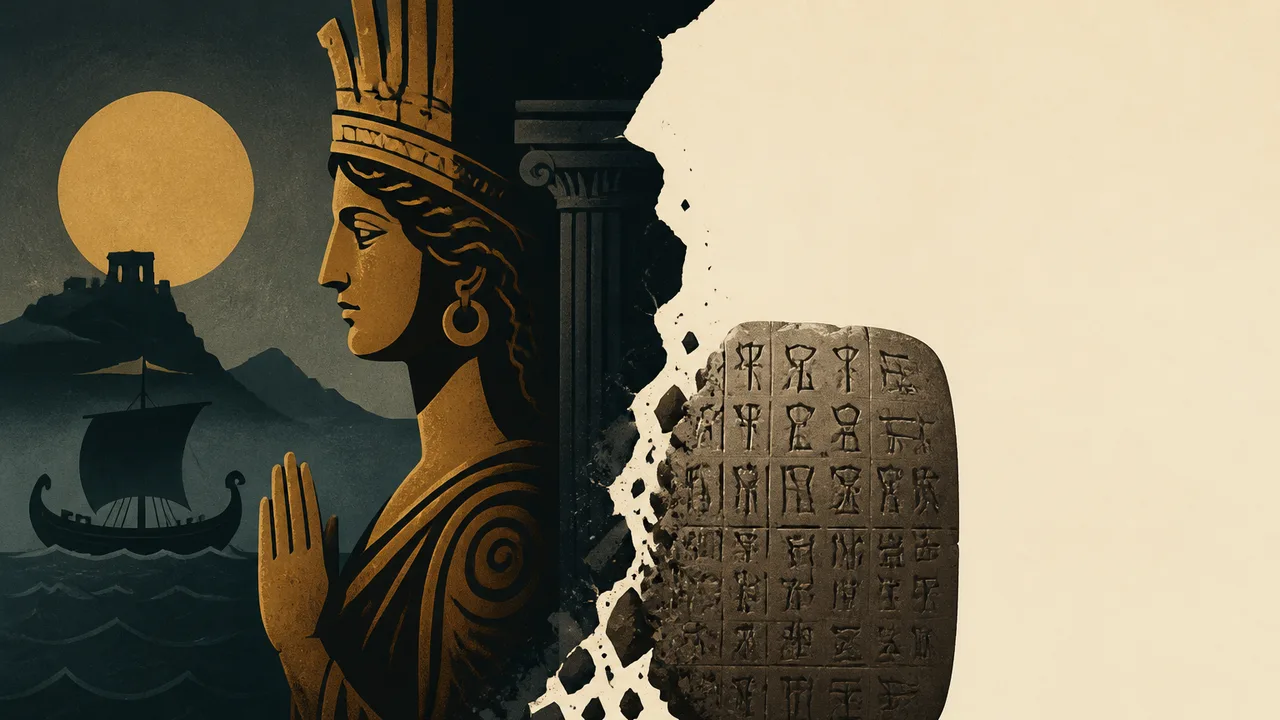
Photo: AI. Mika Sørensen
When the first trailer for Christopher Nolan's Odyssey dropped, the historical accuracy crowd mobilized quickly. Matt Damon's Odysseus appeared in a bronze helmet with a horsehair crest — the kind of thing you'd see on a Roman legionary, not a Mycenaean warrior from 1200 BCE. The correct headgear, as any Bronze Age enthusiast will tell you with visible satisfaction, is the Dendra panoply: a full suit of bronze plate topped with a helmet fashioned from rows of boar's tusks. The critics had a point. But the ReligionForBreakfast channel's recent deep-dive on the subject raises an uncomfortable follow-up: they were also assuming Homer himself was a reliable guide to the Bronze Age. He isn't — and the religion he describes is perhaps the most anachronistic thing about him.
The gap between Homer and the world he wrote about is vertiginous. The Mycenaean palaces fell around 1200 BCE. Homer, if he was a single historical person at all, probably lived in the 700s BCE. The poems may not have reached their final fixed form until the late 7th or 6th century. That's a minimum of 500 years between the civilization Homer describes and the poet who described it — roughly the distance between Christopher Nolan and Christopher Columbus. Whatever Homer remembered about the Bronze Age was mediated through half a millennium of oral tradition, cultural transformation, and the particular assumptions of his own Iron Age world.
So what did Bronze Age Greek religion actually look like? The main primary source is the Linear B tablets, clay documents pressed with a syllabic script that represents the earliest written Greek we have. Deciphered in the 1950s, these tablets were found at palace centers including Knossos, Pylos, Mycenae, and Thebes. And here is where the inquiry immediately runs into a methodological wall: the tablets are administrative records. Palace bookkeeping. As scholar Thomas Palaima puts it bluntly, "we find in the Linear B tablets no myths, hymns, prayers, ritual prescriptions or laws or sanctuary regulations." What we have are gods appearing as line items in a budget — recipients of offerings, names attached to sanctuaries, divine figures allocated grain or oil or wool. The ReligionForBreakfast presenter offers a useful analogy: it's like trying to reconstruct Christianity three thousand years from now using only the financial ledger of a megachurch accountant. You'd learn something. You'd reconstruct a liturgical calendar from the dates when money flowed in. You'd notice the wine and bread. You'd find salaries for people with titles like "pastor." But you'd never recover what anyone believed about the Trinity.
With those limits acknowledged, the tablets still yield a portrait of a pantheon that is recognizable in places and genuinely strange in others.
Zeus is there, listed as Diway, and Hera appears beside him — already paired, possibly already a divine couple, though the tablet puts them side by side without explicitly saying they're married. Hermes, Artemis, and Ares are present. Dionysus shows up as Diwonuso, receiving honey at a sanctuary of Zeus in Knossos, which fits his later identity as son of Zeus with striking neatness. But then the familiar map gets complicated. Alongside Zeus in that Pylos tablet sits a figure called Diwios — son of Zeus — a divine child who vanishes completely from later Greek mythology. There's also Diwia, a feminine form of Zeus's name, a goddess with her own shrine at Pylos, and by Homer's time she too has disappeared without a trace.
More striking still is the relative positioning of the gods. Zeus is king of the Olympians in every Classical source we have. But at Mycenaean Pylos, the dominant deity appears to be Poseidon. Tablet UN 718 records the provisions for a feast in his honor: wheat, wine, a bull, cheese, and honey, contributed by the wanax (the Mycenaean term for king), the second-ranking official called the lawagetas, and the damos, the local community. The entire social pyramid of Pylos, top to bottom, pooling resources for Poseidon's feast. No other deity at Pylos receives that treatment.
Then there's Potnia — "the mistress" or "she who has power" — arguably the most significant figure in the tablets and the most thoroughly obscured by Homer's rewriting. In later Greek, Potnia survives as an epithet, a title you attach to another goddess's name. But in Mycenaean religion it designated a plurality of goddesses with specific domains: the Potnia of horses, Sitopotnia (mistress of grain), Potnia Asiwia (linked to the Anatolian coast), and on one Knossos tablet, Atana Potnia — something like "mistress of Athena," possibly Athena herself. Alongside these named variants, scribes often simply wrote Potnia, full stop, no epithet. This unmodified Potnia at Pylos received some of the most valuable offerings in the kingdom. Entire teams of palace craftsmen were designated "Potnian" — a Potnian blacksmith, a Potnian leatherworker — meaning they somehow worked under the goddess's patronage.
Whether this represents one goddess with many manifestations or many distinct goddesses sharing a title is a question the tablets refuse to settle, and scholars have argued it both ways for decades. Sir Arthur Evans, who excavated Knossos in the early 20th century, promoted the idea of a single great mother goddess at the center of both Minoan and Mycenaean religion. That interpretation was influential for a long time. But when the tablets are read alongside the archaeology rather than instead of it, the picture is more diffuse: roughly 50 to 60 deities named in total, male and female in roughly equal numbers, Poseidon dominant at Pylos, local gods appearing and disappearing across sites. The great mother goddess thesis has been largely dismantled by subsequent scholarship, though it keeps its grip on popular imagination.
What Homer does with all of this is partly faithful and largely transformative. The ReligionForBreakfast presenter identifies several genuine echoes. When Telemachus sails into Pylos in the Odyssey, he finds the entire community on the shore sacrificing bulls to Poseidon — nine companies of men, nine bulls each, presided over by the pious King Nestor. This maps remarkably well onto what the tablets show us: a Pylos where Poseidon commanded communal, state-level devotion. Thomas Palaima suggests Homer may be preserving a genuine cultural memory of Pylos's reputation, passed down across the centuries. The sacrifice ritual itself also holds up: archaeologists found thigh bones at Pylos stripped of meat and then burned for the god, and Homer describes exactly this procedure in Iliad Book 1, when the priest Chryses sacrifices to Apollo and "they cut out the thigh pieces, wrap them in fat, and then burn them while the men feast."
But the renovations Homer performs on the Bronze Age are equally telling, and nowhere more so than in what gets erased. Aphrodite is entirely absent from the tablets. Demeter too, though scholar Thomas Palaima suggests her functional role may have been filled by Sitopotnia, the mistress of grain. Meanwhile the whole Potnia apparatus — arguably the spine of Mycenaean religion — has collapsed in Homer to a decorative epithet. When Homer writes Potnia Athena or Potnia Hera, he's using what amounts to a linguistic fossil: a title that once designated perhaps the most powerful divine figure in the Aegean, reduced to an honorific modifier.
The death rituals tell a similar story. Homer's heroes are cremated. The great funeral pyre of Patroclus in Iliad Book 23 is one of the poem's most indelible scenes. But the Mycenaeans largely buried their dead. Cremation only became common in Greece after the Bronze Age collapse. At Lefkandi on Euboea, a 10th-century burial reads almost as a checklist from the Iliad: cremated man, ashes wrapped in cloth, weapons beside him, horses killed in the same shaft, a great mound raised over everything. Homer's heroes are being buried like Iron Age lords, because Homer is an Iron Age poet.
The scholarly debate about what this all means for the long continuity of Greek religion is genuinely unresolved, and the two positions on offer are not symmetrical. Walter Burkert, in his foundational work Greek Religion, argued that the evidence for Mycenaean-to-Classical continuity is thin — a few divine names carried over, some vocabulary, but the religion the Classical Greeks actually practiced largely took shape after the Bronze Age collapse. Against this, Linear B specialist Susan Lupack, in a 2020 essay on continuity and change, draws a crucial distinction: when the palaces burned around 1200 BCE, what died was palace religion. The wanax system, the state cult, the professional priestly class on the palace payroll — all of that collapsed. But as Lupack points out, most Mycenaean religion was never palace religion. The ash altar on Mount Lykaion in the Peloponnese has been excavated layer by layer: Mycenaean material at the bottom, then Iron Age, then Archaic, then Classical, an unbroken record of sacrifice accumulating over more than a millennium. The sanctuary at the top of that mountain, with its blackened mound built from the debris of countless offerings, was operating continuously from the Bronze Age through the Hellenistic period — indifferent to every palace that ever rose or fell in the valleys below.
As Lupack herself puts it, "a good deal of the way the Mycenaeans practiced their cult would have been familiar to someone in the Archaic and Classical periods."
The honest accounting, then, is that Homer was doing something more complicated than either remembering or inventing. He was assembling a world from fragments — ruined palace walls still visible in his landscape, gods still worshipped with rituals passed down through local communities, vocabulary whose origins had been forgotten, and perhaps an actual boar's tusk helmet preserved in someone's household as a curiosity from an age no one quite remembered. The Nolan film gets the helmet wrong by five centuries. Homer gets the entire religious infrastructure wrong by a similar margin, and gets some of the details startlingly right. The interesting question isn't which of them is more accurate. It's what it tells us about how cultural memory actually works — what survives the collapse of a civilization, what gets quietly rewritten, and what gets mistaken for the original by everyone who comes after.
More Like This
Bodmin Moor's Bronze Age Village and Its Neolithic Cairn
Archaeologists confirm a Bronze Age village on Bodmin Moor—and find a 6,000-year-old cairn that may have outlasted the community that built it.
Unveiling Rome's Gladiator Underworld
Explore the hidden world beneath ancient Rome's arenas, unveiling gladiator training, underground tunnels, and cultural practices.
Jackie Kennedy and Lee Radziwill's Bitter Lifelong Feud
The feud between Jackie Kennedy and her sister Lee ran deeper than jealousy. A look at the betrayals—plural—that made it permanent.
Did the Valar Abandon Middle-earth?
The Valar all but vanish by the Third Age. Robert from In Deep Geek argues that's not absence—it's a handoff. Here's what the text actually supports.
Pavlopetri: Inside the World's Oldest Sunken City
A Bronze Age city has sat submerged off southern Greece for 3,500 years. New technology is finally letting archaeologists read what it says about us.
The Gods of Pre-Islamic Arabia, In Their Own Words
Ancient desert inscriptions reveal the polytheistic world before Islam—gods, prayers, sacrifice, and fate, recorded by the nomads who lived it.

Ten Scientific Discoveries Nobody Saw Coming
From Fleming's contaminated petri dish to Hubble's blurry mirror, accidental observations have repeatedly reshaped what we know about life and the cosmos.
The Nefertiti Bust's Disputed Past and Present
The Nefertiti bust raises two unresolved questions: is it genuinely ancient, and was it legally taken from Egypt? The evidence on both is more complicated than Berlin admits.