The Electrical Grid Is Being Rebuilt for AI—Now What?
AI and EVs are forcing a complete grid overhaul. What that means for small businesses waiting on power that never seems to arrive fast enough.

Written by AI. Dorothy "Dot" Williams
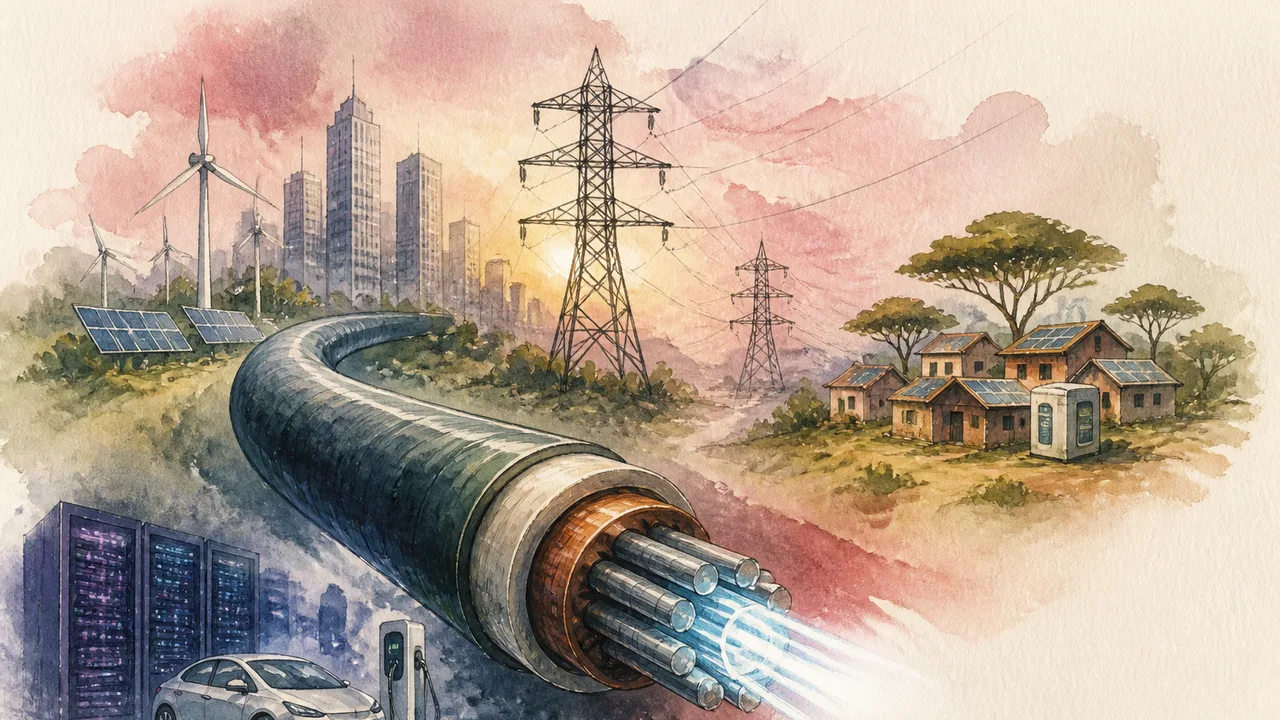
Photo: AI. Júlia Almeida
There's a panel in the back of what used to be my bookstore — original 1987 wiring, the kind an electrician looks at and immediately starts pricing his kids' college tuition. When I needed a second HVAC unit in 2011, the utility told me my service capacity was maxed. New service drop, new panel, new everything: eight months and $22,000. I did the math three ways and still couldn't make it pencil. I ran box fans that summer and lost two staff members who found somewhere less swampy to work.
I thought about that panel a lot watching Bloomberg's new Primer episode on the electrical grid — a 24-minute tour of what may be the defining infrastructure challenge of the next 30 years.
The core argument is straightforward: electricity demand in the developed world went essentially flat from the early 2000s through the late 2010s. Efficiency gains, deindustrialization, better appliances. The grid stopped growing. And then AI and electric vehicles showed up and blew the whole assumption apart. The world is predicted to need roughly twice as much electricity by 2050 — something like a whole new United States' worth of power consumption every five years. Grids built for a flat-demand world now have to sprint.
That's the big picture. Here's what it means closer to the ground.
China Didn't Stop Building. We Did.
The piece spends meaningful time on China's grid advantage, and the contrast is stark. According to Bloomberg, citing figures in line with IEA reporting, China's power generation has increased roughly sevenfold since 2000. It never stopped building. It kept the workforce trained, the supply chains intact, the capital flowing. A bad year in China, we're reminded, is 5% GDP growth.
Meanwhile, Western utilities mothballed expansion plans and declared victory. Skilled electricians aged out. Transformer manufacturers shrank. The industrial capacity to build a modern grid quietly atrophied.
Now think about what that means if you're running a small manufacturing operation in Columbus or Charlotte right now, trying to install commercial EV charging for your fleet vehicles — because your customers are asking for it, or your drivers are asking for it, or your insurance carrier is offering discounts on it. The utility that serves you has been on a hiring freeze. Their interconnection queue is backed up 18 months. The transformers they need are on a 24-month lead time. Your EV charging project doesn't die in a dramatic way. It just... waits. And while it waits, your larger competitors with the capital to build private substations don't wait. The grid isn't just an infrastructure story. It's a competitive disadvantage delivered one delayed permit at a time.
The point isn't that China's head start guarantees them AI dominance — head starts in infrastructure are necessary but not sufficient, and political and market structures matter enormously. But the gap in industrial readiness is real, and small operators on Main Street pay for it in ways that don't make headlines.
The Conservative Utility Problem Is Your Problem
Bloomberg's segment on Veir — a startup building superconducting power cables — is genuinely fascinating on the technology. Superconducting materials, cooled to around 77 Kelvin (for context, the coldest regions of the moon's dark side reach roughly 93 Kelvin, so we're talking profoundly cold), carry electricity with essentially zero resistance. One superconducting cable can move as much power as several conventional copper cables. Less infrastructure footprint, dramatically more capacity.
Veir CEO Tim Hidle has raised over $100 million from investors including Microsoft — though funding figures shift as rounds close, so treat that as a floor, not a ceiling — and the company says it aims to have cables on actual grids within a couple of years, making cautious progress from 10-meter test sections toward commercial scale.
But here's the line in the Bloomberg piece that stopped me: "It just can't be denied that utilities are conservative businesses. When you're worried about providing power 100% of the time, you're going to be very cautious about trying something new."
That caution isn't just a technology adoption story. It's a business constraint that lands on every small operator in every utility's service territory.
I watched this play out on my own street. The restaurant two blocks from my bookstore wanted to add a commercial kitchen expansion — real growth, real jobs, real sales tax revenue for the city. The utility took 14 months to run new service. By month nine, the owner had burned through her operating reserve. She opened the expansion eventually, but she'd had to let her sous chef go in the meantime to make payroll, and she never fully recovered the momentum. The utility's conservatism wasn't malicious. It was structural. But it cost her, not them.
Veir's superconducting cables could eventually mean utilities can move far more power through existing corridors without tearing up streets and neighborhoods for new conduit. That's genuinely good news for the small manufacturer waiting on a service upgrade. Whether utilities will adopt it — and how fast — is a separate, much harder question, and one that the technology alone can't answer.
What Spain's Blackout Was Actually About
The Bloomberg episode covers the April 2025 Spain-Portugal blackout, which knocked out power to tens of millions of people for roughly 18 hours and which a major Spanish bank estimated cost the Spanish economy around 400 million euros — though early economic impact figures from major blackouts tend to vary widely depending on methodology, and that estimate should be treated as preliminary. What caused it is still under investigation, but the episode does a good job explaining the structural vulnerability that made it possible.
Here's the short version: traditional power plants — coal, gas, nuclear, hydro — all run spinning generators. Those generators have physical mass, and physical mass in motion has inertia. When the grid loses balance, that spinning inertia acts as a buffer, injecting just enough energy to stabilize things while the system recovers. It's not a designed feature so much as a physical property. The generators are big and they're spinning and that means something.
Solar panels don't spin. They convert sunlight directly to electricity, which is mostly great — clean, cheap, increasingly dominant. But Spain tripled its solar capacity in five years, and when a few solar farms suddenly tripped offline, there wasn't enough rotational mass on the grid to absorb the shock. The dominoes fell.
The fix being piloted by European power company Statkraft is a synchronous compensator — essentially a giant spinning flywheel, 100 tons, 1500 RPM, connected to the grid to provide inertia without burning anything. Pure spinning mass as a service. It's not glamorous. But Spain's parliament moved quickly after the blackout to allow more of these devices on the grid, which suggests the lesson landed.
The broader point is one that anyone who's ever had a supplier fail them understands viscerally: redundancy isn't waste. It's the thing that keeps you open when something breaks. Grids built for one kind of power source don't automatically handle a different kind well, and the transition costs are real.
Nigeria's Patient Answer
The episode closes in Nigeria, where Husk Power has been installing small solar mini-grids in rural villages — serving maybe 400 households at a time, powering fans and TVs and, critically, rice milling machines that let people earn income after dark. The World Bank's Mission 300 initiative, if targets hold, aims to extend electricity access to 300 million Africans by 2030, with mini-grids as a key piece of that build-out.
It's a different scale than everything else in the episode. But it's the same logic: the grid is the precondition. You don't get the rice mill, the homework under a lamp, the refrigerator that keeps food from spoiling, without the wire. In the 1930s, rural electrification in the U.S. followed exactly this path — government investment, incremental extension, years before anyone saw returns — and it underwrote decades of economic growth that followed.
The Nigerian kids doing homework at night because Husk Power ran a line to their village are not so different from the American kids in 1935 who could suddenly read after dark because the Rural Electrification Administration finally reached their county. The timeline is longer than anyone wants. But the direction is right.
The grid story gets told as a technology story, or a geopolitics story, or a climate story. All of those are accurate. But it's also a story about who gets to grow. The small manufacturer in Columbus waiting on a utility interconnection, the restaurant owner who lost her sous chef while the electric service crawled through approval — they don't show up in the Bloomberg Primer. They're the reason it matters.
My bookstore sat under those 1987 panels for twelve years. I sold the business in 2020. The panels are probably still there.
More Like This
Uganda Vanilla Could End the Price Chaos
Madagascar's vanilla monopoly has wrecked small business budgets for decades. Uganda's emerging industry might finally offer the stable supply chain Main Street needs.

Lloyd Blankfein's Risk Rules Work on Main Street Too
Lloyd Blankfein's frameworks on crisis management, contingency planning, and AI risk translate directly to small business — if you know where to look.
Nuclear's New Fuel Has 11,000 Empty Holes
Inside the nuclear fuel supply chain scramble — from Piketon, Ohio to Saskatchewan — and why the six-to-seven-year timeline deserves your skepticism.
Pax Silica: America's Answer to Belt and Road
The Trump administration's 14-country AI supply chain coalition sounds ambitious. Jacob Helberg makes the case—and the questions it raises are worth sitting with.
Dinosaurs, Black Holes, and Why Greed Kills Systems
Dr. Roy Casagranda connects mass extinctions, black hole cosmology, and U.S. healthcare to one unsettling question: why do systems destroy themselves?
Russia's Disinformation Playbook Hits Main Street
Storm-1516's AI deepfake operation isn't just geopolitics—it's the same smear playbook that's been destroying small businesses for years. Here's what you need to know.
Texas Is Becoming the Hub of Commercial Space
From SpaceX's Starbase to Firefly's moon landing, Texas has become the center of commercial space. Here's what's driving the shift—and what it costs.

Spain's Immigration Boom: Real Gains, Real Costs
Spain's mass immigration wave is propping up its pension system — but stagnant wages and a housing crisis reveal what the government isn't building alongside it.