Pax Silica: America's Answer to Belt and Road
The Trump administration's 14-country AI supply chain coalition sounds ambitious. Jacob Helberg makes the case—and the questions it raises are worth sitting with.

Written by AI. Mike Sullivan
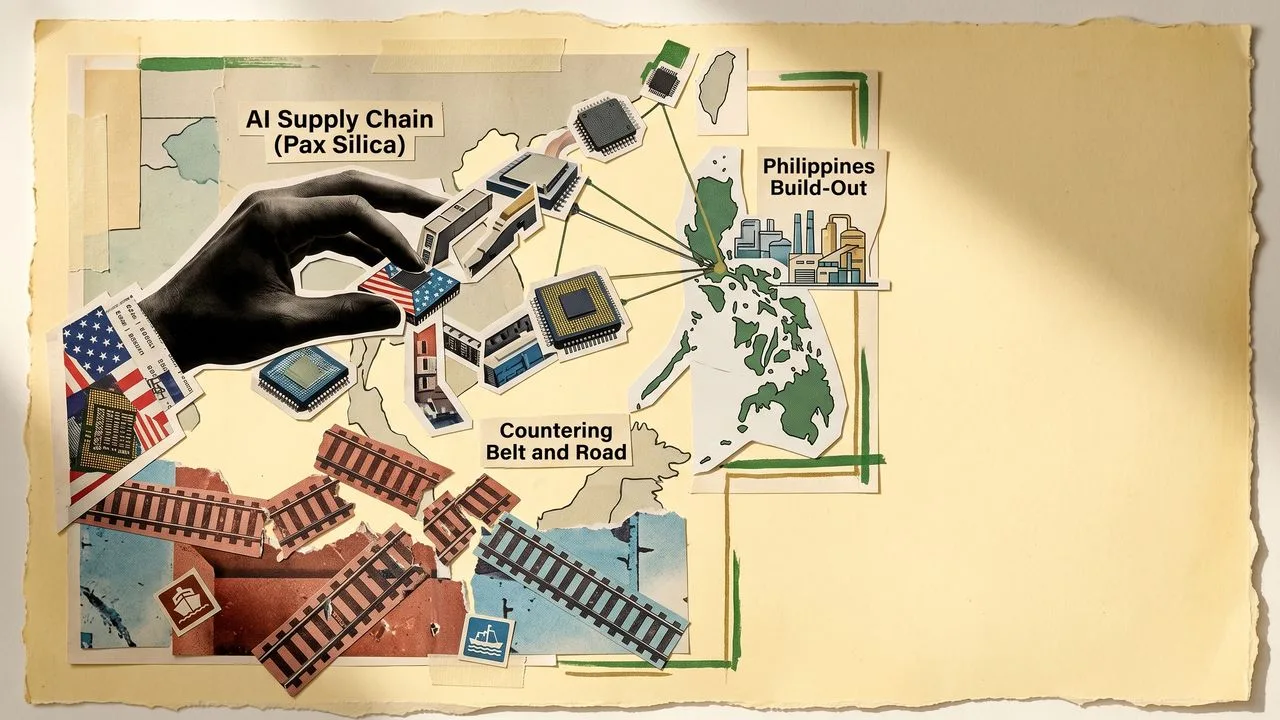
Photo: AI. Wren Sugimoto
Every decade or so, Washington discovers that the supply chain for something critical runs almost entirely through a country it doesn't fully trust. In the 1970s it was oil. In the 1980s it was steel. Today, it's the entire physical stack that makes AI run—chips, rare earth magnets, precision reducers, actuators, server motors. The list is long, the concentration risk is high, and most of it points toward China.
Enter Pax Silica.
Jacob Helberg, the Trump administration's Under Secretary of State for Economic Affairs, appeared on the No Priors podcast to lay out what he's calling an "economic security coalition" now comprising 14 countries, purpose-built to diversify the AI supply chain away from Chinese dominance. The centerpiece, at least for now, is a 4,000-acre plot in the Philippines—about a third the size of Manhattan—that the State Department is taking into diplomatic custody and plans to develop into what Helberg calls an "economic security zone."
That's not a special economic zone in the traditional sense. Phase one involves the land operating under the same legal framework as a U.S. embassy. Phase two, over the next two years, involves negotiating the long-term investor protections, tax regimes, and legal frameworks with Filipino counterparts that will govern the site for multiple decades. The goal is to attract private companies—particularly those in the robotics supply chain—by combining American legal predictability with Philippine manufacturing advantages.
The pitch to partner countries is straightforward: the AI boom is generating record demand for copper, cobalt, and a long tail of industrial inputs. Countries that get a stake in that supply chain now can ride the growth curve. Helberg frames it explicitly as non-zero-sum. "The amazing thing about the tech industry, especially when we go through these inflection points, is the pie grows really fast," he told hosts Sarah Guo and Elad Gil. "It's really not zero-sum, which actually makes it incredibly conducive to forge very mutually beneficial partnerships."
That's a more sophisticated pitch than you usually hear from government officials, and it's worth examining why.
The Belt and Road Comparison Is Doing a Lot of Work
The most clarifying moment in the conversation is when Helberg dissects China's Belt and Road Initiative to explain what Pax Silica is not. His diagnosis of Belt and Road's failure mode is credible: state-owned enterprises deploy capital to Chinese companies, those companies write IOUs to the host country, costs inevitably balloon, and nations that signed up for X in liabilities end up holding 10X. The debt converts to equity on default, which happens regularly, and suddenly the host country doesn't own its own port anymore.
Helberg's contrast: "We're not going to do government-operated supply chains because that's not how we shine as a country. Our superpower is really our private sector and our companies."
The Steve Jobs invocation is a bit on-the-nose, but the underlying logic is sound. The U.S. genuinely does have a comparative advantage in building commercially viable platforms that attract private capital and create aligned incentives. The question is whether that advantage translates to the kind of long-horizon infrastructure investment that supply chain security actually requires—the kind of patient, unglamorous, decade-spanning commitment that China's state apparatus can make in ways that quarterly-earnings-driven American corporations typically cannot.
Helberg's answer is essentially: we're designing the platform so the incentives align, and the VC ecosystem helps us identify which operators can actually execute. He described wanting venture capital to function as a talent-screening layer—firms that are "hardwired to assess personality attributes of founders" can signal to the government which companies are worth backing with public capital. It's a clever model in theory. Whether it survives contact with the procurement process is a different question.
The Rare Earth Problem Is Real, and More Complicated Than "Just Mine More"
One of the more useful exchanges in the conversation involves rare earth minerals—specifically the misconception embedded in the name. They're not actually rare. What's rare, as Helberg correctly explains, is refining capacity. The processing facilities that turn raw ore into the magnets and components AI hardware needs are overwhelmingly concentrated in China, which also subsidizes the market heavily enough to make competing facilities economically unviable almost everywhere else.
The administration's approach, per Helberg, runs on two tracks: supply-side investment to expand non-Chinese processing capacity, and demand-side negotiations to address the pricing problem that makes new entrants commercially unworkable. He expressed confidence that the pricing issue gets resolved before the end of the current term.
That's an ambitious timeline for restructuring a globally subsidized commodity market. For context, the U.S. has been trying to rebuild domestic rare earth processing capacity since at least the Obama administration. MP Materials reopened Mountain Pass in California. It's still working on building out domestic magnet manufacturing. Progress exists, but it moves in years and decades, not in administration-length sprints.
Durability Is the Real Question Nobody Fully Answered
The hosts pressed Helberg on the obvious vulnerability: executive orders get reversed. The next administration might have different priorities. How does any of this stick?
His answer acknowledged the constraint—State Department officials can't comment on electoral politics—but gestured toward a few structural stickiness factors. Tax reform is hard to unwind. The forward-deployed industrial base, once built and operational, develops its own constituency. The Philippines partnership involves diplomatic property, which has its own legal durability. He also pointed toward legislation as the gold standard for longevity, without specifying what legislation is in flight.
The honest answer is that some of this will stick and some won't. The physical infrastructure, if actually built, is sticky. The policy environment around it is only as sticky as the next administration's priorities. That's not unique to Pax Silica—it's the fundamental problem with using executive action to pursue multi-decade industrial policy. Congress hasn't shown much appetite for the kind of comprehensive industrial strategy legislation that would lock this in, and the "One Big Beautiful Bill" tax incentives Helberg mentioned are a different category of commitment than, say, a NATO-style treaty obligation.
The "Underdog" Framing Is Interesting, Whether You Buy It or Not
Near the end of the conversation, Helberg pushes back against Graham Allison's "Thucydides Trap" framing—the one that casts America as the established declining power and China as the ascending challenger. His counter is that America has always been an underdog nation, from the Revolutionary War through COVID, and performs best when its back is against the wall.
It's rhetorically effective, particularly for a Silicon Valley audience that runs on contrarian-founder mythology. "Every founder started out as having a contrarian idea that was kind of seen as heretical by the expert class," Helberg said. The implicit message: Washington is finally speaking your language.
What the framing sidesteps is that the underdog story requires a protagonist who actually wins. The vaccine-in-a-year story is real and genuinely impressive. So is the smartphone. But for every comeback narrative there are also cautionary tales—American manufacturers who didn't make it back, industries where the supply chain never got rebuilt, strategic dependencies that deepened despite years of stated intent to reduce them.
Pax Silica, at its most compelling, is a serious attempt to apply private-sector logic to a problem that has historically defeated government-only approaches. Helberg knows the Belt and Road literature cold, the Philippines arrangement is genuinely novel from a legal standpoint, and the instinct to make partner countries stakeholders rather than debtors reflects hard-won lessons.
What it isn't yet is a proven model. The economic security zone in the Philippines is still in phase one—diplomatic property on a two-year negotiating clock. The 14-country coalition has announced itself but hasn't yet produced the four or five major "lines of effort" Helberg said were coming. The rare earth pricing problem remains unsolved.
The history of American industrial policy is littered with initiatives that were genuinely well-designed and still didn't scale. The question Pax Silica will eventually have to answer isn't whether the theory is sound. It's whether the execution is.
More Like This

Claude Code Routines: AI That Audits Your Code While You Sleep
Anthropic's new Claude Code Routines automate security audits and code improvements on schedule. We tested it on a to-do app and found 75 vulnerabilities.

AI Growth Systems: A Practical Guide
Explore AI-driven growth systems with human oversight. Avoid AI slop and embrace SEO for real business impact.

Who Gatekeeps AI? The Question Washington Just Made Urgent
Google posted $109.9B in revenue as the White House eyes pre-release AI vetting. The real question: who controls what gets out—and who benefits from controlling it?

An Ex-OpenAI Researcher Says AI's Default Path Is Bad
Former OpenAI researcher Daniel Kokotajlo warns that unaligned superintelligence isn't a fringe scenario—it's the default outcome if nothing changes.
Software Lost $400B Last Week. Should You Care?
The SaaS apocalypse wiped out $400 billion in market value. Here's what's actually happening beyond the panic—and what it means for software's future.
T3 Code Wants to Fix AI Coding Tools. Can It?
T3 Code promises a better way to manage AI coding agents. Open-source, free, and performant—but is a GUI wrapper the solution developers need?

IBM NanoStack and the Future of Chip Architecture
IBM's NanoStack stacks transistors from separate wafers using atomic bonding. The physics works. The harder question is whether anyone can manufacture it at scale.

Inside the Smartphone: 120 Years of Hidden Engineering
Professor Hannah Fry tears apart a modern smartphone to trace 120 years of engineering history — from Marconi's radio waves to a 200-million-pixel camera sensor.