BYD Beat Tesla—Without Selling a Single Car in America
BYD is now the world's top EV seller—despite a 100% U.S. tariff wall. Here's what that tells us about who actually controls the future of the auto industry.

Written by AI. Aminata Diallo
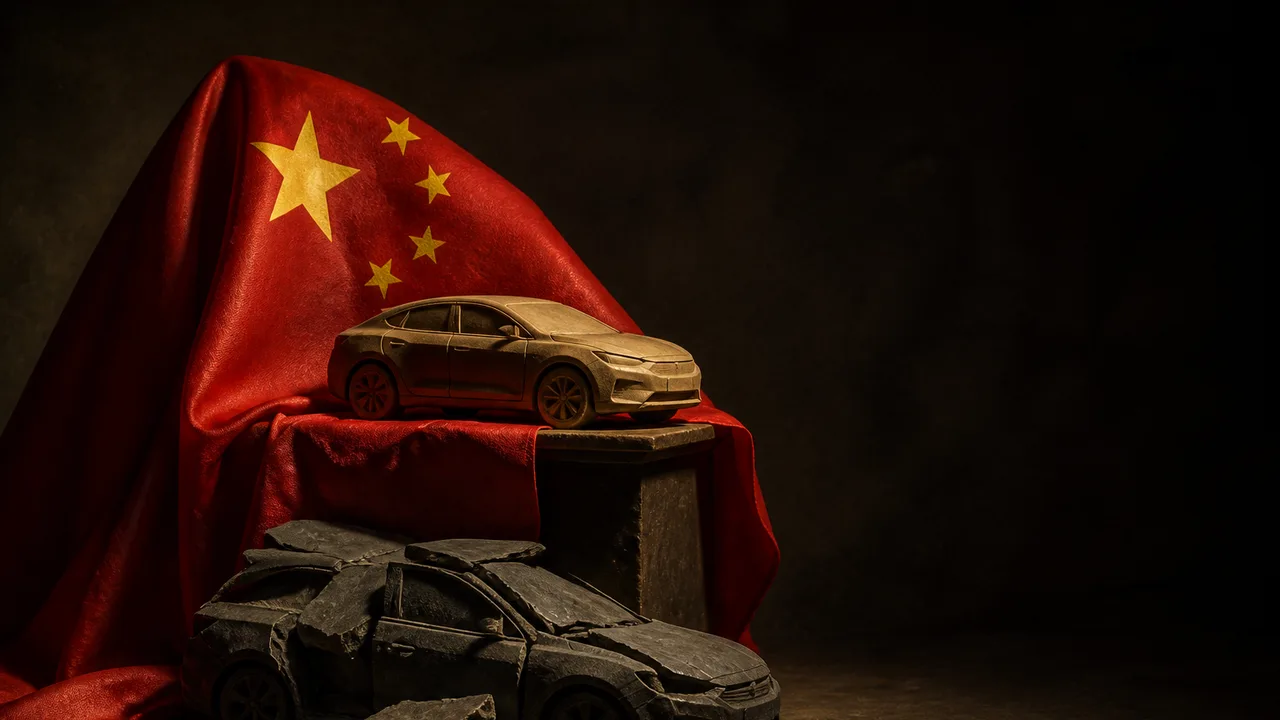
Photo: AI. Soraya Hadid
There is a BYD dealership in an upscale neighborhood in Casablanca. There are BYD taxis queuing outside Changi Airport in Singapore. One in seven new cars sold in the United Kingdom now carries a Chinese-owned brand—a figure that sat at 1.3% just five years ago. And yet if you live in the United States, you have almost certainly never seen one in traffic.
That gap—between BYD's global footprint and its near-total American invisibility—is the most clarifying fact in the current EV story. It tells you something important, not just about one Chinese company, but about how industrial competition actually works when one major market decides to wall itself off.
BBC Asia Business Correspondent Suranjana Tewari made the case recently in a conversation with BBC's Global Story podcast, and what she described from the floor of Auto China—now the world's largest auto show—cuts through a lot of the noise that surrounds this topic in Western media.
How You Build a Winner
BYD did not emerge from a garage in Shenzhen with a visionary founder and a PowerPoint deck. It started making rechargeable batteries in the early 2000s, pivoted into combustion-engine vehicles (which, Tewari notes, "were not very well-received"), brought in engineers with Volkswagen experience to develop its first EVs, and spent roughly a decade finding its footing before going properly global around 2020. That arc matters, because it complicates the narrative that Chinese EV dominance is purely a function of government money distorting a fair market.
State support was real and substantial. Beijing designated electric vehicles as a strategic industry from the early 2000s, providing subsidies, infrastructure investment, and market incentives that no Western government matched at comparable scale or duration. This is what Tewari means when she describes China's "industrial policy ecosystem"—it is not just a check written to a company, it is a coordinated bet on a technology across an entire economy, sustained for two decades.
The downstream effects are visible in the factories. Tewari visited a Nio facility—Nio being another major Chinese EV manufacturer targeting the premium segment—and described what she saw: "Different models floating around on these robots, moving from station to station getting doors attached and getting windshields attached, completely autonomously." The workforce inside was minimal. The throughput was not. This kind of capital-intensive, software-directed manufacturing at scale is what China won by building the entire supply chain ecosystem domestically—battery chemistry, rare earth processing, software stacks, and production robotics—rather than assembling a car company on top of a global supply chain it does not control.
The price point that results from all of this is not a subsidy artifact alone. It is the output of twenty years of compounding industrial investment. A BYD sells in London for between $25,000 and $60,000. In Southeast Asian markets, the entry-level models go lower. In China, every second car sold is now electric.
The Flash Charging Question
One piece of technology deserves particular attention, because it addresses what has long been the most stubborn obstacle to EV adoption globally: range anxiety and charging time.
BYD launched what it calls "flash charging" at the Beijing Auto Show. According to Stella Lee, BYD's executive vice president and global spokesperson, the system charges a battery to roughly 70% in five minutes, delivering approximately 400 kilometers of range. "Our demand is much higher than what we can supply," Lee told Tewari, "especially after we introduce flash charging. It's a really big game changer."
That claim warrants scrutiny—five-minute charging at that range would require grid infrastructure and battery chemistry that are still being stress-tested at scale. But the direction of travel is clear. The company that started as a battery manufacturer is now competing on the dimension where EVs have been most vulnerable. If the charging bottleneck cracks, the remaining consumer hesitation about going fully electric diminishes substantially.
What the Tariff Wall Actually Does
The U.S. currently imposes a 100% tariff on Chinese electric vehicles. The Biden administration put this in place; the Trump administration has maintained and extended the logic. The explicit justifications are two: protecting American manufacturing jobs, and national security concerns about Chinese-connected software in vehicles that are, as Tewari puts it, "smartphones on wheels."
Both justifications have real substance. The job argument is straightforward enough—Detroit cannot compete with BYD's cost structure, and the American political economy of auto manufacturing makes this an existential issue for several swing states. The security argument is less intuitive but serious: a connected vehicle that interfaces with your phone, your home network, and potentially your driving data is a different kind of exposure than a Chinese-made toaster.
Democratic Congressman Don Beyer of Virginia framed the economic concern with unusual candor in Politico: "The only thing that terrifies me is BYD. The fact that it's so inexpensive would destroy every other car company's investment in electric vehicles."
That is a striking statement from a Democrat—the party that spent the Biden years arguing for accelerated EV adoption. It reveals the bind. The U.S. wants American consumers to switch to electric vehicles, wants American manufacturers to lead that transition, and simultaneously wants to keep out the company best positioned to make that transition affordable. These objectives are not easily reconciled.
What the tariff wall demonstrably does not do is slow BYD down. Latin America is letting Chinese EVs in. Canada is letting them in. Europe is grappling with its own tariff debate while watching Chinese brands take market share in the UK and Germany. Tewari puts it plainly: BYD "can survive without the US market." Stella Lee confirmed as much directly—the pipeline of demand from Southeast Asia, the Middle East, Latin America, and Europe is sufficient.
Japan's Object Lesson
The sharpest data point in Tewari's reporting involves not China and America, but China and Japan. For decades, Japanese manufacturers—Toyota, Honda, Nissan—set the global standard for automotive quality and efficiency. They then made a considered technological bet on hybrid vehicles rather than full electrification.
That bet may prove to have been the most consequential strategic error in modern industrial history. A Honda executive visiting a Chinese EV factory recently was reported to have said simply: "We can't compete." The scale, the automation, the vertical integration—none of it is easily replicated by a company whose manufacturing identity was built around a different propulsion system.
The lesson is not that state support automatically produces winners. Japan had plenty of government-industry coordination in its automotive ascent. The lesson is about timing and commitment—about what happens when an industry reads the energy transition correctly and concentrates resources accordingly, versus what happens when it hedges.
Where This Leaves the U.S.
The political dynamics around Chinese EVs in America are genuinely strange. The tariff wall has bipartisan support. So does the anxiety about it. Trump, on a visit to Detroit, reportedly signaled some openness to Chinese EVs operating in the U.S. under certain conditions—a comment that alarmed Republican and Democratic lawmakers alike, precisely because it was made in the capital of American auto manufacturing. Tewari notes that EVs are almost certain to feature in any serious U.S.-China trade negotiations going forward.
The tension the U.S. faces is structural. It wants to lead the EV transition but has not built the industrial infrastructure to compete with companies that have been doing nothing else for twenty years. It wants to protect domestic manufacturing but is watching its consumers and allies in other markets integrate Chinese vehicles into daily life without apparent catastrophe. And it is doing all of this while one of China's next-generation EV makers, Xpeng, is apparently preparing to manufacture flying taxis—vertical takeoff vehicles that emerge from a second vehicle—with an expectation of real-world deployment within three years.
That last detail sounds like a publicity stunt until you remember that the same Western analysts who dismissed BYD as a subsidized also-ran are now watching it top global sales charts without access to the world's largest consumer market.
The wall keeps BYD out of America. It does not keep the future out.
More Like This
GoFundMe's CPTO on Marketplace Failure & AI Growth
GoFundMe's CPTO Arnie Katz breaks down 3 marketplace failure modes and how AI agents are driving real revenue—not just dev productivity.
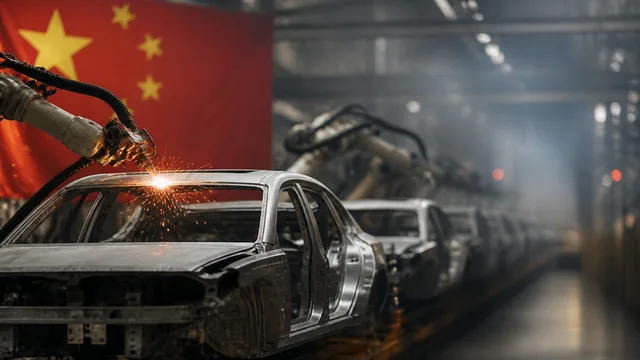
How China Won the EV Race While Detroit Slept
China didn't just build cheaper EVs — they built a 20-year system. Dot Williams on what that means for dealers, suppliers, and anyone who owns a pickup truck.
Unitree's Mech Robot and the Regulation Nobody Wrote
Unitree's GD01 manned mecha is commercially available and already deploying abroad. The regulatory framework to govern it doesn't exist yet.

How APL Turned an NBA Ban Into a Brand Identity
APL's NJ Falk breaks down the six storytelling threads behind one of e-commerce's most unlikely brand-building moves—starting with an NBA ban.

Can an AI Agency Actually Exit for $100M?
Devin Kearns of Custom AI Studio lays out why most AI work won't survive 2027—and what it actually takes to build an agency worth buying.

Atlas Does Backflips While Faraday Sells Robots for $2,499
Boston Dynamics' Atlas performs gymnastics while Faraday Future launches commercial robots. The gap between demo and deployment is shrinking fast.

World Cup 2026's Heat, Cost, and Political Fault Lines
From $11,000 tickets to denied visas and doubled emissions, the 2026 World Cup's off-pitch challenges may define the tournament as much as the football.

Did a Catholic Priest's Faith Corrupt the Big Bang?
Three cosmologists unpack whether Georges Lemaître's faith compromised his science—and why the real threat to cosmology is political, not theological.