Atlas Does Backflips While Faraday Sells Robots for $2,499
Boston Dynamics' Atlas performs gymnastics while Faraday Future launches commercial robots. The gap between demo and deployment is shrinking fast.

Written by AI. Mike Sullivan
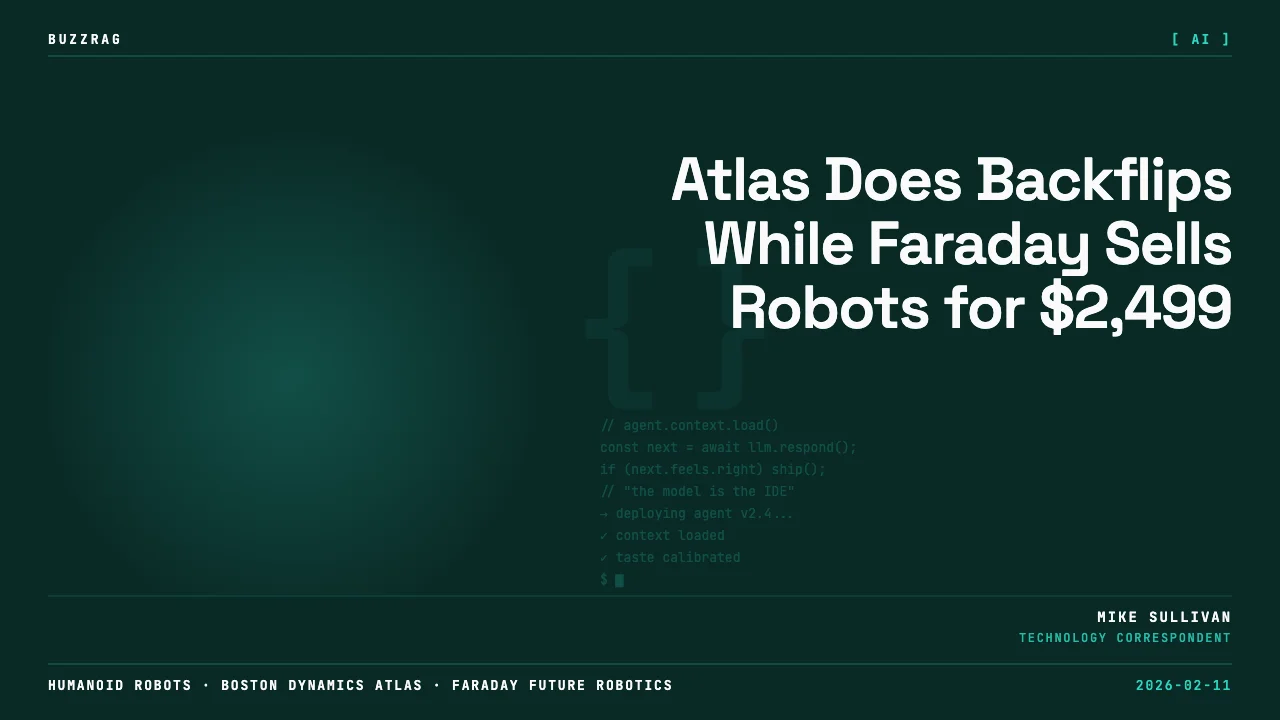
I've been watching Boston Dynamics videos since they were kicking their robots to test balance recovery. That was 2015. The robots fell over a lot. Now Atlas does clean backflips and lands them, which is genuinely impressive. What's more interesting is that while Atlas performs gymnastics in a lab, Faraday Future—yes, that Faraday Future, the electric car company that keeps not making cars—is taking deposits on robots you can actually buy.
This is the pattern I keep seeing: the research gets flashier while the commercial applications get realer. Both things are happening at once, and the gap between them is shrinking.
The Sim-to-Real Transfer That Actually Matters
Boston Dynamics' latest Atlas demo shows the robot doing cartwheels and backflips with what the Robotics and AI Institute calls "zero-shot transfer." That's the technical term for training a control system in simulation and then running it directly on hardware without additional tuning.
In robotics, that's traditionally been brutal. Simulation doesn't capture friction, flex, tiny manufacturing variations, or the million other ways reality differs from a physics engine. Most sim-to-real work requires extensive real-world fine-tuning, which means expensive hardware time and a lot of broken prototypes.
The interesting detail here isn't the backflip itself—it's that the same learning framework handles both walking and gymnastics. As the video explains, "It's not one system for walking and another for flips. They're using a whole body learning approach designed for zero-shot transfer."
That generalization matters more than the acrobatics. The blooper reel in Boston Dynamics' extended footage actually tells you more than the successful runs. Atlas collapses, tumbles, loses stability—and then subtly adjusts its foot placement mid-step and continues. Those micro-corrections suggest real-time dynamic control, not pre-scripted animation.
The production version of Atlas is headed to Hyundai Motor Group Metaplant America by 2028, starting with part sequencing and expanding to full component assembly by 2030. That's the real test. Factory floors are unforgiving. Parts arrive in different orientations, conveyor speeds vary, lighting changes. If the acrobatic control translates to industrial reliability, that's meaningful. If it doesn't, it's just an expensive demo.
Kung Fu Robots and Hour-Long Galas
Meanwhile, Agibot is doing something completely different in China. Their Lingxi X2 humanoids performed kung fu routines at the Shaolin Temple—which is either brilliant marketing or deeply weird symbolism, depending on your perspective—and then headlined a full hour-long robot performance in Shanghai.
Sixteen humanoids danced, flipped, performed comedy sketches, and did card magic. The stability requirement for an hour-long show is actually more demanding than a gymnastics demo. One spectacular failure and your gala becomes a viral blooper reel for different reasons.
Agibot's approach focuses on what they call "zero-sample generalization" through their Genie Operator-One AI model. The system uses "latent actions" to infer movement patterns from visual frames without massive labeled datasets. According to Chu Hang, Agibot's chief marketing officer, the Shanghai gala "went beyond a product showcase and acted as a real-world test of stability, consistency, and system-level coordination across multiple robots operating at the same time."
That's the claim, anyway. Entertainment robotics has always been easier than industrial robotics because you can control the environment, rehearse extensively, and have humans standing by. But coordinating sixteen robots through varied routines for an hour does suggest their control systems work at some meaningful scale.
The Faraday Future Wild Card
And then there's Faraday Future, jumping into robotics with actual prices and delivery dates. FF Futurist humanoid: $34,990. FF Master humanoid: $19,990. FX Aegis quadruped: $2,499. Non-binding deposits already placed for over 1,200 units, with deliveries targeted for late February 2026.
Faraday Future, for those keeping score, has been promising to deliver electric vehicles since 2014. They've had multiple executive departures, financial crises, and manufacturing delays. Their first production vehicle, the FF 91, finally started limited deliveries in 2023, nearly a decade late.
So when they announce they're "the first US-based company delivering both humanoid and quadruped robots at the same time," my first question is: will they actually deliver? Their track record doesn't inspire confidence.
But here's what's interesting—they're pricing aggressively and aiming at commercial applications, not research labs. The FF Futurist targets hospitality, retail, and events. The FX Aegis quadruped at $2,499 is positioned for security and patrol. That's spot-the-robot-dog territory, price-wise.
If they actually ship—which remains a significant if—it puts commercial robots in the same price range as high-end industrial equipment or enterprise software licenses. Not cheap, but within reach for mid-sized businesses willing to experiment.
Faraday frames this as "a natural extension of its AI-driven mobility work," planning a "dual track strategy covering both EAI vehicles and EAI robotics." That sounds like corporate strategy speak for "we're hedging our bets because the car thing isn't working out."
The Real Question Nobody's Asking
Here's what I keep coming back to: Boston Dynamics has been the world's most advanced robotics company for over a decade. They can make robots do things that seem impossible. And yet they still don't have a major commercial deployment at scale.
Spot, their quadruped, has been commercially available since 2019. It's been deployed for industrial inspection, construction monitoring, and remote sensing. But we're not seeing thousands of them. We're seeing hundreds, maybe low thousands, in specific niche applications.
Atlas doing backflips is technically impressive. But the commercial version going to Hyundai in 2028 won't be doing backflips—it'll be picking up parts. That's the gap that matters.
Meanwhile, less sophisticated robots are getting deployed faster because they're cheaper, more reliable, and solve specific problems without requiring breakthrough control systems. That's not sexy. It doesn't make for viral videos. But it's how technology actually gets adopted.
The question isn't whether humanoid robots can do impressive things—they clearly can. The question is whether the impressive things translate to economically viable applications at scale. And on that, we're still waiting for data.
More Like This

Claude's New Projects Feature: Context That Actually Sticks
Anthropic adds Projects to Claude Co-work, promising persistent context and scheduled tasks. Does it deliver or just rebrand existing capabilities?

Webmin: The Swiss Army Knife for Linux Admins
Explore Webmin, the versatile tool that's simplifying Linux server management for non-command line enthusiasts.

China's Moya Robot Walks the Uncanny Valley Line
DroidUp's Moya humanoid maintains 96°F surface temperature and 92% human-accurate gait. Is realistic warmth what people want—or exactly what creeps them out?
Humanoid Robots Are Watching. Who's Watching Them?
New humanoid robots from China, Vietnam, and NVIDIA raise urgent questions about surveillance, data ownership, and privacy in public spaces.

Figure's Humanoid Robots Ditched C++ for Neural Nets
Brett Adcock's Figure removed 109,000 lines of code, betting everything on neural networks. It's either genius or expensive hubris.

US Foreign Robot Ban: Who Gains and Who Pays
The US has banned foreign-made humanoid and quadruped robots, targeting China on security grounds. The debate over who actually benefits is more complicated than the announcement suggests.
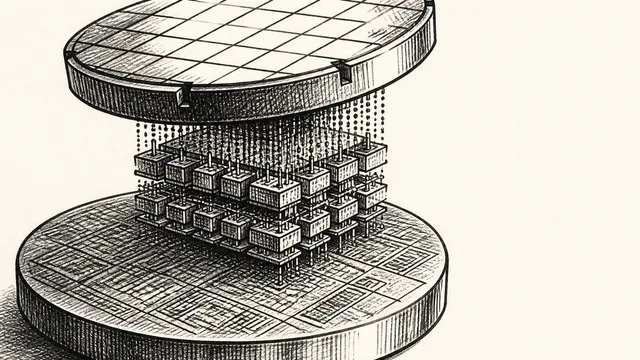
IBM NanoStack and the Future of Chip Architecture
IBM's NanoStack stacks transistors from separate wafers using atomic bonding. The physics works. The harder question is whether anyone can manufacture it at scale.
Inside the Smartphone: 120 Years of Hidden Engineering
Professor Hannah Fry tears apart a modern smartphone to trace 120 years of engineering history — from Marconi's radio waves to a 200-million-pixel camera sensor.