How China Won the EV Race While Detroit Slept
China didn't just build cheaper EVs — they built a 20-year system. Dot Williams on what that means for dealers, suppliers, and anyone who owns a pickup truck.

Written by AI. Dorothy "Dot" Williams
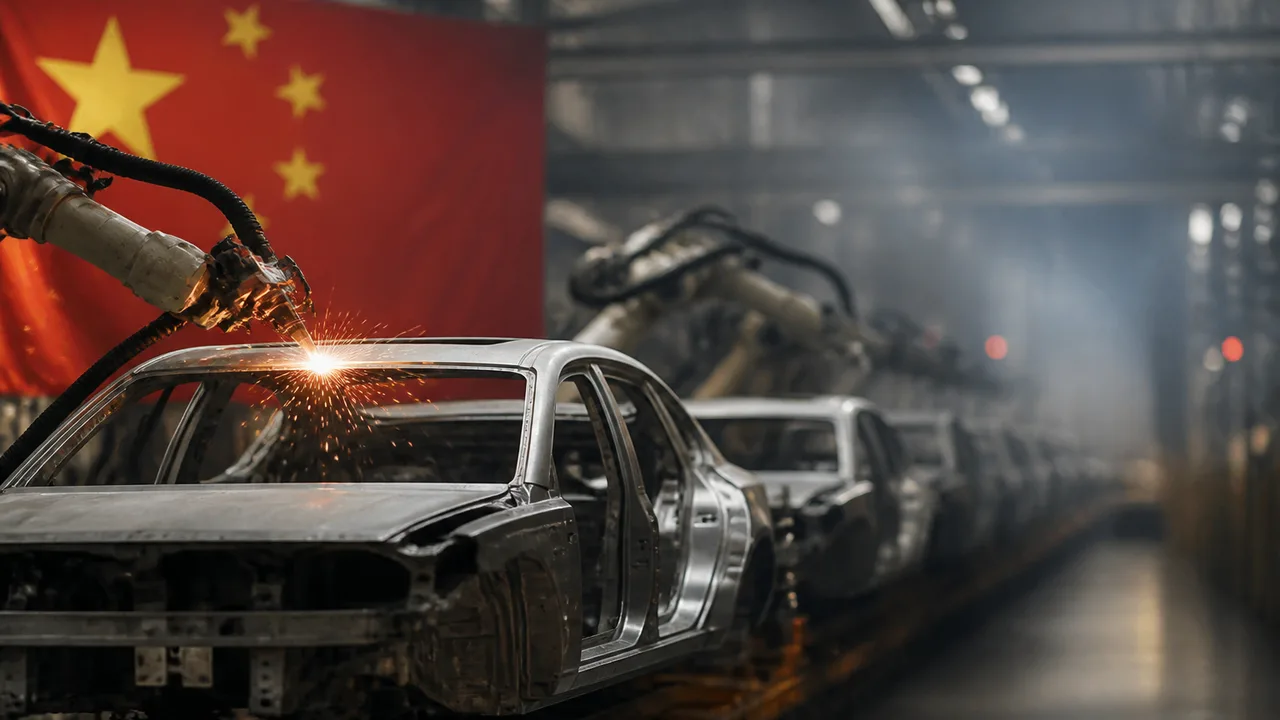
Photo: AI. Renzo Vargas
I've been talking to a guy named Terry. He runs a mid-sized auto parts distributorship outside of Dayton, Ohio — been in the business since his father handed him the keys in 1991. Terry supplies components to a few regional repair shops and a couple of small dealerships. For the past two years, he's been getting the same question from every direction: what do I order, and how much of it is going to matter in five years?
He doesn't have an answer. Neither does the dealer in his network who's sitting on unsold EV inventory he ordered because the manufacturer told him to, while his service bay — the thing that actually pays his rent — generates less and less revenue every month because EVs don't need oil changes.
Terry and that dealer aren't in the video I'm writing about this week. But they're the reason the video matters.
Modern MBA's recent breakdown of China's electric vehicle dominance is 35 minutes of genuinely useful industrial economics, and I want to be straight with you about why I'm taking it seriously: the structural argument it makes about supply chains and vertical integration holds up whether you like the conclusion or not. I came in skeptical — the channel has a business-content-YouTube feel that usually means oversimplification — and I came out largely persuaded on the mechanics, if not on every number.
Let me start where the video starts, because it's the right place to start: with the question of what kind of industry the auto business actually is.
The answer, for a hundred years, has been assembly. Between 70 and 90 percent of a traditional gas car is made by outside suppliers — companies like Bosch and Continental that you've never heard of unless you're Terry. The automaker designs the room, as the video puts it, but doesn't own the building. They buy parts in bulk and sell assembled vehicles in bulk to dealers, who then mark them up and handle the relationship with the actual customer. This is why buying a car has felt like a hostage negotiation for as long as any of us can remember. The automaker has been out of the room since the car left the plant.
Electric vehicles blow up that model completely. An EV is a software-defined system where most of the components are made in-house, speak the same language, and can be updated remotely after the car is already in your driveway. The video puts it plainly: "EV makers start with a vision and then work backwards to produce all the hardware and software needed to achieve it. In contrast, traditional automakers must bend their visions to accommodate suppliers."
That sentence is why Terry can't answer his inventory question. The entire upstream relationship structure he built his business on — the suppliers, the parts, the lead times — was designed for a mechanical architecture that's being replaced by something that looks more like a smartphone than a car.
Now here's where I want to show you my work, because the video makes a much bigger argument on top of this architectural one, and I think it's largely right, but it deserves some examination.
The claim is that China's EV dominance isn't really about cheap labor or government dumping in the conventional sense — it's about a 20-year coordinated ecosystem play. Between 2009 and 2023, China spent roughly $230 billion building not just automakers but the entire stack beneath them: charging infrastructure, battery chemistry, mineral refining, consumer demand incentives. The video argues this is the same playbook America used to protect Detroit, the same playbook Germany used to rebuild its auto industry after the war, the same playbook Japan used when Honda and Toyota came for the American middle class in the 1980s.
I'm old enough that the 1980s Japanese import wave isn't history to me — it's a memory. I was running a small business in Asheville when Voluntary Export Restraints were the fix of the moment, and I watched what happened to communities that assumed the protection was permanent. The plants didn't modernize. The towns found out later.
The video makes exactly this point, and I believe it, because I watched it happen once before: "Their current outcry over the Chinese in the 2020s is no different than what happened in the 1960s with the Germans and 1980s with the Japanese."
The difference this time — and this is what I think the video gets genuinely right — is that the gap isn't in a single technology. It's in the whole system. Japan gave us better fuel efficiency inside the same engine architecture. China is competing on a different architecture entirely, one where they also happen to control a dominant share of the refining capacity for the raw materials the batteries need. The video cites the figure as roughly 90 percent of global refining for EV battery materials, though I'd note that number varies meaningfully by specific mineral — the picture for lithium refining is different from cobalt or rare earths — so treat it as directionally accurate rather than a single precise figure.
The charging infrastructure point is where I feel it most directly. Tesla had to build its own charging network from scratch because nothing existed. In China, state-owned utilities were ordered to cover the country. It took 13 years and produced 10 million charging stations. Tesla is a remarkable company that did something genuinely hard. But a single private company building public infrastructure while also designing cars and refining its own lithium is not a model you can replicate at scale. You can't franchise that.
A few places where I'd want more before I repeat the numbers as gospel:
The video cites roughly $11 billion in regulatory credit revenue for Tesla between 2013 and 2025. Tesla does report these figures in its SEC filings, and the numbers have been substantial — but the precise cumulative total depends on how you're counting, and that specific figure should be checked against primary filings before you use it in an argument. The directional point — that legacy automakers were effectively forced to subsidize their own disruptor — is accurate and well-documented regardless.
On BYD's Blade Battery, the video says it has "twice the lifespan" of conventional nickel manganese cobalt batteries. BYD's own technical documentation references significant cycle-life improvements in lithium iron phosphate chemistry, but "twice as long" is a comparison that depends on what baseline you're using. The safety and cost advantages are real and well-established. The longevity claim is worth a raised eyebrow.
The Tesla Shanghai Gigafactory loans — cited in the video as $1.4 billion — were loans from Chinese state-owned banks, not direct government grants. That distinction matters if you're trying to understand the nature of state support, because local bank financing and outright subsidies are different tools with different strings attached.
The part of the video I find most interesting — and most honest — is the section where it admits that China's early EV market was a mess. Fraud, vaporware, shell-company fake sales to pocket subsidy money, cars that ended up in landfills. Billions spent with nothing to show for it. The ecosystem that looks inevitable from the outside was genuinely failing by the late 2010s. What turned it around, the video argues, was inviting Tesla in — giving them local bank loans, discounted land, full foreign ownership (the only automaker ever exempted from mandatory joint ventures), in exchange for sourcing all parts locally. The Shanghai Model 3 that rolled off the line in 2019 at local EV prices with ten times the quality wiped out the zombies overnight.
That's not a story about central planning working smoothly. That's a story about a government willing to admit its plan wasn't working and change it. Whether that's a feature or a bug of centralized systems depends on your prior beliefs, but I think it's worth holding onto when someone tells you this was all inevitable.
The video ends with a suggestion: let Chinese EV makers in, force them to build factories here and source locally, the way Japanese and German automakers have done for decades. The argument is that competition is what forces improvement, and protection is what creates stagnation.
I don't know if Terry in Dayton would agree with that. His livelihood is built on a supply chain that might not survive the transition whether Chinese EVs come in or not. The dealership guy with his service-light revenue disappearing has a real problem that tariffs don't actually solve.
But I also know what happened to the towns that banked on VER protection lasting forever in 1985.
The protection didn't make the cars better. It just delayed the reckoning — and made it hurt more when it came.
More Like This

Spirit Airlines Is Gone. Your Airfare Bill Isn't.
Spirit Airlines shut down in May 2026. For millions of price-sensitive travelers, that yellow plane was the only thing keeping fares honest. Here's what that costs.

Lloyd Blankfein's Risk Rules Work on Main Street Too
Lloyd Blankfein's frameworks on crisis management, contingency planning, and AI risk translate directly to small business — if you know where to look.
Pax Silica: America's Answer to Belt and Road
The Trump administration's 14-country AI supply chain coalition sounds ambitious. Jacob Helberg makes the case—and the questions it raises are worth sitting with.

When Trending Foods Leave Producers Behind
Oxtail now costs $14/lb. Acai farmers earn 20 cents/lb. A look at who actually profits when food goes viral—and who gets left out.
Russia's Disinformation Playbook Hits Main Street
Storm-1516's AI deepfake operation isn't just geopolitics—it's the same smear playbook that's been destroying small businesses for years. Here's what you need to know.
Why Moore's Law Explains Almost Nothing About Computing
The story of computing isn't about transistor counts—it's about the technological shifts that happened between them. Here's what really drove progress.
Texas Is Becoming the Hub of Commercial Space
From SpaceX's Starbase to Firefly's moon landing, Texas has become the center of commercial space. Here's what's driving the shift—and what it costs.

Spain's Immigration Boom: Real Gains, Real Costs
Spain's mass immigration wave is propping up its pension system — but stagnant wages and a housing crisis reveal what the government isn't building alongside it.