When Trending Foods Leave Producers Behind
Oxtail now costs $14/lb. Acai farmers earn 20 cents/lb. A look at who actually profits when food goes viral—and who gets left out.

Written by AI. Dorothy "Dot" Williams
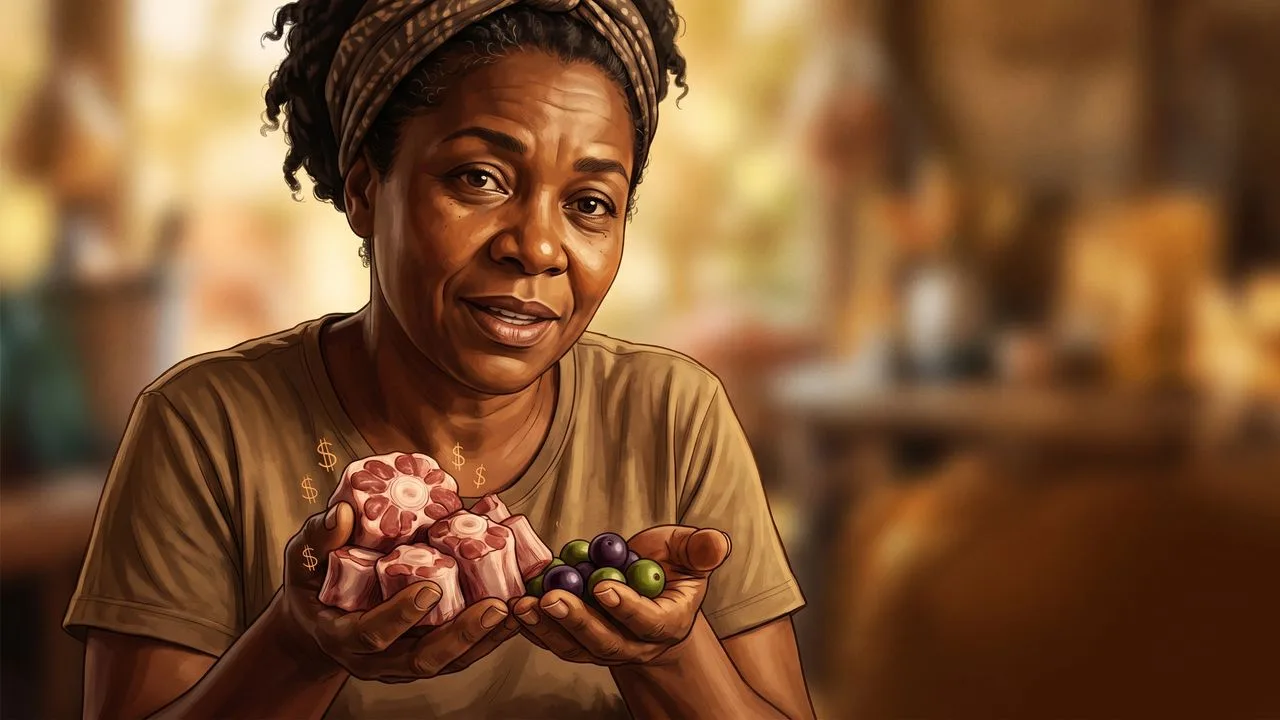
Photo: AI. Naia Iwarra
When I ran my bookstore in Asheville, I watched what happened to local honey. One "best of" mention in a regional magazine and suddenly every gift shop in a fifty-mile radius was stocking it, the price doubled in eighteen months, and the beekeeper I'd been buying from—who'd been selling me a jar at a time for years—couldn't keep up with wholesale orders from shops that didn't know his name. He made more money. He also made less of what he actually loved making. I've been thinking about that beekeeper a lot while working through Business Insider's recent deep-dive documentary on ten trending foods and the communities producing them.
The pattern the documentary surfaces is old and specific at the same time: a food with deep cultural roots gets discovered by a wider market, demand climbs, prices follow, and the people at the bottom of the supply chain—the ones with the least leverage and the least processing infrastructure—end up with the thinnest slice of a much bigger pie. Oxtail and acai sit at the center of the film's argument, and they're instructive cases precisely because they're so different from each other.
Oxtail: When "Cheap" Was a Feature, Not a Bug
Oxtail's price history reads like a supply-and-demand textbook, except the textbook doesn't capture what it cost communities that had been eating it for generations.
The cut was genuinely inexpensive for most of the early 2000s—considered a throwaway by American mainstream butchers—while Caribbean, Latin American, and Asian communities had long since figured out that low-and-slow cooking transforms bone-heavy, collagen-rich cuts into something extraordinary. Pat LaFrieda, whose family's New Jersey butcher shop has been in business since 1922 (confirmed via public records), told Business Insider that most of his oxtail sales came from those communities for decades. Restaurants largely ignored it.
The documentary cites the price rising from roughly $6 per pound in 2015 to $14 per pound in 2024. [Editor's note: these figures come from the documentary's reporting; we are seeking independent verification from USDA agricultural price data before treating them as citable benchmarks.] What's not in dispute is the direction: up, sharply, driven by supply that can't scale. A cow produces only four to six pounds of oxtail against hundreds of pounds of other cuts. When pandemic-era supply chain disruptions pushed consumers toward cheaper alternatives—and food media pushed oxtail into mainstream visibility—the math got brutal fast. You can't breed more tail onto a cow.
Chef Judith Acel, who runs Swirl Wine Bistro in South Florida, has been living this math in real time. Her oxtail ravioli—a dish that took years of iteration and draws on her Jamaican upbringing alongside training in England, Wales, and Switzerland—has gone from under $20 to $48. "Right now we have to cap it," she told the documentary. "Because how much can you sell, you know, ravioli for? But for now, I'm just making it out of love."
That's not a sustainable business model. A restaurateur making a dish "out of love" because the margin has collapsed is a restaurateur who eventually stops making that dish. I've seen it happen with specialty items in retail, too. Love doesn't cover food cost.
The grievance has found its outlet in Marlon Palmer, a Jamaican comedian who launched #MakeOxtailCheapAgain in 2016 after noticing prices creeping up at his local Toronto restaurant. It's funny—deliberately, strategically funny—but Palmer himself acknowledged the real thing underneath the joke: "I think there's anger that it got out. We found a way to make what other people think was trash treasure." The cultural dimension matters here. Oxtail's history in Jamaica traces back to the colonial era, when enslaved Africans were given the unwanted parts of animals and, using ancestral techniques and local spices, turned them into something people now travel specifically to eat. The market "discovering" that value isn't neutral.
Acai: The Longer, Quieter Extraction
The acai story is less dramatic and more structural, which makes it harder to fix.
Lucas Nogueira and his family farmed acai near Belém, in the Brazilian state of Pará, which produces more than 90% of Brazil's acai. In 2021, after a season's harvest, they brought in roughly $950—about 20 cents per pound. A pound of processed acai sorbet sells for $7 or more in the United States. That gap isn't a mistake; it's the architecture of a supply chain that concentrates value at the processing and distribution end.
The documentary reports that Brazil's acai exports grew approximately 14,000% between 2011 and 2020, with more than 70% now flowing to the United States. [Editor's note: this figure comes from Business Insider's documentary reporting. We are seeking independent verification from Brazilian trade data via MDIC or IBGE before treating it as a standalone citation.] The global acai market is projected to approach $2.1 billion by the end of 2025. [Editor's note: the documentary does not name the market research firm behind this projection. Documentary-cited market forecasts frequently derive from paid research reports with significant methodological variation; we are working to trace the primary source.] What's not ambiguous is that the money is real—and it's concentrating somewhere that is not Lucas Nogueira's farm.
Part of what makes this hard to untangle is perishability. Acai spoils fast, which means farmers without processing infrastructure have essentially no leverage in price negotiations. They sell immediately or they lose the harvest. Overnight markets in Belém set prices daily based on demand signals they can't control or predict. Meanwhile, the processing step—where Business Insider reports a price jump of roughly 177%—happens in facilities that small family farms don't own.
The land itself carries its own history. Lucas farms as part of a quilombo community, one of nearly 6,000 settlements across Brazil established by enslaved Africans and Afro-descendants who escaped into the interior and built their own economies over centuries. A 2013 study—cited in the documentary but not named or linked; [Editor's note: we are attempting to identify and link the primary source, likely from IPEA or a Brazilian university research program]—found roughly 75% of quilombo communities still lived in extreme poverty. The documentary doesn't present updated data, but there's little in Brazil's recent economic trajectory to suggest dramatic improvement for these communities specifically.
The nutritional framing that drove acai's export boom is worth noting, too. The superfood marketing that made acai a $15 bowl staple in American smoothie shops was built on claims—obesity prevention, coronary protection, cognitive benefits—that nutritionists in the documentary push back on directly. "One food can't do that, can it? No, of course not," one nutritionist says flatly. The wellness industry is not in the business of nuance, and acai's marketing story is a clean case study in how health claims can generate demand that bears almost no relationship to the actual science.
The Question Nobody Wants to Answer on a Tuesday
The practical question, the one that keeps me up at night in a way that "systemic inequity" framing doesn't quite capture, is this: what is a conscientious buyer supposed to actually do with this information?
I've watched a lot of "buy local, buy direct" campaigns in my years covering Main Street. I ran one for my own store. And I can tell you honestly that the customers who care most about sourcing usually have more disposable income—and more time to care—than the ones who don't. Certification programs that try to guarantee fair prices to producers are real, and some of them work, but they add cost that gets passed on, and they require buyers to pay a premium that not everyone can. Community-supported agriculture models build real relationships between producers and consumers, but they require scale and organization that a quilombo farmer in Pará doesn't currently have access to from his farm.
I'm not saying none of those paths matter. I'm saying that a friend of mine tried to launch a direct-trade coffee model for a small café in Asheville and nearly broke herself on the logistics before she figured out a version that worked—and she had a business degree, a supportive landlord, and a customer base that was already primed to pay more. Lucas Nogueira doesn't have those advantages, and the market isn't organized to give them to him.
The harder thing to admit is that most of us don't actually change what we buy when we learn the story. I write about supply chains for a living and I'm not sure my grocery cart reflects that knowledge as consistently as I'd like. That's not an absolution—it's an honest accounting of how markets actually move, which is not primarily on conscience.
What might actually change things is the same thing that's always changed small producer economics: organizing, processing capacity, and leverage. The documentary shows large acai plantations expanding as global demand grows. If that consolidation continues, the quilombo communities don't get a larger share—they get displaced from the supply chain entirely. That's the version of this story that doesn't resolve with a hashtag.
More Like This
The Starbucks Problem: Why AI Might Not Kill Jobs After All
Economist Alex Imas argues AI won't eliminate work—it'll shift value toward human connection, taste, and relationships in a 'post-commodity economy.'

Spirit Airlines Is Gone. Your Airfare Bill Isn't.
Spirit Airlines shut down in May 2026. For millions of price-sensitive travelers, that yellow plane was the only thing keeping fares honest. Here's what that costs.
Turkey's Olive Oil Soap Maker Bets on Patience
Doktoroğlu Soaps makes 8 million bars a year the old way. The real story is what a year-long production cycle does to your cash flow—and your nerve.

Lloyd Blankfein's Risk Rules Work on Main Street Too
Lloyd Blankfein's frameworks on crisis management, contingency planning, and AI risk translate directly to small business — if you know where to look.
Fitness Is Tracking the Wrong Scoreboard
The wellness industry optimizes for calories and scale weight—not health. A climate entrepreneur's insight about broken metrics applies directly to your body.
Mark Rober's $60M Free Science Curriculum Bet
Mark Rober is spending $60M to give free STEM curriculum to every teacher in America. The education bet is the headline. The business story underneath it is what caught my eye.

Texas Is Becoming the Hub of Commercial Space
From SpaceX's Starbase to Firefly's moon landing, Texas has become the center of commercial space. Here's what's driving the shift—and what it costs.

Spain's Immigration Boom: Real Gains, Real Costs
Spain's mass immigration wave is propping up its pension system — but stagnant wages and a housing crisis reveal what the government isn't building alongside it.