Turkey's Olive Oil Soap Maker Bets on Patience
Doktoroğlu Soaps makes 8 million bars a year the old way. The real story is what a year-long production cycle does to your cash flow—and your nerve.

Written by AI. Dorothy "Dot" Williams
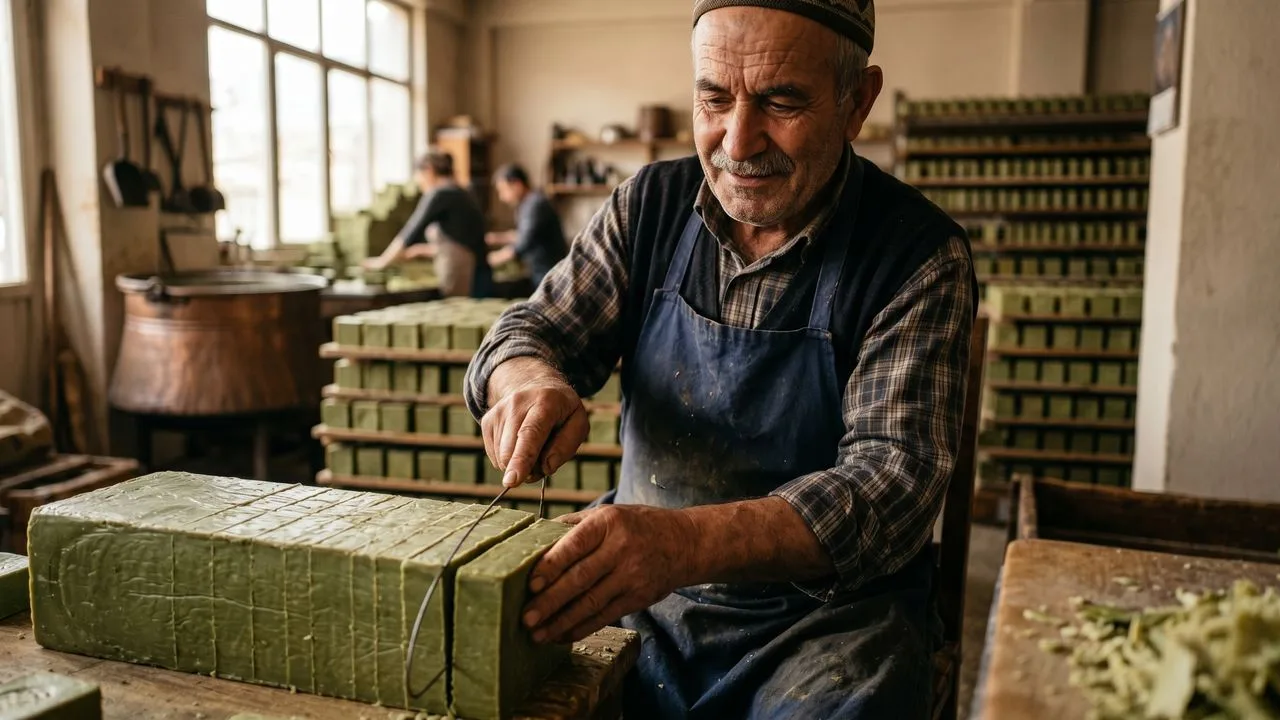
Photo: AI. Naia Iwarra
They pour the hot soap mixture directly onto the factory floor—thousands of square feet of it—and then they walk away. The liquid has to rest overnight. It has to cool on its own terms, settle into itself, begin the long process of becoming something solid and sellable. You cannot rush it. That's not a philosophy. That's a production constraint, and at Doktoroğlu Soaps in Nizip, southern Turkey, it cascades into every financial decision the business makes.
This is what a Business Insider video on the factory gets right without quite saying it: the most interesting thing about making 8 million bars of handmade olive oil soap every year isn't the craft. It's the capital structure that craft demands.
A Year Before You See a Dollar
Here's the actual business problem. Olives are harvested from November to March. That's your production window—three to five months, maximum. The soap that gets poured onto the floor in December won't be hard enough to sell until June. It needs six months of drying to reach the density and shelf life that customers are paying for. So you produce in winter, you wait through spring, and you start selling in summer—against payroll that ran all year, ingredient costs you paid upfront, and floor space that's been occupied by slowly hardening inventory for half a year.
That's not a cash flow problem. That's a cash flow architecture. Your working capital is tied up in soap that isn't soap yet, sitting in stacked formations on the upper floors of your factory while the bills keep coming in regardless. I ran a bookstore for twelve years and I thought seasonal inventory was hard to manage. A bookstore's slow inventory at least stays liquid—you can discount it, return it, move it. You cannot move soap that's still drying.
The video shows the stacking process: workers build towering dome formations, each holding roughly 7,500 bars, with deliberate gaps between every bar so air can circulate. The newer stacks are deep olive green. The older ones have faded to a lighter, almost dusty color—the visual proof that the soap is curing correctly. It's a beautiful system. It's also a beautiful picture of money you can't touch yet.
And then there's the distributor relationship. Doktoroğlu sells in packs of 24 to distributors who then set their own retail price. That's a common arrangement, and it's not a bad one, but it means you're absorbing all of the production risk—the timing, the ingredient cost, the six-month wait—while someone downstream captures margin you'll never see. When your production cycle is this long and your pricing power at the end of it is this limited, you need volume and you need your distributor relationships to hold. Neither is guaranteed.
The Hedge Bet
Arhan, whose grandfather founded Doktoroğlu in 1965, knows exactly what he's running. The video notes, almost in passing, that the factory also produces machine-made soap varieties—rose, clay, honey—because they can't run the handmade lines year-round.
Read that again. The third-generation owner of one of Turkey's largest handmade soap producers is running a conventional machine-made soap line to keep the business solvent between olive seasons.
That's not a compromise. That's smart. Every small business owner I've talked to over twenty years has some version of this: the catering company that takes corporate lunch contracts to bridge the slow wedding months, the furniture maker who sells commercially produced accessories alongside the custom pieces, the indie bookstore that builds out a gift section because margins on candles beat margins on paperbacks by a mile. You protect the thing you love by being practical about everything around it. Arhan's rose and clay soaps are funding his grandfather's legacy. There's nothing romantic about it—it's just what keeping a business alive actually looks like.
The question worth asking is whether that hedge holds as the "natural products" market matures. Right now, Doktoroğlu's handmade line has genuine positioning: three ingredients (olive oil, water, and lye), a process unchanged for generations, provenance you can trace to a specific harvest season. That's a real story, and real stories are worth real money to a subset of buyers. But if the machine-made line starts to feel like it's diluting the brand, or if a larger industrial player decides to market their synthetic bars as "simple" and "clean," the positioning gets crowded fast.
What Conflict Does to a Supply Chain
The video makes a point of visiting olive oil soap producers in the West Bank and Lebanon—places historians consider among the earliest centers of the craft. The Business Insider team visited Al-Shaka Soap Factory in Nablus in 2020, when, according to the video, the West Bank had gone from nearly 40 operating workshops to around 15. (Both figures come from the video without sourced verification, and given how rapidly conditions in the region change, treat them as directional rather than precise.)
The business story here is specific and worth naming plainly. Workers at the Nablus factory don't have hoses to spread the liquid soap—they carry it in buckets, trip after trip, back and forth from the tanks. In Lebanon, workers at Masban Aida make roughly 700 bucket runs to cover the floor with a single batch. That's not tradition. That's what undercapitalization looks like in a production process. When a business can't access financing, can't reliably get to export markets, and operates in an environment where the next disruption could shut the floor down tomorrow, you don't invest in hoses. You do what you can with what you have, and you hope the run of stability lasts long enough to matter.
The craft in Nablus and Aleppo has roots that arguably predate Turkey's industry—historians place Nablus soap production as early as the 9th to 10th centuries, though it's worth noting that Aleppo's famous laurel soap uses bay laurel oil alongside olive oil, making it a distinct tradition that the video conflates somewhat loosely. But the age of the tradition doesn't protect the businesses. The businesses in the West Bank are more expensive to operate (higher ingredient costs, the video notes), less able to reach export markets, and competing in a global "natural soap" trend they helped create but can't fully participate in. That's the cruel arithmetic of geography and instability.
The Museum Question
Nizip has a 400-year-old building that used to be a working soap factory and now operates as a museum, drawing thousands of visitors a year to see what the production process looked like across its different stages.
I've watched a lot of communities build museums around industries that didn't survive. Sometimes that's the right call—preservation is legitimate, and documentation matters when the living practice is dying. But Doktoroğlu is still running. The craft isn't dead here; it's producing 8 tons of soap a day. The museum, in that context, functions less as an elegy and more as marketing infrastructure—a visitor experience that explains why this product is worth more than the industrial alternative. That's actually a savvy move. You're not just selling soap; you're selling the story of soap. The museum makes the story legible to people who'd otherwise have no frame of reference for why a six-month drying process justifies a premium price.
I've seen enough "heritage" marketing go sideways to know it's not a guaranteed strategy. But as a complement to an active production business with genuine process integrity? It's a reasonable investment in customer education.
What "Traditional" Is Actually Worth at Checkout
The natural products market is real. Consumer surveys consistently show preference for simple ingredients, clean labels, and products with traceable origins. That preference has built a meaningful segment of buyers—particularly among people with sensitive skin, as the video notes, who have functional reasons to avoid the synthetic fragrance and coloring agents that can run 20 ingredients deep in mass-market bars.
But I've also watched enough small businesses bet the whole operation on a consumer preference that turned out to be an aspiration rather than a purchase decision. People tell you they want natural. They tell you they want local. They tell you they want the thing made the old way. And then a meaningful percentage of them buy the cheaper version because it's right there and the difference at the register is too easy to rationalize.
What Doktoroğlu has going for it is that the product integrity is real and visible. The color change as the soap ages, the three-ingredient formula, the process that requires actual workers doing actual skilled work—these aren't brand claims. They're verifiable facts that hold up to scrutiny. In a market where "artisanal" has been so thoroughly diluted by mass producers using it as a label, genuine provenance still commands a premium from buyers who know how to evaluate it.
The machine-made line suggests Arhan understands that you can't run a business on premium positioning alone. You need volume, you need something to sell in the off-season, you need a product that can compete on the middle shelf while you cultivate the customers who'll reach for the top one. That's not selling out the tradition. That's how you keep the tradition funded until the market catches up to it.
The floor is cooling. The soap is hardening. The question for every small producer betting on "natural" and "traditional" as a market position is whether they've built enough runway to wait it out.
More Like This

Dozzle: The Docker Log Viewer That Does Less (On Purpose)
Dozzle is a 7MB tool that streams Docker logs to your browser. No storage, no database, no complexity. Better Stack shows why that's the point.

Amazon Spring Sale Tech Deals: What's Actually Worth It
Tech reviewer Alex covers 10 Spring Sale deals, from charging stations to OLED monitors. We examine what's genuine value and what's seasonal hype.
6 Claude Code Skills That Actually Sell to Businesses
Nate Herk spent 400 hours in Claude Code and found 6 skills businesses keep paying for. Here's what they do—and what to verify before trusting the hype.

Spirit Airlines Is Gone. Your Airfare Bill Isn't.
Spirit Airlines shut down in May 2026. For millions of price-sensitive travelers, that yellow plane was the only thing keeping fares honest. Here's what that costs.
Understanding the 7 Levels of Business Growth
Explore the 7 levels of business growth, from dreamer to industry leader, with insights for each stage.
Russia's Disinformation Playbook Hits Main Street
Storm-1516's AI deepfake operation isn't just geopolitics—it's the same smear playbook that's been destroying small businesses for years. Here's what you need to know.

Texas Is Becoming the Hub of Commercial Space
From SpaceX's Starbase to Firefly's moon landing, Texas has become the center of commercial space. Here's what's driving the shift—and what it costs.

Spain's Immigration Boom: Real Gains, Real Costs
Spain's mass immigration wave is propping up its pension system — but stagnant wages and a housing crisis reveal what the government isn't building alongside it.