Spirit Airlines Is Gone. Your Airfare Bill Isn't.
Spirit Airlines shut down in May 2026. For millions of price-sensitive travelers, that yellow plane was the only thing keeping fares honest. Here's what that costs.

Written by AI. Dorothy "Dot" Williams
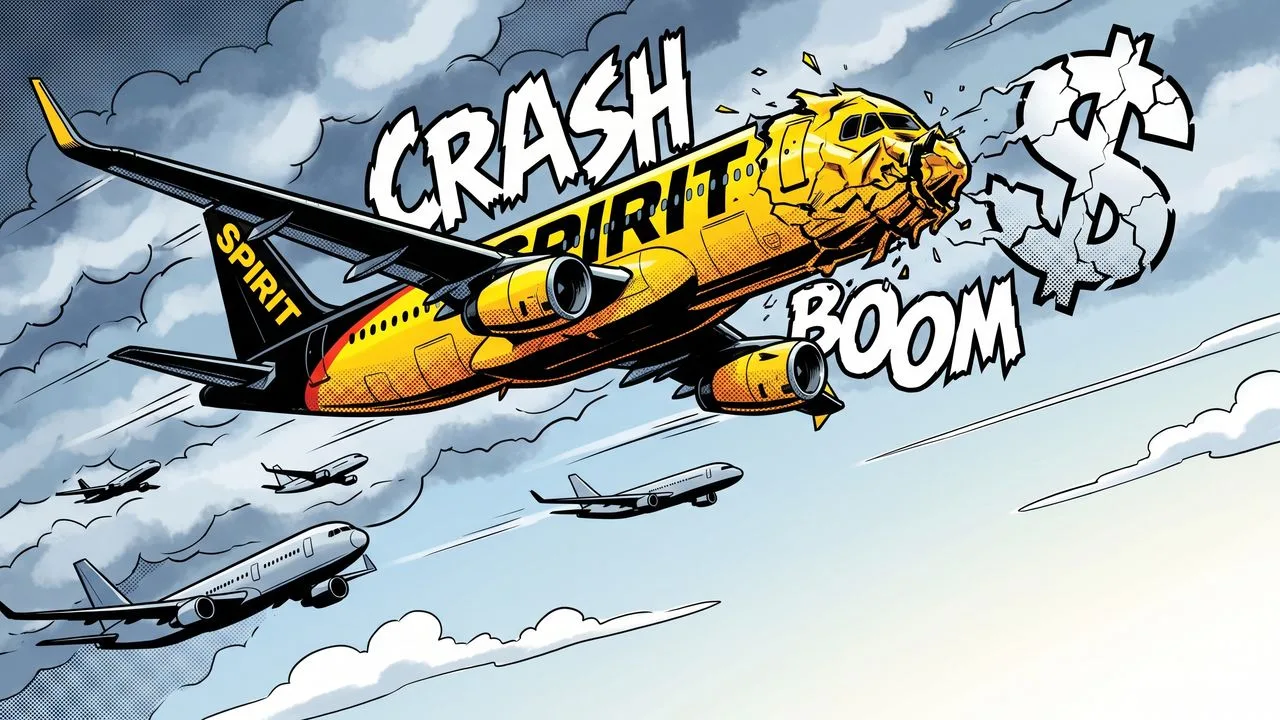
Photo: AI. Marco Velez
When the bookstore I ran in Asheville lost its anchor neighbor — a regional grocery that had anchored that end of the block for twenty years — I didn't feel it immediately. My customers still came in. My coffee still brewed. Then, six months later, I looked at foot traffic numbers and understood what that grocery store had actually been doing for me. It wasn't a neighbor. It was gravity. Spirit Airlines was gravity.
On May 2nd, 2026, Spirit shut down completely. Nine thousand flights canceled overnight. Employees got emails at 12:30 in the morning. 1.8 million summer travelers suddenly had nowhere to go. And the airline industry, which had been quietly watching those bright yellow planes disappear from routes one by one, exhaled.
Here's what that exhale costs you: according to senior aviation reporter Taylor Rains, when Spirit left a route — any route — fares on that route went up an average of 14 percent. That's not a Spirit story. That's a grocery-store-closing story. That's a Walmart-moving-in story. That's the story I've been covering on Main Streets for years, dressed up in aviation terminology.
Spirit's origin story is improbable enough to be charming. The company traces its roots to 1964 as a Michigan trucking operation — the specific cargo type is a detail that varies depending on who's doing the telling — before Ned Homefeld pivoted it into passenger aviation in 1983 as Charter One, running gambling junkets to Atlantic City and Vegas. By 1992, it was Spirit Airlines, four DC9 jets and a whole lot of ambition. By 1993, it was moving a quarter-million passengers and generating $21 million in revenue.
The genius move came in 2004 when Spirit adopted the ultra-low-cost model: you get a seat and a personal item. Full stop. Snacks, baggage, leg room, printing your boarding pass — all extra. Water, apparently, was extra. Water. It sounds outrageous until you realize the base fare was sometimes $39, and that $39 bought a lot of people a relationship with air travel they'd never had before.
Ben Baldanza, who took the CEO role around 2005 (the video places it at 2006; public records suggest otherwise, and this is worth confirming before you repeat it), leaned into the branding with a zeal that made most corporate communications departments faint. After the Deepwater Horizon spill in 2010, Spirit ran an ad. A racy one. The airline was, as a Business Insider breakdown of its rise and fall describes it, "going after gamblers and spring breakers," not high-class travelers. The ads worked precisely because they didn't pretend otherwise.
At its peak in the mid-2010s, Spirit had 200 planes and had forced the entire industry to respond. Delta and American — airlines that had spent decades assuming their brand names were a moat — started rolling out "basic economy" fares to compete. That is the competitive legacy of Spirit Airlines. It made the big guys flinch.
The valuation figures cited in the Business Insider video — $6 billion at peak — should be treated with some caution; Spirit's market cap fluctuated considerably and independent analyses have placed its peak closer to $3-4 billion. The number is disputed enough that I'd want a source and date before I repeated it at a dinner party.
What happened next is the kind of story where every sentence contains a hinge.
The pandemic broke Spirit's cost structure at the same moment it broke its customer's habits. Pilot shortages drove labor costs through the roof. And post-COVID, the traveler who came back to airports wasn't the same person who'd left them. The average flyer wanted free carry-ons, seatback screens, and legroom included in whatever price they saw. Business travelers wanted lounges and lie-flat beds. The pandemic had, somehow, made people more willing to pay for comfort — or at least more aware of what they were missing when they didn't have it.
Spirit tried. It added extra legroom options. It refreshed "Big Front Seat," its version of first class. It bundled fares to make the add-ons less maddening. None of it worked, and I'll tell you why in two sentences, because I watched this exact movie play out on Main Street for three decades: you cannot spend twenty years telling customers exactly who you are and then ask them to forget it because you added a fancier seat. I tried to add a wine bar to my bookstore once. My customers were lovely about it. They still came in to browse paperbacks and buy nothing.
The Business Insider breakdown puts it more bluntly: "They were essentially a Waffle House trying to be a Michelin star restaurant." I want to be clear that Waffle House is excellent and I will die on this hill. But the metaphor is right. You are what you are. Spirit was a $39 fare. Trying to be Delta with Spirit's cost structure was always going to end badly.
In four years, Spirit lost $2.5 billion. JetBlue tried to buy it in 2022; a federal judge blocked the deal on antitrust grounds in 2024. Spirit filed for bankruptcy in November 2024, cleaned up its balance sheet, then promptly ran into soaring jet fuel costs — worsened by conflict in Iran — and aircraft lease costs it couldn't cover. By August 2025, it had filed for bankruptcy again with over $8 billion in debt. Talks with the Trump administration about a reported $500 million bailout — the figure comes from the video; the sourcing on those negotiations is thin enough to flag — ultimately stalled when the government couldn't find the funding.
May 2nd, 2026. Lights out.
I want to sit with what that actually means for a minute, because the industry coverage has a way of turning real people into data points.
Yananisha Thomas found out Spirit was shutting down from an email that arrived at 12:30 in the morning. She'd been with the airline for four years. "It's like a family or it's your home," she said in the Business Insider video, "and now your home is burnt down and you have to start from the ground." If she wants to move to United, she faces four weeks of training — some of it unpaid — to learn an entirely new aircraft type. She starts over. Seniority, familiarity, the rhythms of a job you know — gone.
And then there's the other thing, the thing that hits me harder because of where I've spent my working life. Spirit wasn't just a cheap flight. In some parts of Florida, Spirit was the only flight. It was the sole carrier connecting smaller communities to the broader country. The Business Insider reporting makes this plain: "It's the entire towns in Florida where Spirit was largely the only way to get there. So all of the communities, employees that were in that town that supported the operation, that's all gone."
I've seen that happen. Not with planes, but with stores, with services, with the one bank branch, the one pharmacy, the one decent grocery within twenty miles. When the only option leaves, the people who needed it most don't find a better alternative. They go without, or they pay more, or they stop doing the thing entirely. The grandmother in Tampa who sees her grandkids twice a year — she didn't buy Spirit because she liked the branding. She bought Spirit because it was what she could afford, and now that fare is 14 percent higher, or worse, just not available at all. The small business owner flying coach to a trade show in Orlando, watching the ticket cost come out of the same account as the next inventory order — that's a real calculation, and it just got harder.
A TikTok campaign to crowdfund Spirit's revival reportedly collected over $130 million in pledges within days — a claim that deserves scrutiny, because pledges and funds are very different things, and the figure hasn't been independently verified against the campaign's actual filings. The Spirit employees union backed the effort. The sentiment is genuine, and the people behind it understand something the markets don't always price: that competition has value even when the competitor is ugly and cramped and charges you for water.
But running an airline isn't a crowdfunding project. It's pilot rest rules and fuel hedging and lease agreements and regulatory compliance. Wanting to save Spirit and being able to save Spirit were always two different conversations.
Frontier's stock went up after the announcement. JetBlue rolled out $99 fares to Florida. The market filled the gap the way markets do — partially, imperfectly, and with an eye on its own margins.
Budget airfare isn't gone. Allegiant and Frontier and Breeze are still flying. But there are fewer seats, fewer routes, fewer check-in lines, and for the small business owner watching her travel budget and the grandparent who flies twice a year to Tampa, "more expensive" isn't an abstraction. It's the difference between going and staying home.
That's what gravity does when it disappears. You don't notice until you're already off the ground, and then you notice very quickly.
More Like This

The Coding Job Is Now Planning and Review—And Needs New Tools
Louis Knight-Webb argues software engineering is becoming plan-and-review work as AI coding agents mature. He's shutting down his startup to prove it.
Understanding the 7 Levels of Business Growth
Explore the 7 levels of business growth, from dreamer to industry leader, with insights for each stage.
Consulting's Role in Disneyland's Safety Decline
Explore how McKinsey's cost-cutting at Disneyland impacted safety, leading to tragic accidents and raising questions about corporate priorities.
Block Just Cut Half Its Staff. Here's What That Means.
Jack Dorsey's Block laid off 4,000 employees despite growing profits. The reason reveals something fundamental about how AI is reshaping tech work.

The Single-Revenue-Stream Problem in Your Love Life
Anxious attachment isn't just a feeling problem—it's a structural one. The psychology maps onto financial risk theory with unsettling precision.
Lessons Learned: Building a Sustainable Business
Explore Ryan Deiss's insights on sustainable business growth and learn from his challenges and strategies.
Texas Is Becoming the Hub of Commercial Space
From SpaceX's Starbase to Firefly's moon landing, Texas has become the center of commercial space. Here's what's driving the shift—and what it costs.
Spain's Immigration Boom: Real Gains, Real Costs
Spain's mass immigration wave is propping up its pension system — but stagnant wages and a housing crisis reveal what the government isn't building alongside it.