Alexandria's Library Was More Than a Library
Dr. Roy Casagranda's lecture on the Great Library of Alexandria reveals a research institute, innovation hub, and the ancient world's most powerful idea engine.

Written by AI. Helen Papadopoulos
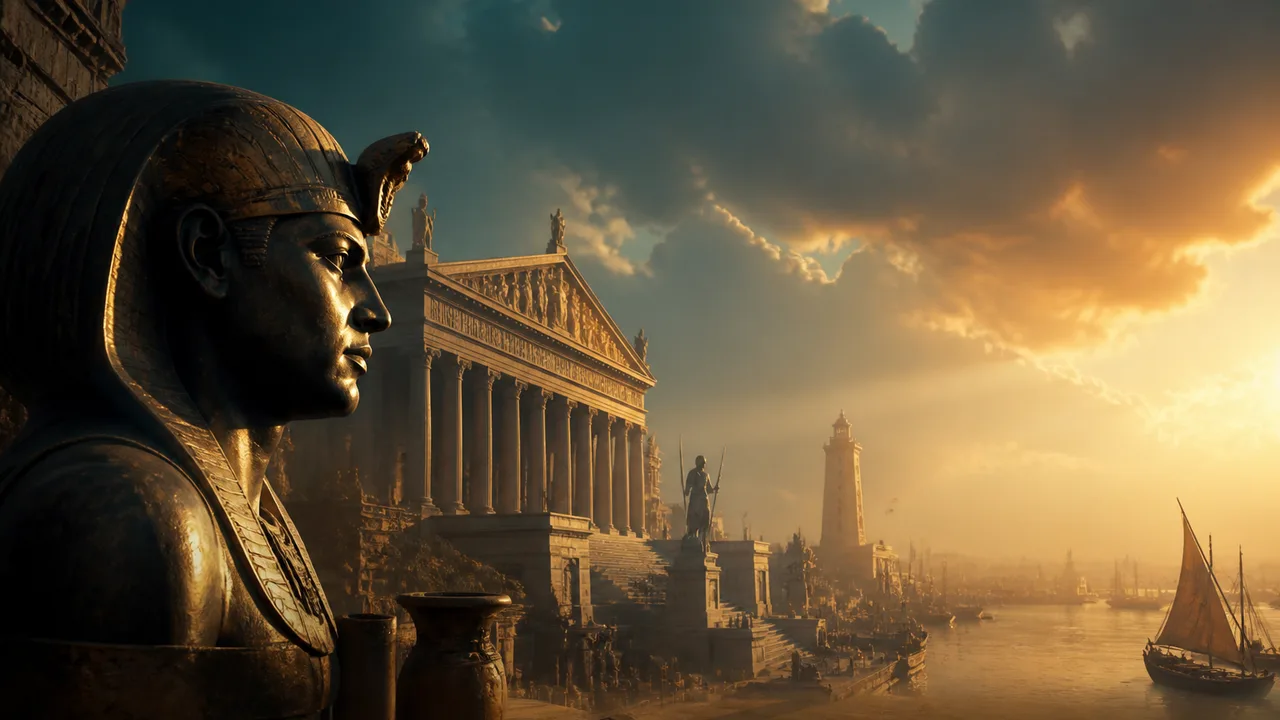
Photo: AI. Astrid Lehmann
We have a habit of mourning the Library of Alexandria as a tragedy of destruction — the fire, the loss, the darkness that supposedly followed. Dr. Roy Casagranda, in a two-hour lecture delivered at Dubai's Museum of the Future, thinks that framing gets nearly everything wrong. The destruction, he argues, is the least interesting thing about the place. What the Library was — that's the story worth telling.
It's a story that begins, unexpectedly, with a question about borders.
The Mediterranean Is Not a Boundary
Before Casagranda gets anywhere near a scroll or a shelf, he spends considerable time dismantling one of the foundational myths of how we organize the ancient world: the idea that the Mediterranean Sea separated civilizations rather than connected them. "The Mediterranean is by no means in any way, shape or form historically ever been a boundary," he says. "It's a superhighway that connects North Africa to Europe to Southwest Asia."
This isn't a throwaway provocation. It's the load-bearing argument of his entire lecture. If you accept that the Mediterranean was a zone of perpetual cultural exchange — linguistically, genetically, commercially — then you stop asking whether the Great Library was a "Greek" institution that happened to be located in Egypt, and start understanding it as the product of that exchange. The Greeks, the Egyptians, the Persians, the Jews, the Romans: they weren't parallel civilizations glancing suspiciously at each other across a sea. They were constantly in each other's houses, borrowing each other's gods, mispronouncing each other's city names, and occasionally murdering each other's children. That intimacy is what made Alexandria possible.
He illustrates the point with Fayum mummy portraits — those extraordinary painted faces placed over Roman-period Egyptian sarcophagi. DNA analysis of the individuals depicted confirmed they were overwhelmingly of native Egyptian descent, many having adopted Greek names and Greek as their primary language. Casagranda's gloss on this: "I think if you went to Egypt right now and looked around, you're going to see people who look just like this person." The question of who the ancient Egyptians "really were" has a straightforward answer. We keep asking it anyway, because the mythology of racial separation from antiquity is too useful to too many people to retire quietly.
How a Macedonian General Ended Up Building the World's Greatest Library
The man most responsible for the Library was Ptolemy I, who came to Egypt by a route that required first understanding Alexander the Great's improbable career and even more improbable death at 32. According to Encyclopedia.com's entry on Ptolemy I, he was educated alongside Alexander under Aristotle at the Macedonian court — part of the cohort of future generals and power brokers that Philip II had assembled around his son. That education, steeped in Aristotelian empiricism and the Greek intellectual tradition, never quite left Ptolemy.
When Alexander died in 323 BC and his generals began carving up the empire, Ptolemy made a calculation that looked eccentric at the time and looks visionary in retrospect. He wanted Egypt. Not Persia, not Macedon, not the rich satrapies of Asia Minor — Egypt.
Casagranda has Ptolemy argue his case to his fellow general Perdiccas by invoking what he'd witnessed during Alexander's Egyptian campaign: the engineering of the pyramids, which were already 2,300 years old when Ptolemy visited them; Egyptian knowledge of anatomy; a civilization that had been compounding its technological expertise for millennia. "They're doing brain surgery," Casagranda's Ptolemy insists. "They know more about human anatomy than the whole rest of the planet combined." This is Casagranda's imaginative reconstruction, not a surviving ancient source — but as a frame for understanding Ptolemy's reasoning, it has real explanatory force.
The strategic logic wasn't purely intellectual. Egypt sat at the trade nexus of the ancient world: the Nile connected to a canal that the ancient Egyptians had built to the Red Sea, meaning a merchant in Athens could sail to India without ever losing sight of the African coast. Every caravan and every ship that passed through Egypt left money, goods, and ideas behind. The place was an innovation engine whether it wanted to be or not, simply because of the density of cross-cultural contact it generated.
Not a Library. A Research Institute with a Library Attached.
Around 297 BC, Ptolemy founded what we call the Great Library — but the name has always been misleading. Casagranda is insistent on this point. Yes, there was a collection of texts gathered from across the known world and translated into Greek, creating something approaching a universal reference archive. But there were also classrooms, resident scholars, and something called the Mouseion — the first institution ever given that name, and the direct ancestor of our word "museum."
The Mouseion bore almost no resemblance to what we call a museum today. It wasn't a repository of old things. It was a working display of the most advanced technology of the era, open to anyone, with no concept of intellectual copyright. "If you made an innovation," Casagranda explains, "you were supposed to bring one of your innovations and put it in the museum to advance to the next level." It was a museum not of the past but of the future — which makes its physical location inside the Museum of the Future in Dubai feel less like irony and more like recognition.
The scholarship that emerged from this ecosystem reads like a catalogue of things we think we invented much later. Aristarchus of Samos worked out a heliocentric model of the solar system at the Library — roughly 1,800 years before Copernicus. Eratosthenes, bored one afternoon, read about a well in Syene where the sun cast no shadow at the summer solstice, compared that to the shadow angle he measured in Alexandria (approximately 7.2 degrees), hired someone to pace the distance between the two cities, and calculated the circumference of the Earth to within roughly half a percent of the correct figure. He then attempted to calculate the distance to the sun, arrived at a number too large to write with the notation available to him — zero had not yet entered Mediterranean mathematics — and stopped. They were that close, and that's the part Casagranda finds almost unbearable.
The Antikythera mechanism — the geared analog computer recovered from a shipwreck near the Greek island of Antikythera, capable of predicting celestial positions by entering a date and turning its gears — points back to the same intellectual tradition. So does Hero of Alexandria's aeolipile: a steam-powered rotating sphere that is, in every meaningful sense, a rocket engine. Hero also built a steam-powered gear mechanism that could enact a narrative sequence with sound effects — moving figures, crashing waves, whistles and clacking. "The first TV, 2,000 years ago," Casagranda says. "Turn it on, you sit there, you drool, and you're entertained."
The Question the Destruction Actually Raises
The Library's end came in stages rather than in a single dramatic fire, and Casagranda's lecture examines how its knowledge survived — through the scholars who carried texts out, through the Byzantine preservation tradition, through the Islamic translation movement that saved enormous quantities of Greek learning during the medieval period. Hypatia of Alexandria, the mathematician and philosopher killed by a Christian mob in 415 AD, appears in the lecture as a figure who represents both the tradition and its vulnerability: what happens to knowledge when political violence decides that certain kinds of thinking are dangerous.
What the story of the Library actually teaches, Casagranda argues, isn't about the fragility of books. It's about the conditions that made the accumulation possible in the first place. "The Mediterranean is a superhighway," he keeps returning to — a zone of encounter, friction, and synthesis. Alexandria worked because Ptolemy deliberately built a city designed to attract foreigners, which meant absorbing the full range of what different cultures knew. The Library wasn't an archive of Greek genius. It was the distillation of the Mediterranean world's collective intelligence, given institutional form.
Which raises an uncomfortable question for the present. We have more information stored and accessible than at any point in human history, and Casagranda is not optimistic about what we're doing with it. "Boredom is the key to creativity," he says, noting that Eratosthenes made his great discovery specifically because he was wandering through the Library with nothing particular to do. "We live in a society where we're in the process of making it so creativity will be very difficult for our species going forward."
The Great Library was destroyed in pieces over centuries. What we're building now is something different: an attention economy that leaves the texts intact and makes it nearly impossible to sit with them long enough to see the shadow at the bottom of the well.
More Like This
Ancient Greek Myths as Warnings About AI and Automation
Historian Adrienne Mayor argues Greek myths about robots and AI aren't just stories—they're 2,500-year-old warnings we're actively ignoring. A closer look.
WW1 Trench Life: What the Western Front Was Really Like
From Pals' Battalions to the Vickers gun, a new documentary unpacks the grim machinery of survival on the WW1 Western Front in unflinching detail.
Common History Myths That Schools Still Teach
From Napoleon's height to Viking helmets, a new video maps the historical myths that textbooks kept alive—and asks why bad history is so hard to dislodge.
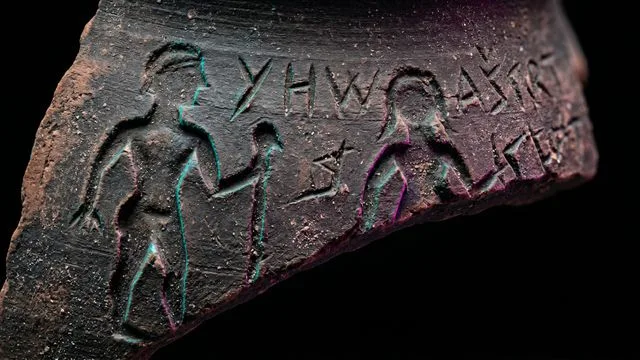
Asherah: Was She the Wife of the God of Israel?
Inscriptions, figurines, and Ugaritic myth suggest ancient Israelites worshipped a goddess alongside Yahweh. The evidence is real. The debate is very much alive.
Inside Anthropic's Project to Scan Millions of Books for AI
Anthropic's Project Panama destroyed hundreds of thousands of books to train Claude. Here's how AI companies are turning literature into training data.
Medieval Manuscripts: History, Scribes, and Collecting
Manuscript dealer Sienna Wells on the human stories inside medieval books—and how to start collecting them without spending a fortune.
Ancient Maps That Modern Archaeology Proved Accurate
From a Bronze Age rock carving to Ptolemy's coordinates, ten ancient maps have been verified by modern archaeology. What does that tell us about lost knowledge?
Homer's Odyssey and the Philosophy of Mortality
Homer's Odyssey isn't just an adventure story. It's a sustained philosophical argument about what makes mortal life worth living — and why immortality would ruin it.