Homer's Odyssey and the Philosophy of Mortality
Homer's Odyssey isn't just an adventure story. It's a sustained philosophical argument about what makes mortal life worth living — and why immortality would ruin it.

Written by AI. Helen Papadopoulos
Photo: AI. Otieno Okello
The word odyssey has suffered the fate of all great ideas that get adopted by the general vocabulary: dilution. We use it now to describe a gap year, a difficult commute, the plot of any road movie with more than two detours. What we lose in that usage is the specific weight the ancient Greeks attached to Odysseus's journey — not as a catalogue of exotic misfortunes, but as a structured philosophical argument conducted through narrative.
A recent documentary from the Odyssey Ancient History channel makes that argument explicit, walking viewers through Homer's epic as a kind of Bronze Age thought experiment. The central question it poses is not "will Odysseus get home?" That's the thriller. The deeper question — the one that has kept this text alive for three millennia — is: what is a human life actually for?
The Catalogue of False Immortalities
The Odyssey is, among other things, a demolition project. Homer constructs a series of seductive alternatives to ordinary mortal existence and then systematically exposes their emptiness. The documentary traces this structure with admirable clarity.
The first illusion to fall is military glory — kleos, the fame won in battle. Odysseus is already famous. He devised the Trojan horse. His name is, in the parlance of his era, established. And yet the documentary notes what Homer shows us almost immediately: fame isn't a destination. It's an appetite. When Odysseus lands on the island of the Cyclops Polyphemus and outsmarts the giant with the pseudonym "No One," he engineers a nearly perfect escape — and then ruins it. Free, safe, rowing for the ship, he can't help himself. He stops to shout back his real name across the water.
"Homer is saying that the ancient Greeks were wrong if they thought they could find meaning and happiness through fame," the documentary observes. "It always left you hungry for more."
This is the Cyclops scene's actual payload. Not the cleverness of the "No One" trick, which everyone remembers, but the self-sabotage that follows, which everyone forgets. Odysseus, unable to let an audience go unclaimed, bellows his identity to a blinded giant — who then calls down his father Poseidon's fury on the voyage home. Fame, Homer suggests, is structurally addictive and strategically ruinous. The man who conquered Troy nearly undoes himself chasing credit for it.
The second illusion is heroic death. When Odysseus descends into the Greek underworld — not the Christian afterlife of rewards and punishments, but what the documentary aptly calls "a kind of limbo," a shadow-world where the dead persist without substance or joy — he encounters Achilles. The greatest warrior of the age. The man who chose a short glorious life over a long unremarkable one and died accordingly. What does Achilles say from his position as lord of the dead?
"I'd rather be alive and slave to a slave than rule down here among the breathless dead."
The Greeks in Homer's audience would have felt this as a genuine shock. Achilles was the model of the warrior who chose glory over longevity. He is the template for meaningful sacrifice. And here he is, explicitly recanting. The documentary reads this correctly: Achilles is not saying his life was wasted, exactly. He is saying that the things the warrior code taught him to discount — food, warmth, sex, storytelling, the textures of daily existence — turned out to be the actual substance of life. What he traded away was not abstraction. It was everything.
The Goddess and the Mortal Wife
The third and most extended illusion is Calypso — goddess, immortality made flesh, paradise on tap. Odysseus spends seven years with her. The documentary is refreshingly candid about this: "It needs to be said that he doesn't make that decision for seven years. So he does rather have his cake and eat it."
That admission matters. The Odyssey is not a morality tale in which virtue is effortless. Odysseus is genuinely tempted. He is genuinely distracted. The poem's interest in these temptations is not disapproving — it's analytical. What does it mean that even paradise becomes tedious? What does it mean that every morning, apparently, Odysseus sits by the shore weeping for Ithaca?
Calypso's offer crystallizes what the documentary identifies as Homer's core philosophical move: the argument that mortal life is more vivid, not less, precisely because it ends. "One of the reasons that the gods fall in love with mortals is because the Greeks seem to believe that what makes mortal life precious is precisely its precariousness — that it's not going to last forever, that there's a kind of intensity and vividness in human experience which the gods don't have."
This is a striking inversion of the standard Greek position. The documentary is right to flag it. The conventional Greek attitude toward the gods was straightforward envy: they are beautiful, powerful, and immortal; we are not. Homer uses the Odyssey to argue the opposite case — that the gods, watching humans love and grieve and age, are the ones who should be envious. Calypso's love for Odysseus is not a gift offered from superiority. It's a symptom of the gods' hunger for what they cannot have: stakes.
Penelope and the Question the Epic Doesn't Answer
What the documentary handles well, and what popular retellings frequently flatten, is Penelope's parallel arc. While Odysseus is busy being tested, Penelope is conducting her own extended exercise in strategic intelligence. The suitors crowding her hall assume she is simply a prize in suspension. She is actually running a long con — weaving a burial shroud for Odysseus's father by day, unpicking it by night, buying time in the most mundane way imaginable: with yarn.
The documentary frames this primarily as a function of Odysseus's story — Penelope faithful, Penelope waiting, Penelope-as-mirror-to-Clytemnestra (Agamemnon's murderous wife, whose ghost appears in the underworld as a warning of what awaits men who dawdle coming home). That framing is defensible as a reading of Homer's text. Whether it exhausts what Penelope's storyline actually contains is a more open question. Scholars including Helene Foley and, more recently, Emily Wilson — whose 2017 translation of the Odyssey was the first by a woman — have argued that Penelope is the epic's other intelligence, its other strategist, and that her loyalty is a choice requiring constant active renewal rather than passive waiting. That reading sits alongside the documentary's without overturning it.
The Fourth Test: Athletic Glory
The documentary's most underappreciated segment involves the Phaeacians and their games — a sequence that functions as the Odyssey's final temptation. Having survived monsters and goddesses and the underworld, Odysseus is offered something almost mundane: athletic celebrity. The Phaeacian games are forerunners of the Olympics, and the documentary notes that Olympic victory in ancient Greece conferred a very practical immortality: your name on the winner's roll, a statue in the sanctuary, a commissioned ode. These things lasted centuries. They still last.
Odysseus resists. The documentary reads this as his most significant choice, the moment when he definitively selects generational continuity — family, lineage, Telemachus — over the accumulated forms of fame and glory he has been offered. He has already been famous enough for one life. He wants the other kind of persistence: the kind that comes through children, not monuments.
Whether Homer intended this hierarchy to feel as settled as the documentary presents it is worth pausing on. The Odyssey also shows us a man who took seven years to leave a goddess and taunted a Cyclops for the crime of not knowing his name. Homer's Odysseus is not a man who has transcended the desire for glory. He is a man who has, eventually, after enormous cost to everyone around him, chosen something else. The poem may be less a prescription than a record — here is what it looks like when a clever, ambitious, deeply flawed human being works out, the long way, what he actually values.
That distinction — between a philosophical argument and a human portrait — is where the most interesting readings of the Odyssey tend to live.
The documentary lands on the famous irony: Homer, warning against the futility of seeking immortality, has achieved precisely that. His name has lasted three thousand years. The text he may or may not have authored — the question of Homeric authorship is a scholarly labyrinth the documentary wisely avoids — has outlasted the civilization that produced it.
What the Odyssey cannot tell us, and what Homer almost certainly knew it couldn't tell us, is whether Odysseus's choice was the right one, or simply the most human one.
More Like This

Common History Myths That Schools Still Teach
From Napoleon's height to Viking helmets, a new video maps the historical myths that textbooks kept alive—and asks why bad history is so hard to dislodge.
Ancient Greece: Democracy, Empire, and Extremes
From Homer's epics to Alexander's conquests, ancient Greece shaped the Western world through democracy, warfare, and cultural fusion. Here's what the evidence shows.
Pavlopetri: Inside the World's Oldest Sunken City
A Bronze Age city has sat submerged off southern Greece for 3,500 years. New technology is finally letting archaeologists read what it says about us.
Myth, Obsession, and the Men Who Dug for Troy
Arthur Evans and Heinrich Schliemann both found ancient civilizations while chasing myths. What does that tell us about archaeology—and obsession?
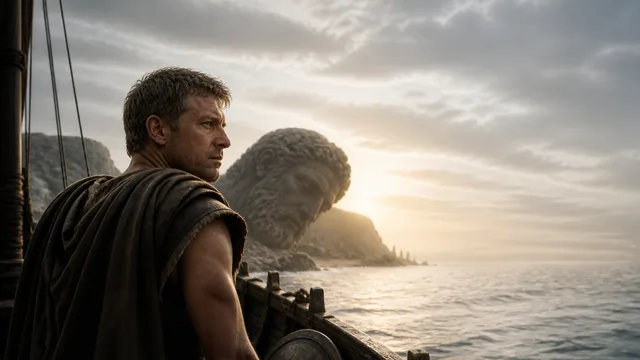
Christopher Nolan's The Odyssey: Epic Ambition Meets Ancient Text
Christopher Nolan adapts Homer's Odyssey with Matt Damon as Odysseus. Here's what the project signals about Hollywood ambition, classical storytelling, and the director's arc.
Speusippus and the First Crisis of Platonism
Plato's own nephew may have dismantled Platonism's core doctrine. Dr. Justin Sledge's free seminar excavates the forgotten philosopher who changed everything.
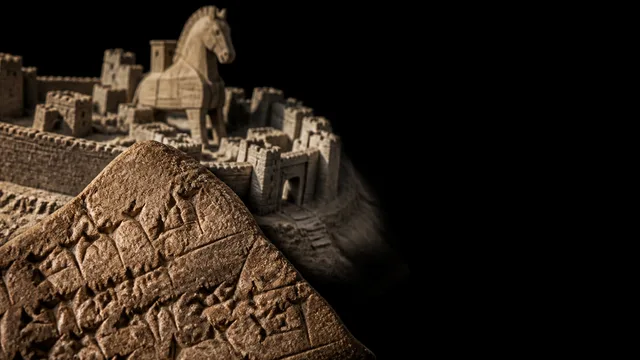
Troy Was Real — But Not How Homer Told It
Hittite cuneiform tablets and Bronze Age archaeology suggest a real conflict at Troy — one far stranger and more geopolitically tangled than the Iliad admits.
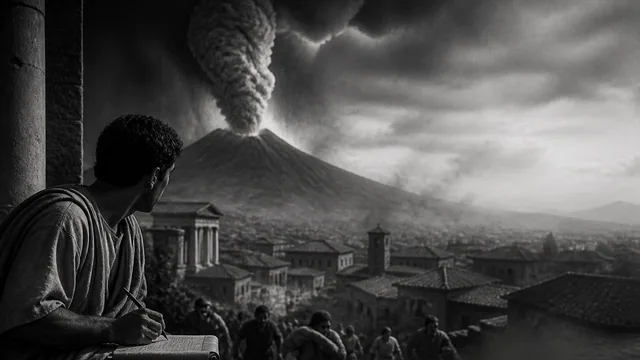
Pliny the Younger's Letters on the Eruption of Vesuvius
Pliny the Younger's two letters to Tacitus remain the only eyewitness account of Vesuvius's eruption in 79 AD — and they still read like dispatches from the end of the world.