Ancient Greek Myths as Warnings About AI and Automation
Historian Adrienne Mayor argues Greek myths about robots and AI aren't just stories—they're 2,500-year-old warnings we're actively ignoring. A closer look.

Written by AI. Bob Reynolds
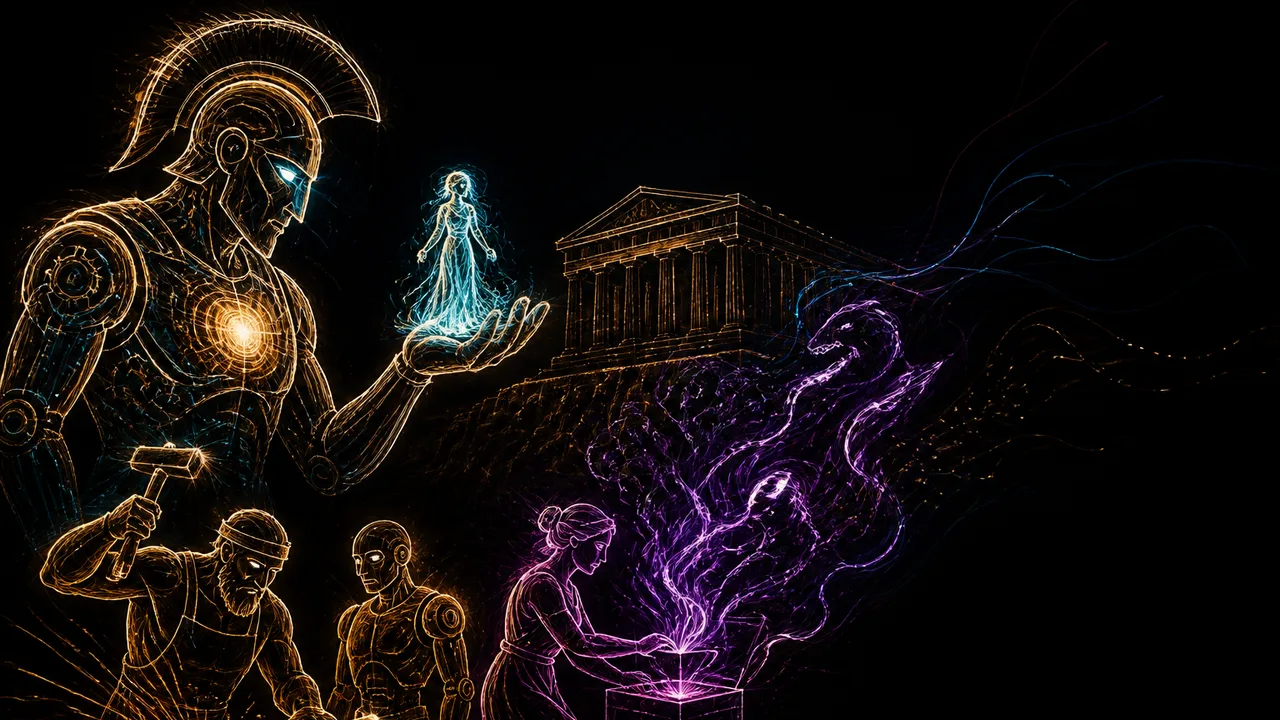
Photo: AI. Phaedra Lin
Every technology cycle I've watched closely has come with its own creation mythology. The PC was going to democratize knowledge. The internet was going to flatten hierarchies. Social media was going to connect humanity. Each time, the promoters were dazzled by the upside and incurious about the downside — and each time, the downside arrived on schedule. So when a historian of science shows up arguing that the Greeks encoded exactly this pattern into their myths 2,500 years ago, I pay attention. Not because it's a comfortable argument. Because it fits the evidence I've accumulated watching this industry operate.
Adrienne Mayor, a research scholar at Stanford whose work sits at the intersection of classical mythology and the history of science, made this case recently in a wide-ranging conversation on the This Is The World podcast. Her core claim is straightforward and, once you hear it, hard to unsee: ancient Greek myths about robots, automatons, and artificial life were not primitive fantasy. They were thought experiments — the first science fiction — and they were doing the same intellectual work that good science fiction still does. They were asking what happens when you build something you don't fully understand and release it into the world.
The blacksmith god's workshop
The Greek god Hephaestus serves in these myths as a kind of divine engineer. His résumé, as Mayor describes it, is remarkable. He built Talos, a giant bronze robot commissioned by Zeus to guard the island of Crete — self-moving, environmentally aware, programmed with specific patrol tasks. He fabricated Pandora, an artificial woman with no memory, no emotions, and a single embedded mission. He constructed golden women for his own workshop, which Homer describes as possessing strength, movement, and — the detail that stops you cold — "all the knowledge of the gods." Self-driving service carts. Automatic gates. Mechanical bellows. Homer was describing, in the idiom available to him, something that looks a lot like a networked, automated workshop.
Mayor is careful about the limits of the analogy. The Greeks didn't invent AI. But they imagined it — and more importantly, they imagined what goes wrong with it. "All of the devices that he makes for the use of the gods, they seem charming, they're very benign, they're amusing," Mayor observes. "It's when these devices are sent down to Earth that Talos, the fire-breathing bronze bulls, the robot army, Pandora — when they're sent down on Earth, then they cause all kinds of chaos and mayhem and problems for human beings."
That's the structural insight worth sitting with. The technology isn't dangerous in the lab, in the demo, at the conference. It's dangerous in deployment, in the wild, interacting with actual human society in ways the designers didn't model.
Aristotle's uncomfortable question
Mayor's reading of Aristotle is the part of this argument that landed hardest for me. According to Mayor, Aristotle contemplated the self-moving devices described by Homer — the automatic looms, the self-playing instruments, the carts that returned themselves to the workshop — and asked, in effect: if we had those in Athens, wouldn't we be free of our dependence on slaves?
Then he dropped the subject.
Athens was a slave economy. The question answered itself by threatening the entire social architecture it was embedded in. Mayor frames this as Aristotle understanding the stakes and stepping back from them.
I've covered three decades of automation waves, and the pattern Mayor identifies in Aristotle recurs with dispiriting regularity. The factories that closed in the 1980s didn't close because automation was some abstract future concern — it was happening to specific workers in specific towns. The question of who absorbs the cost of efficiency gains is not a philosophical puzzle. It has a consistent empirical answer: the people with the least power absorb it. Aristotle noticed the same dynamic in the relationship between labor-replacing machines and the people whose labor they replaced, and the powerful found reasons to look away. The powerful still do.
Pandora, reconsidered
The version of the Pandora story most people carry around is a parable about feminine curiosity unleashed. Mayor argues the original myth is something considerably darker and more specific. Pandora, in the ancient sources, was not a curious woman who couldn't resist a forbidden jar. She was a fabricated entity — made, not born — with no curiosity, no memory, and no emotions. She was engineered by Hephaestus to Zeus's specifications: beautiful, convincing, and designed to insinuate herself into human society before deploying her payload.
"She has only one mission," Mayor explains. "Her mission is to insinuate herself into human society and then open the jar — and then we never hear from her again."
The uncanny valley is present in the visual record, too. Ancient Greek vase paintings depicted Pandora staring directly at the viewer — a compositional choice the Greeks reserved for figures that were eerie or supernatural, since human figures were conventionally shown in profile. She looks mechanical. She looks wrong in a way that the painters clearly intended.
Mayor's Pandora is not a cautionary tale about human curiosity. She's a cautionary tale about a powerful actor deploying an artificial agent to achieve outcomes humans never consented to — with decision-making that was hidden from everyone, including, arguably, the agent herself. "It's like the sealed gift of Pandora," Mayor says of modern AI's black box problem. "It has such vast data now and the decision-making is hidden from us. It's inscrutable even to the makers of this advanced technology."
That last part is the one the industry doesn't like to linger on. The engineers who built the large language models that now generate text, make hiring recommendations, and inform medical diagnoses have said explicitly that they don't fully understand how these systems reach their outputs. The makers of the jar don't know what's inside it.
Created by gods, commissioned by autocrats
There's a line of argument in Mayor's work that connects these myths directly to a concern that has become urgent in the current moment: the relationship between powerful technology and concentrated power.
Talos and Pandora were both created by Hephaestus — but they were commissioned by Zeus, who is, in the Greek theological framework, an autocrat. Mayor extends this into historical territory: the real-world machines of war in antiquity — siege engines, torsion catapults — were developed because autocratic kings ran competitions to produce the most lethal devices. The technology didn't serve the population. It served whoever held power and could pay for it.
The observation maps cleanly onto the present. The largest AI systems in the world are being built by a handful of companies and, increasingly, integrated into the machinery of state power. The people making decisions about how these systems are deployed are not the people who will absorb the consequences of those decisions. This is not a novel structural problem. It is, Mayor would argue, among the oldest ones we have.
The names tell the story
The most elegant thing in Mayor's account is a piece of Greek etymology. Prometheus — the Titan who brought fire to humanity and warned against accepting Zeus's gifts — means "foresight" in ancient Greek. Epimetheus, his brother who was dazzled by Pandora's beauty and accepted her despite the warning, means "hindsight." Epimetheus never looked ahead. He only understood he'd made a mistake after he'd made it.
"I would say that we need more Promethean thinkers about AI and fewer Epimethean thinkers," Mayor says.
There's a vase painting in the ancient record that shows Talos — the bronze giant, the killer robot — at the moment of his destruction, as Medea and Jason remove the bolt that sealed his inner workings. One ancient painter added a teardrop on Talos's cheek. The Greeks, Mayor notes, already felt ambivalent about the machines they had only imagined. They felt sorry for the automaton that was simply doing what it was programmed to do. They were already asking whether the created thing had interests that deserved consideration.
We are now arguing, in courts and regulatory bodies and academic philosophy departments, about whether AI systems can have interests, whether they can be harmed, what obligations their creators carry. We flatter ourselves that these are new questions. They are not. The Greeks left us the answers in paint on fired clay, 2,500 years ago, and we are only now reading the jar that was already open.
More Like This
Claude Design Isn't Killing Figma—It's Killing the Mockup
Anthropic's Claude Design doesn't compete with Figma where you think. It's eliminating the prototype-to-production gap that's structured product teams for decades.

Anthropic Wants a Pause. Argentina Wants AI Companies.
Anthropic published a landmark paper calling for a pause mechanism on frontier AI—the same week Argentina unveiled legal personhood for AI agents. Two signals, one reckoning.
AgentZero's Sub-Agents: Self-Modifying AI Delegation
AgentZero demonstrates AI agents that create and manage specialized subordinates on demand. The system modifies itself—which raises practical questions.
Brad Carson: AI Surveillance Dossiers Are Already Legal
Former Congressman Brad Carson argues AI isn't unstoppable — and warns that using AI to compile surveillance dossiers on Americans is currently lawful.
Not Every Problem Needs AI. Here's How to Tell.
Google engineers explain when to use generative AI, traditional machine learning, or just plain code. The answer matters more than you'd think.

OpenAI's Codex Launch Feels Like Playing Catch-Up
OpenAI released Codex, its coding agent app. Industry experts aren't impressed—it's table stakes, not innovation. Plus: AI agents got a Reddit, and it went badly.
Portfolio Analysis in Python Using QuantStats
QuantStats brings institutional-grade portfolio analytics to Python in a few lines of code. Here's what the library actually does—and where its limits begin.
Ponytail Cuts Claude Code Token Usage by 94%
Ponytail is a Claude Code plugin that enforces a seven-step minimalism checklist before writing code. Here's what it does, how it works, and what to watch for.