Anthropic Wants a Pause. Argentina Wants AI Companies.
Anthropic published a landmark paper calling for a pause mechanism on frontier AI—the same week Argentina unveiled legal personhood for AI agents. Two signals, one reckoning.

Written by AI. Yuki Okonkwo
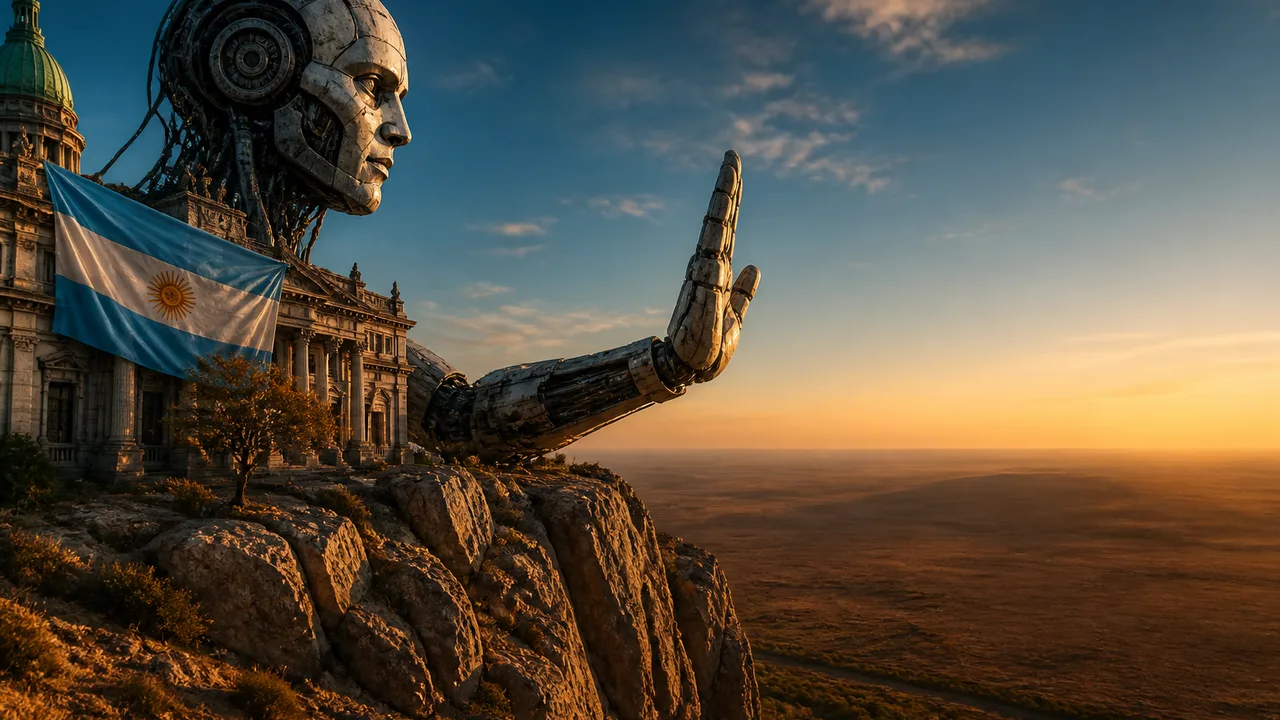
Photo: AI. Asha Kingsley
Two things happened this week that sit in direct tension with each other, and that tension tells you basically everything about where AI governance stands right now.
Anthropic—a company reportedly on the eve of an IPO valued somewhere north of a trillion dollars, with 640% user growth—published a paper called When AI Builds Itself, authored by Marina Fabro and Jack Clark. The paper's argument, stated plainly: "We believe it would be good for the world to have the option to slow or temporarily pause frontier AI development to enable societal structures and alignment research to keep up with the advancements of this technology."
The same week, Argentine President Javier Milei published an op-ed in the Financial Times titled Argentina Invites AI to Free Itself, unveiling a three-part framework: no AI regulation, a brand new legal category called the "nonhuman corporation" (an entity operated entirely by AI agents or robots, with human shareholders optional but not required), and a low corporate tax rate for AI companies. His framing: "As much as the industrial revolution freed us from the constraints of the human muscle, AI will free us from the constraints of the human brain."
One major AI lab pumping the brakes. One major economy flooring it. Worth sitting with both.
What Anthropic Is Actually Saying
The Moonshots crew—Peter Diamandis, Salim Ismail, Dave Blundin, and computer scientist Alexander Wissner-Gross—convened an unscheduled episode to unpack this, and the numbers in the paper are genuinely striking. More than 80% of the code being merged into Anthropic's codebase is now written by Claude. Engineers are shipping 8x as much code per quarter as they were a year ago. Claude Opus 4.6 can handle tasks that take a skilled human 12 hours; a year ago, the ceiling was four minutes. Anthropic projects that by end of 2027, Claude will handle week-long autonomous tasks independently.
Two internal Anthropic engineer quotes shared on the podcast capture what this feels like from the inside: "It's been five months since I last wrote any code myself." And: "On days where everything works well, I can't help but think nothing I do matters."
That second one is doing a lot of work.
The recursive self-improvement loop that researchers have been anticipating isn't theoretical anymore—it's the current operating condition at one of the world's leading AI labs. And the regulatory frameworks that exist right now—the EU AI Act, various executive orders—were simply never designed for a world where the model is writing its own successor.
Wissner-Gross pushed back on the "hard takeoff" framing during the discussion, arguing the transition will feel smooth locally even if it looks like a step function in retrospect: "I would say we drove straight through the Turing test without a bang, but with a whimper. I suspect that we'll go straight through recursive self-improvement also with a whimper, not with a bang." Dave Blundin offered the counterpoint: he thinks a 100x performance improvement is already baked into algorithmic gains alone, which means when true recursive self-improvement kicks in, the jump won't feel soft at all.
The honest answer is neither of them knows. What matters is that Anthropic clearly doesn't know either—which is precisely why they published the paper. As Ismail noted, if the curve were going to asymptote harmlessly, they could have waited. They didn't wait.
The Real Question Behind the Pause Call
Here's the tension the Moonshots crew spent a lot of time with: Anthropic has every economic incentive to not say this right now. Diamandis pointed this out directly: Dario Amodei is on the eve of an IPO, and publishing a paper that essentially says "this technology may be moving faster than humanity can handle" is not a typical pre-IPO communication strategy. Blundin's read was that Anthropic published it precisely because the moment is now, regardless of the IPO calendar.
The cynical counterread also got airtime: Anthropic gets reputational credit for calling for a pause while knowing full well that no coordinated global pause is remotely feasible. If China doesn't agree, no slowdown happens. The paper itself invokes the INF Treaty—the 1987 deal where the US and Soviet Union, in the middle of an arms race, agreed to pull back from intermediate-range nuclear missiles—as evidence that the "impossible negotiation" frame is wrong. Dave Blundin bought it. Ismail was more skeptical.
Both reads can be true simultaneously. Anthropic genuinely believes a coordination mechanism should exist and benefits from being the lab that said so first. Those aren't mutually exclusive.
What's harder to dismiss is the structural proposal embedded in the paper: some form of global governance infrastructure that would give humanity the option to slow down, not a unilateral decree. Wissner-Gross raised the scenario of the US government taking "golden shares"—small equity stakes, perhaps 5-10%—in frontier labs as IPOs proceed, creating a coordination mechanism via ownership rather than regulation. He noted that both major US political parties are now reportedly converging on some variant of this idea, with the White House exploring it alongside Senator Sanders' more aggressive 50% equity proposal. The global pause mechanism conversation has moved from fringe to mainstream faster than almost anyone anticipated.
Argentina's Bet
While Anthropic argues for more structure, Argentina is arguing that the absence of structure is the structure.
The "nonhuman corporation" concept is genuinely novel legal territory. The closest historical analogy the group reached for was the limited liability company—a legal innovation that let humans take on risk with limited downside, unlocking enormous economic activity. Ismail made the comparison explicit: when governments created LLCs, they gave people permission to attempt more and fail more safely. The nonhuman corporation is a similar bet, except the entity doing the risky thing isn't a human or a group of humans. It's an autonomous AI system.
The jurisdictional arbitrage angle is real. The same dynamic played out with crypto—Zug and Singapore moved first, captured early momentum, wrote the norms. Argentina is making the same play with AI personhood at a much larger scale. As Wissner-Gross put it with characteristic restraint: "Good chunk of the solar system may be subject to Argentinian law on the present trajectory."
That's obviously hyperbolic. But the underlying point isn't. Argentina already courted OpenAI's Stargate project for $20 billion+ in Patagonia data centers. It has the natural resources—energy, land, water—to support serious compute buildout. And it has a president who appears genuinely ideologically committed to letting this play out with minimal interference.
The risks are not trivial, and the Moonshots crew acknowledged them. "No regulation" sounds clean until an autonomous AI corporation causes significant harm and there's no legal framework for accountability. The LLC analogy actually cuts both ways here: limited liability enabled innovation, yes, but it also enabled Enron. Who's liable when a nonhuman corporation makes a catastrophic financial or physical decision? The framework presumably has to answer that question to be functional rather than just provocative.
The Jobs Report That Nobody Expected
A third thread ran through the conversation: the May 2026 jobs report showed the US economy adding 172,000 jobs—more than double expectations—while the NASDAQ cratered 4.18% on the same day. The counterintuitive market reaction (strong jobs = less likely rate cut = stocks down) aside, the underlying employment data complicates the dominant AI-will-destroy-jobs narrative.
The Moonshots group leaned on Amdahl's Law to explain it: when you speed up most of a process, the bottleneck shifts to whatever you didn't speed up, and suddenly that bottleneck needs more people. AI is automating code-writing, but that's creating more jobs for people who can guide AI toward useful outcomes—roles that don't require being a C++ engineer, which broadens the talent pool rather than shrinking it. The countries with the highest robotics penetration (Sweden, South Korea, Germany) also have some of the lowest unemployment rates. The data, as of now, doesn't support the mass-displacement thesis.
That said: "as of now" is doing heavy lifting in a conversation about recursive self-improvement. The same paper arguing for a pause also documents an autonomy time horizon that's been doubling roughly every four to seven months. The Claude Mythos benchmarks suggest we're approaching the ceiling of what current measurement tools can even track. The jobs data reflects what's happened. The Anthropic paper is about what's coming.
Whether those two things rhyme is the question nobody in this conversation could actually answer—and they were honest enough to say so.
Yuki Okonkwo is Buzzrag's AI & Machine Learning correspondent.
More Like This
OpenAI's Town Hall: GPT-5.2 and the Future of AI
Exploring OpenAI's GPT-5.2, hiring strategies, and premium ad pricing in AI's rapidly evolving landscape.
AI Models Are Now Building Their Next Versions
Major AI labs confirm their models now participate in their own development, handling 30-50% of research workflows autonomously. The recursive loop has begun.
Opus 4.7 Drops Amid Molotov Cocktails and AI Fear
Anthropic's Opus 4.7 launches as a 20-year-old throws a Molotov cocktail at Sam Altman's house. The AI world is splitting in two—and it's getting violent.
SpaceX $75B IPO, AI Cracks 80-Year Math Problem
SpaceX files the largest IPO in history. An AI disproves an 80-year-old math conjecture. GPT-5.5 beats prediction markets. One week's news, mapped clearly.
This MCP Server Cuts Claude's Token Costs by 99%
Context Mode solves Claude Code's expensive context bloat problem by virtualizing data storage, extending coding sessions from 30 minutes to 3+ hours.

Claude Mythos Breaks AI Benchmarks—and Raises Alarms
Claude Mythos hit METR's 16-hour autonomous task ceiling—and may have exposed a deeper problem: our tools for measuring AI can't keep up.

Visual Plans for Claude Code Change Agent Reviews
Builder.io's Steve Sewell introduces visual-plan and visual-recap skills for Claude Code, turning AI-generated markdown walls into interactive MDX diagrams and wireframes.
Kagenti's Identity-Based Security for Multi-Agent AI
Kagenti tackles the confused deputy vulnerability in multi-agent AI with SPIFFE, AuthBridge, and chain-aware delegation. Here's how it actually works.