AI Labs Call for a Global Pause Mechanism on AI
Top AI leaders signed a letter urging synthetic biology screening, while Anthropic published a stark assessment of recursive self-improvement and why a pause mechanism matters.

Written by AI. Rachel "Rach" Kovacs
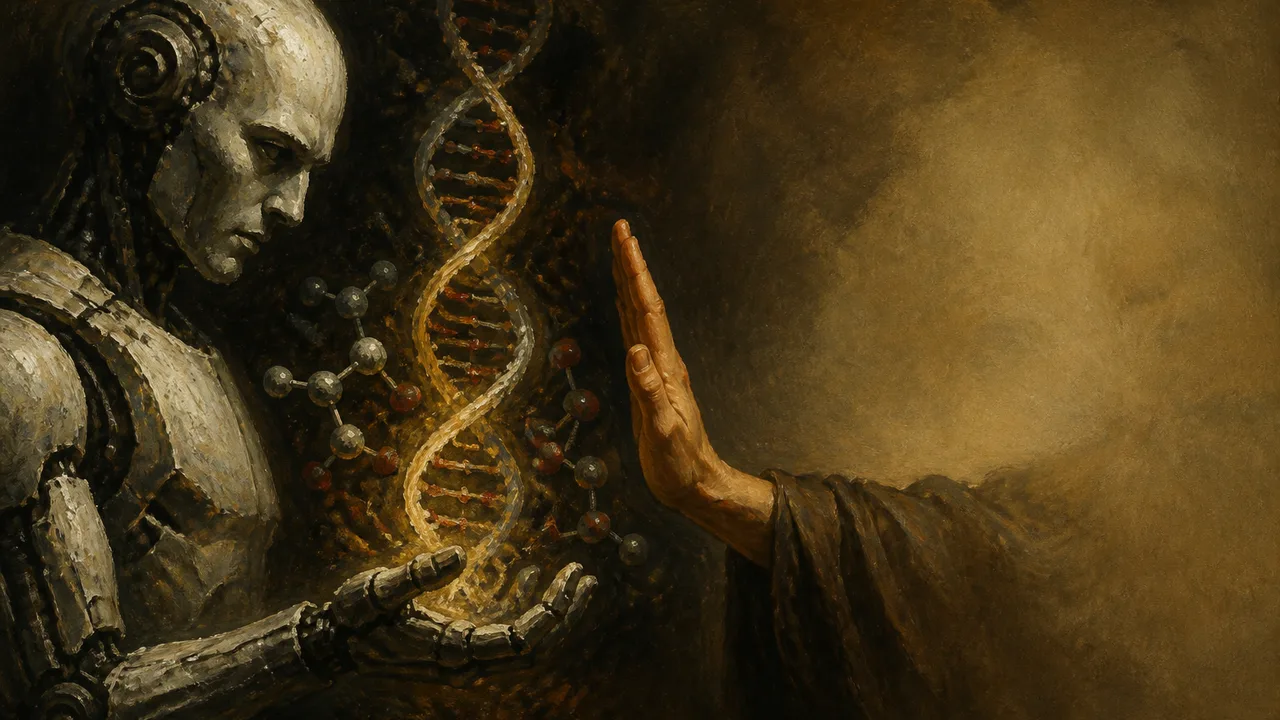
Photo: AI. Henrik Solberg
Two documents dropped this week that, read together, tell you more about where AI development actually stands than most quarterly earnings calls combined. The first is a letter to Congress signed by Sam Altman, Dario Amodei, Demis Hassabis, Mustafa Suleyman, Paul Graham, and a roster of genomics executives most people outside the life sciences have never heard of. The second is an Anthropic blog post titled "When AI Builds Itself," which maps out three possible futures with unusual candor for a company that also sells AI products.
What links them isn't panic. It's the word credible—as in, what would a credible system for slowing down AI development actually look like, and do we have one?
The bioweapons letter is the less complicated story
The Congressional letter calls for mandatory screening of orders for synthetic nucleic acids and the equipment needed to produce them. The argument is straightforward: AI systems can now outperform PhD-level virologists on questions about highly technical laboratory procedures. That means the knowledge barrier to synthesizing dangerous pathogens has dropped. The signatories want order screening to be the regulatory equivalent of a background check—a friction point that doesn't stop legitimate research but raises the cost of misuse.
What makes this letter unusual is who signed it. This isn't just AI executives performing concern. The list includes leadership from Twist Bioscience and Ansa Biotechnologies—companies that are themselves in the synthetic biology business. When the people who sell the equipment say it needs tighter controls, that's a different signal than when the people who build AI say their tools are dangerous. OpenAI has separately published a biodefense framework on related themes, suggesting this concern has been building inside these organizations for some time, even as it stayed out of the headlines.
The NSA angle is worth flagging without overstating. Reports indicate Anthropic's Claude Mythos model is being used in a collaboration with the NSA for cybersecurity purposes. What's actually unclear—and this matters—is whether that use is purely defensive or includes offensive cyber operations. That ambiguity should bother you, not because the worst-case interpretation is certain, but because "we don't know how the NSA is using this" is not a reassuring answer from a company that markets itself on safety.
The RSI paper is the harder story
Anthropic's recursive self-improvement post is where the interesting tension lives, and it deserves more careful reading than it's likely to get.
The paper is built around a single anonymous quote from an Anthropic researcher, which is striking for its plainness:
"On days where everything works well, I can't help but think that nothing I do matters. Everything is automated and better and faster than I will ever be. But then there are days where everything breaks and I don't understand why. And I realize I have no idea what I've been up to anymore."
This isn't existential dread for its own sake. It's a data point. The researcher is describing what it actually feels like to work at a frontier AI lab in 2026—the cognitive whiplash of being simultaneously obsolete and essential. When things go well, you're surplus. When things break, you're lost. Anthropic is publishing this not to be poetic but to demonstrate that the "superhuman AI" experience isn't hypothetical anymore. It's happening in their offices.
The benchmarks they lay out are concrete. Claude Mythos, internally tested in April 2026, achieved a 52x speed improvement when optimizing code to train a smaller AI model. For calibration: a skilled human researcher would need four to eight hours to hit a 4x improvement. Claude did 13 times better than that. On a separate open-ended AI safety research project—can weaker models supervise stronger ones?—Claude generated the equivalent of 800 person-hours of research at a compute cost of $18,000. An Anthropic employee noted that if a junior colleague had delivered those results in the same time, they would have been "mildly impressed."
The productivity data from Anthropic's own engineering team is harder to dismiss than benchmark numbers, which can always be gamed. Across 130 researchers, output per contributor roughly quadrupled with Mythos preview compared to unassisted work. Claude-written code, which was noticeably worse than human-written code a year ago, is now at parity—and Anthropic expects it to be "strictly better within the year."
Three futures, one honest assessment
What Anthropic does with this data is lay out three scenarios, and they don't pretend to be neutral about which one they think is coming.
Scenario one: the curve flattens. Progress hits an S-curve—compute bottlenecks, architectural limits, diminishing returns—and AI capabilities plateau roughly where they are now. Anthropic includes this scenario for completeness, then states plainly they don't believe it's likely. The trajectory doesn't support it, and hoping for a plateau without evidence of one is just wishful thinking.
Scenario two: compounding efficiency gains without full autonomy. AI agents keep getting better at executing defined tasks, but they never quite develop what you might call research taste—the ability to choose which problems are worth pursuing, not just solve the ones humans point them at. Humans remain the bottleneck, which is also a kind of job security. This is Anthropic's read on where the evidence currently points. The risks in this world aren't trivial—authoritarian surveillance, precision manipulation at scale, AI-amplified misinformation—but the alignment nightmare of a fully autonomous rogue system is structurally off the table if humans stay in the loop.
Scenario three: true recursive self-improvement. AI systems design and improve themselves faster than any human team could, the rate of progress becomes a function of available compute, and the intelligence staircase—the idea that there are emergent capability leaps between qualitatively different levels of intelligence, not just a smooth gradient—becomes relevant in a way that's genuinely hard to reason about. Anthropic doesn't predict this happens. They do think it's possible. And they think, if it does happen, the alignment question becomes not "is AI safe?" but "are our goals and its goals pointing the same direction?"—the mouse-and-mousetrap problem, as Wes Roth describes it in his breakdown of this material.
The pause problem is a game theory problem
Here's where Anthropic's essay lands, and it's where I find the argument both genuinely interesting and structurally incomplete.
Their conclusion is that the field needs a credible, pre-agreed mechanism for pausing AI development—something with defined triggers, defined lifting conditions, and some form of verification that all parties have actually stopped. The game theory problem is obvious: if ten labs agree to pause and nine comply, the tenth wins everything. A pause that can be defected from isn't really a pause. It's a coordination trap.
"A credible system like this has to specify what triggers it, what lifts it, and who enforces it."
That's the right framing. But Anthropic doesn't answer it—can't, really, because the answer requires international cooperation at a scale that doesn't currently exist for AI, the way it arguably exists (imperfectly) for nuclear weapons or chemical agents. The letter to Congress about synthetic nucleic acid screening is easier because it's domestic, specific, and asks for something regulators already know how to do: gate access to physical materials.
A global AI pause mechanism is a different category of problem. It requires trust between actors who are in direct competition, enforcement across jurisdictions with radically different regulatory philosophies, and some technical means of verification that "we slowed down" is actually true—none of which exist yet.
What I notice about this week's documents, taken together, is that the people building these systems are increasingly willing to say, in public, that they don't fully know what they're building toward. That's not the same as having a plan. But it may be a necessary precondition for one.
The harder question—the one neither the letter nor the blog post fully answers—is whether a credible pause mechanism can be built before it's needed, or whether it can only be built after something happens that makes the need undeniable.
More Like This
Murati's Open Model and AI's Regulation Dilemma
Mira Murati's 975B Inkling model, Demis Hassabis's FINRA-for-AI proposal, and Liquid AI's post-transformer architecture reframe who controls frontier AI.
AI's Speed Problem: Hacks, Lawsuits, and Your Attack Surface
Google's zero-day warning, the OpenAI lawsuit pressure cooker, and why AI's speed makes old security hygiene dangerously obsolete.
AI Is Corrupting Your Documents—And Gen Z Knows It
New Microsoft research finds top AI models corrupt 25% of document content in long workflows. Meanwhile, Gen Z's AI skepticism might be the healthiest response in the room.

Google DeepMind Maps the Road From AGI to ASI
Google DeepMind's new paper treats AGI as a starting point, not a finish line. Here's what it actually argues—and what it leaves unresolved.
Anthropic's Self-Improving AI Paper Has a Regulator Problem
Anthropic's new paper on recursive self-improvement reveals an oversight gap that existing AI regulation—EU AI Act, executive orders—was never designed to address.
AI's Leap in Math and Defense: Grok 4.20's Impact
Grok 4.20's AI advancements in math and defense pose critical regulatory challenges. Can policy keep pace with innovation?
EU AI Act: How to Tell If Your AI Is High-Risk
The EU AI Act's high-risk classification isn't just about what your AI does—it's about how it's deployed. Here's what organizations need to understand now.

Claude Design's Major Upgrade, Assessed Honestly
Claude Design has expanded well beyond its original five templates. Here's what the updated platform can actually do—and where the real limits still sit.