Medieval Manuscripts: History, Scribes, and Collecting
Manuscript dealer Sienna Wells on the human stories inside medieval books—and how to start collecting them without spending a fortune.

Written by AI. David Oyelaran
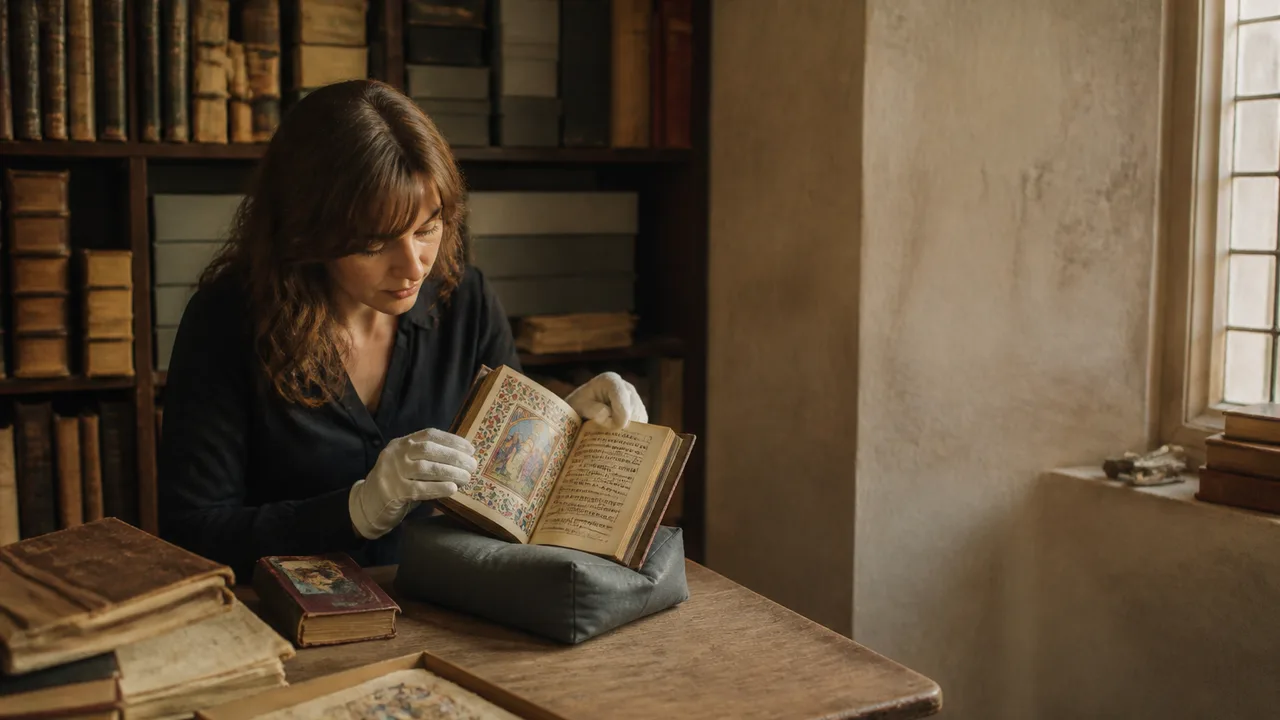
Photo: AI. Marcel Dubois
There is a Book of Hours sitting in Sienna Wells's office—small enough to hold in one hand, over five hundred years old—that has a section on the Office of the Dead. The prayer cycle for the night before a funeral. And in that section, the illuminated scene of two priests has been rubbed away. Not worn down by time. Rubbed. Someone held this book, probably in grief, and pressed their fingers into the image again and again until the pigment smeared and the faces disappeared.
Wells, a medieval manuscript dealer and historian at Tom W. Ayling Rare Books & Manuscripts in South Oxfordshire, described what it felt like to catalog that book for the first time. "I'm holding someone's kind of like their heart in a way," she said in a recent conversation on the ESOTERICA channel. "A lot of the other miniatures don't have the same marking. This one is the one that has really been rubbed so significantly that their faces and their bodies have like pretty much completely gone."
That detail—two priests worn to ghosts by someone's grief—is a good place to begin, because it tells you more about what medieval manuscripts actually are than any taxonomy of scribal styles or parchment types ever could. These are not primarily art objects. They are records of lives. The art is almost incidental.
The Book That Thinks You're Scared of It
Part of what Wells does, practically speaking, is demystify. The medieval manuscript market is real, active, and genuinely accessible to people who aren't institutions—and yet most people assume it isn't. Prices range from a few hundred dollars for a single leaf of a 15th-century text to figures that require Christie's and a very different conversation. The intimidation is understandable. These books are written in Latin, on animal skin, in scripts that require training to read. They look, as Wells put it, "very different to books we have now."
Her advice for anyone wanting to start collecting is direct: talk to a specialist bookseller. "We can start to kind of unpick different things that you might be interested in that you might not necessarily know about," she said. "There are fragments that have lived in bindings. There's so many different elements of medieval manuscripts and I think booksellers, we're able to kind of just—we really want to help and to take away this kind of wall that's there with them."
The most abundant material on the market is religious texts, particularly the Book of Hours—the medieval bestseller, as Wells calls it. Think of it as a portable version of the Divine Office, adapted for domestic use, structured around the hours of the day for prayer. They ranged from plain text-only volumes to lavishly illuminated productions, from pristine to, in Wells's words, "really well thumbed and rubbed and kissed." The Flemish and Netherlandish workshops of the 15th century were particularly prolific, and there's a recognizable regional style in their production that collectors learn to identify.
Land deeds are another entry point—cheaper, more fragmentary, but surprisingly intimate. You get names. You get places. "If it's somewhere local to you, that's so exciting," Wells said. A deed isn't abstract. It's proof a specific person existed, in a specific place, making a specific claim about a strip of land.
What You're Actually Holding
The material science of a medieval book is stranger and more interesting than most people realize. The pages are parchment—animal skin, usually sheep or goat, occasionally calf, depending on what was being farmed nearby. The primary ink is iron gall: oak galls (the spheres that form when a gall wasp lays an egg on a tree branch), crushed and infused with water, mixed with ferrous sulfate and gum arabic. It's so chemically aggressive it can eat through the very parchment it's written on. Wells has seen manuscripts in her office where the ink has dissolved the page beneath it over the centuries, leaving shadows where words used to be.
Some of the most beloved pigments have origins that are, let's say, humbling. Orcanet purple—the color you see in some of the most celebrated manuscripts of the medieval world—comes from lichen soaked in ammonia. Which is to say, urine. "What you're looking at is fungus and urine," the host observed, looking at images of the Lindisfarne Gospels. "It's a beautiful purple, when it's all said and done."
The production of a single book was a team operation, and the romanticized image of one monk working alone by candlelight is, Wells notes, probably wrong. We don't actually know what a medieval scriptorium looked like—the pictorial evidence we have tends to show scribes working individually, not in groups. What we do know is that the pipeline involved a parchmenter (processing the skins through washing, soaking in lime solution, scraping, stretching, and drying—"very smelly," Wells adds), a scribe or multiple scribes copying the text, illuminators working on different sections sometimes simultaneously, bookbinders, and people coordinating commissions. In commercial book production, sections of a manuscript could be distributed to different workers in parallel, which accelerated output considerably.
You can often see the seams. On the Beowulf manuscript, there's a page where the second scribe takes over, and the hand is visibly different—more archaic, suggesting an older writer. In long-production manuscripts, you can sometimes watch a scribe's handwriting improve across the pages. That kind of longitudinal intimacy with another person's skill development is something no other medium quite offers.
The People History Kept Unnamed
One of the more significant threads in Wells's conversation is the question of who made these books—and whose names we assumed without asking.
The default assumption, for a long time, was that unnamed scribes and illuminators were men. Wells argues this was frequently wrong. Women worked as scribes, illuminators, workshop owners, and book traders throughout the medieval period. The Guild of St. John the Evangelist in 15th-century Bruges required anyone working in the book trade to join, and Wells cited records suggesting that between 1454 and 1500, women made up roughly a quarter of its membership—as named apprentices, illuminators, and owners of workshops. Among its members were women who ran workshops and trained others.
The colophon—a note left, typically at the end of a manuscript, identifying who made it—is one of the best tools for recovering these histories. Wells mentioned a 15th-century scribe named Brigitta, who left a colophon identifying herself and noting, with characteristic self-criticism, that she had written a psalter "but not as well as she ought to have done." She signed off: pray for me a sinner. There's something in that—the combination of documented achievement and pre-emptive apology—that feels very much like a particular kind of professional woman navigating a particular kind of institutional culture.
One of the most striking examples from medieval history is Guda, a German nun of the late 12th century, who created what is recognized as the earliest surviving signed self-portrait in Europe. According to Encyclopedia.com, her colophon reads Guda peccatrix mulier scripsit et pinxit hunc librum—"Guda, a sinful woman, wrote and painted this book." The self-deprecatory formula was conventional. The act of signing her name to her own image was not. Wells described learning about Guda after university: "Oh, I didn't know that when I was at university. And that's something I found out later and I was like, Oh, this is so interesting."
The medieval book world also produced women authors: Margery Kempe, who wrote the earliest surviving autobiography in English by a woman; Christine de Pizan, whose The Book of the City of Ladies remains a landmark of feminist literature and who is widely recognized as Europe's first professional female writer.
Wells, as a woman working in the rare book trade now, is clear about why this history matters to her personally. It's not just correction for its own sake. It's about understanding what the trade actually was—and is.
Recycling and the Long Game
A concept that's become fashionable in book-collecting circles lately is binding waste: fragments of medieval manuscripts that were cut up and repurposed as covers, flyleaves, or structural reinforcement inside later printed books. Parchment is extraordinarily durable—more so than paper—and bookbinders in the early print era recognized this. Sometimes an entire musical antiphonary sheet became a book's cover. Sometimes a strip of Thomas Aquinas ended up sandwiched in a spine.
What makes this interesting, beyond the obvious archaeology of it, is what the waste occasionally reveals. When the Nag Hammadi codices were discovered in Egypt, the papyrus covers were taken apart for conservation, and inside them was papyrus binding waste—scraps used as structural fill. One of those scraps had a receipt with a date on it. Which meant scholars suddenly had a hard terminus post quem for when the books could have been made.
A random piece of packaging waste became a dating tool for one of the most significant manuscript discoveries of the 20th century.
Binding waste is also an entry point for new collectors. The fragments are cheaper than intact manuscripts, often easier to acquire, and—Wells argues—no less fascinating. You're still holding the handwriting of a specific person who lived and worked and got cold and complained about it.
About that last part: the complaints. Irish monks left some of the most candid colophons in the manuscript tradition—notes about aching backs, numb fingers, bad lighting, the relief of finishing. The scribes of the Book of Kells apparently had feelings about their working conditions that are, across the distance of a thousand years, entirely legible.
"When you're holding or interacting with a book," Wells said, "I would describe it as like you're reaching your hand through time and you're holding the hands of everyone that has come into contact with that book."
Beowulf survives in one manuscript. That manuscript caught fire in the Cotton Library disaster of 1731 and was partially destroyed. The poem survived because it had already been transcribed. Most of what was probably produced in medieval Europe—Wells and her host estimate something like 1% of it survives—is simply gone. When you hold a leaf of a 15th-century prayer book, you're holding something that outlasted a fire, a political upheaval, a revolution in information technology, and several centuries of indifference.
Whether that makes you want to own one, or simply to know they exist and are being cared for, is your call to make.
More Like This
Middle Platonism's Hidden Role in Western Esotericism
ESOTERICA's new crowdfunded seminar argues Middle Platonism built the foundations of Hermeticism, Gnosticism, and early Christian theology. Here's what that means.
Unveiling the Mayan Secrets of the Oldest American Book
Explore the Códice Maya de México and its astrological secrets tied to Venus, revealing Mayan culture's celestial insights.
The Gods of Pre-Islamic Arabia, In Their Own Words
Ancient desert inscriptions reveal the polytheistic world before Islam—gods, prayers, sacrifice, and fate, recorded by the nomads who lived it.

Rolls-Royce: Craft, Class, and a Century of Decline
How Rolls-Royce built the world's finest cars on bespoke craftsmanship — and what was really lost when that tradition could no longer survive.
Ancient Egyptian Princesses Were Trained Weapon Users
New skeletal analysis of five Middle Kingdom mummies reveals ancient Egyptian princesses used bows and daggers — and a bias that buried that fact for decades.
Bookpilled's Vintage SFF Deep Dive Is Worth Hearing
Bookpilled's 28-minute tour of 20 obscure sci-fi and fantasy books is provisional criticism done out loud — and that's exactly what makes it worth your time.
Homer's Odyssey and What Mortality Means Today
Homer's Odyssey is more than epic adventure — it's a philosophical argument for why a finite life matters, and why immortality might be the real curse.
DNA Names a Revolutionary War Teen Soldier After 245 Years
Genetic genealogy has identified Private John Pumphrey, a Maryland teen who died at the Battle of Camden in 1780 — one of America's oldest John Doe cases.