Belzoni's Tomb: The Strongman Who Found Seti I
Giovanni Belzoni was a circus strongman who became Egypt's greatest explorer. His 1817 discovery of Seti I's tomb rewrote what we knew about the ancient world.

Written by AI. Margaret "Maggie" Holloway
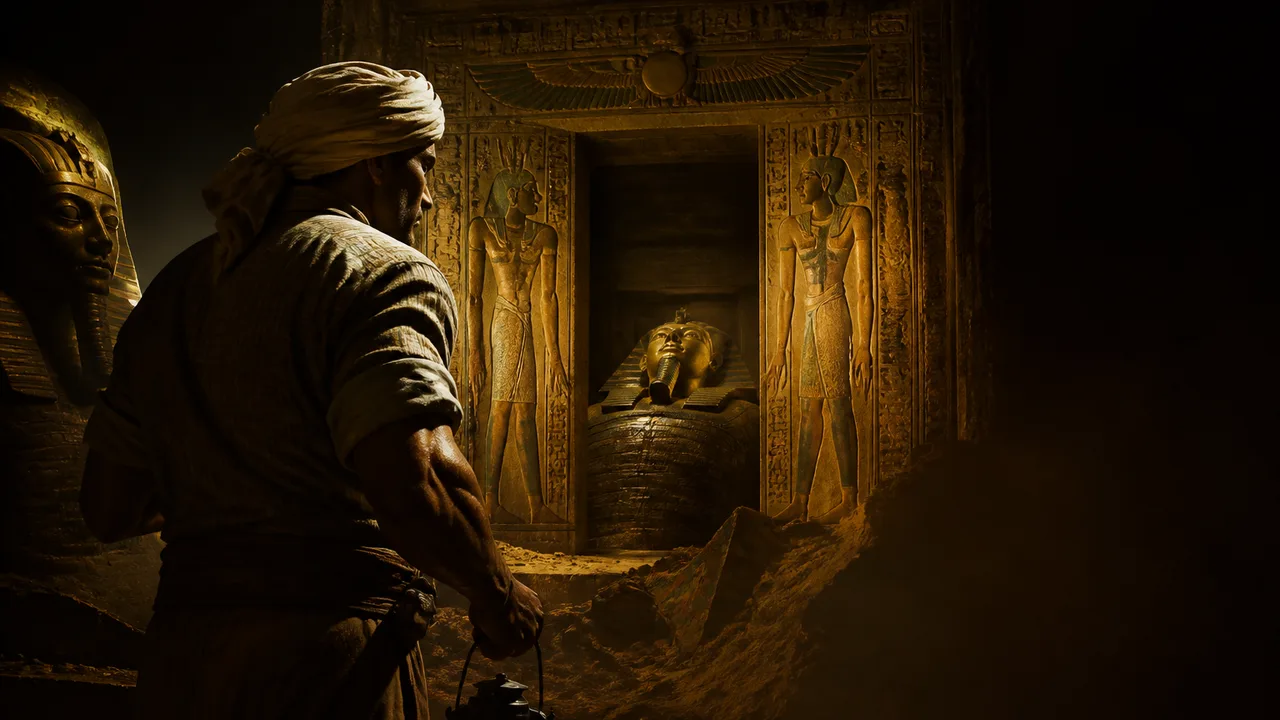
Photo: AI. Liora Goldstein
On the 16th of October, 1817, a man who had spent years performing feats of strength at Sadler's Wells theatre in London crawled through a hole in a limestone cliff in the Egyptian hills and found himself standing inside the largest, most elaborately decorated tomb ever discovered in the Valley of the Kings. It was the burial place of Seti I, father of Ramesses the Great — a space so immense that Tutankhamun's famous tomb, unearthed a century later, would look, by comparison, like a garden shed.
The man who found it was Giovanni Belzoni, a failed irrigation engineer, former strongman, and, as the Odyssey documentary Inside The Largest Pharaoh's Tomb Ever Discovered In The Valley Of The Kings argues with considerable evidence, arguably the greatest explorer Egypt has ever had. He also raises genuinely uncomfortable questions about who exploration serves — and who gets remembered for it.
The Most Unlikely Man in the Valley
Belzoni's biography reads like something invented to make a point. Born in Padua, he trained as an engineer, drifted into theatre, and ended up in London performing as "the Patagonian Samson," lifting improbable numbers of people across a stage. By 1814 he was broke, unwanted, and leaving Britain without a clear plan. He washed up in Cairo with his wife Sarah and their servant James Curtin, tried his luck as an irrigation engineer, failed again, and was in genuine danger of vanishing from history entirely when a chance encounter with the Swiss explorer Johann Ludwig Burckhardt redirected everything.
The job Burckhardt dangled in front of him — moving a seven-ton granite bust of Ramesses the Great across four miles of floodplain to the Nile — was the kind of task that sounded impossible to everyone except a man who'd spent years calculating how to move weight for a living. Belzoni accepted, and the technique he devised was, it turned out, almost identical to what Ramesses's own engineers had used three thousand years earlier: rollers, ramps, and raw human effort.
That synchronicity runs through the whole story. Belzoni kept finding himself reinventing ancient solutions, not because he was a classically trained scholar, but because he understood mechanics and spectacle the way Ramesses did. As Belzoni himself observed after entering Abu Simbel: "I don't know his name, but I know he is a real showman."
Two Showmen Across Three Millennia
The Odyssey documentary uses this parallel deliberately, and it earns its weight. Ramesses II was, among other things, a propagandist of genius. His temple at Abu Simbel — carved directly into a sandstone cliff face in Nubia, buried under sand for two thousand years before Belzoni found it — was engineered so that the rising sun would illuminate the inner sanctuary twice a year, falling on the statues of the gods Rah, Amun, and Ptah, while leaving only Ptah, god of the underworld, permanently in shadow. The entire structure was a light show calculated to run indefinitely.
Ramesses also understood permanence as a design problem. Previous pharaohs had carved their reliefs in raised form — elegant, but easily defaced or overwritten by successors. Ramesses insisted his carvings be cut deep into the stone, harder to chisel over, more visible in harsh sunlight. His name was not going to be erased. Three thousand years later, it wasn't.
What the documentary handles thoughtfully is the gap between Ramesses's warlike self-presentation and what scholarship now understands about his actual legacy. The walls of Abu Simbel proclaim a warrior-god who turned certain defeat at the Battle of Kadesh into divine triumph: "I was like fire. I was like a falcon pouncing. I was like a lion with its prey." But the historical record tells a more complex story. Sixteen years after Kadesh — a battle that appears to have been a near-disaster Ramesses narrowly survived by personal bravery — he signed a peace treaty with the Hittites. It is the oldest recorded peace treaty between superpowers, and it held. His reign lasted 67 years, and Egypt prospered. The greatest warrior-pharaoh's most enduring achievement was diplomacy.
The Trouble with Treasure Hunters
Belzoni's story cannot be told honestly without accounting for what he was actually doing. The early 19th century was an age of unregulated extraction in Egypt — European powers and their agents competed to strip the Nile valley of antiquities and ship them home. Belzoni operated in this world. He moved the Ramesses bust to the British Museum on behalf of the British Consul, Henry Salt; he removed an obelisk from Philae; he documented and excavated across a vast stretch of territory that belonged to none of the Europeans contesting it.
His chief rival, the French-backed agent Bernardino Drovetti, was openly cynical — described in the documentary as a man who "made a fortune by stripping Egyptian monuments" with "an army of thugs." Belzoni, the film argues, was different in motivation if not always in method: increasingly driven by scholarship rather than commerce, by the desire to understand and record rather than merely to acquire.
That tension is dramatized in a pivotal scene at the Valley of the Kings, when a member of Belzoni's party reveals that Henry Salt has been using him all along — that the antiquities were never destined for the British Museum as a public gift, but were Salt's private collection, assembled for resale. Belzoni's response is telling. Rather than quit, he keeps going. The discovery of Seti's tomb follows shortly after. Whatever his patron's motives, Belzoni's own were shifting toward something closer to what we'd now recognize as archaeology.
The documentary doesn't quite press this tension to its limit. Absent from the account — as is common in stories told from the European explorer's perspective — are the Egyptian workers who performed most of the physical labor, the local communities whose heritage was leaving on British and French boats, and any sustained consideration of where these objects belong today. Belzoni recorded Seti's tomb in meticulous detail; in 1821, a full-scale reproduction of part of it became the centerpiece of a celebrated exhibition in London's Piccadilly. The artifacts he gathered are still central to the British Museum's Egyptian galleries. These are facts, and they carry more than one meaning.
What the Tomb Says
Seti I's tomb is worth pausing on for what it is, separate from the story of its discovery. Where Tutankhamun's tomb is famous partly because it was found intact — gold, mummies, the whole preserved inventory of royal death — Seti's was empty of treasure when Belzoni entered it. What it contained instead was decoration of extraordinary refinement: painted walls that became more vivid the deeper you went, a burial chamber whose ceiling mapped the night sky, and at its center a sarcophagus of translucent oriental alabaster so fine, Belzoni wrote, that "I cannot give an adequate idea of this beautiful piece of antiquity." Light passed through it. You could see through the stone.
Ramesses would have stood in that room too, at his father's burial, and looked at the same alabaster. He was 25 when Seti died, already father to twelve children, already dreaming of temples and empire. The tomb was his starting point, not just his father's ending. 3,096 years later, Belzoni stood in the same spot, recording details by candlelight in heat so fierce that perspiration soaked through the paper as fast as he could write.
Both men were chasing permanence, in their different centuries. One built deep into stone; the other documented what the stone contained. The sarcophagus is now in the Sir John Soane's Museum in London — Salt sold it there, as Sarah had predicted he would. Belzoni's name is on the tomb. Salt's is mostly forgotten.
Whether the sarcophagus would be better understood in London or in the country it came from is a question that Belzoni's story makes harder to dismiss, not easier to answer.
More Like This
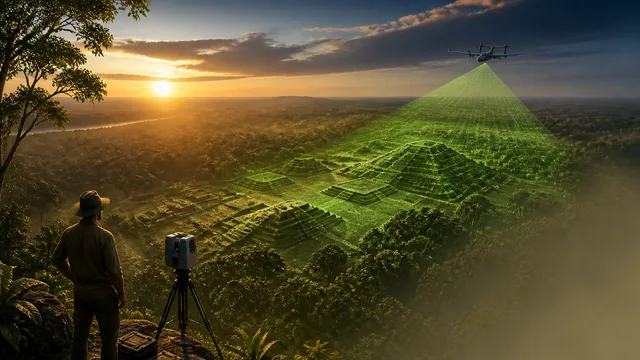
LIDAR Is Rewriting What We Know of Ancient Cities
Anthropologist Luke Caverns is planning the largest LIDAR scan ever done in the Amazon. What the technology finds may force a rewrite of ancient history.
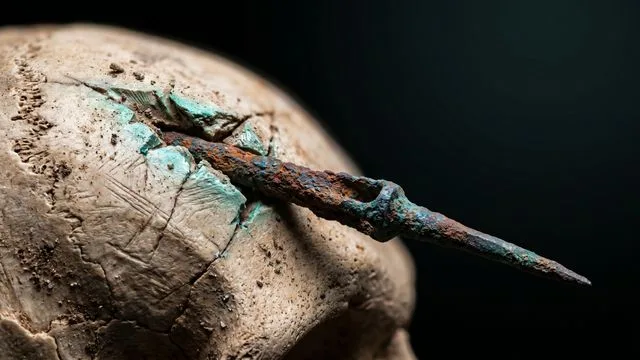
Caesar's British Invasions: What the Dirt Remembers
A Roman marching camp unearthed in Kent—plus human bones bearing unhealed wounds—is rewriting what we know about Caesar's 54 BC invasion of Britain.
The Roman Triumph: Power, Humiliation, and Legacy
Explore the Roman Triumph, a spectacle of power and humiliation, and its enduring legacy.
Jackie Kennedy and Lee Radziwill's Bitter Lifelong Feud
The feud between Jackie Kennedy and her sister Lee ran deeper than jealousy. A look at the betrayals—plural—that made it permanent.
Attila the Hun: Scourge of God or Economic Strategist?
Attila never sacked Rome—yet he's history's ultimate barbarian. The real story is stranger, and more familiar, than the legend.
1938: The Year the World Chose Not to See
From Munich to the Yellow River, 1938 was the year crisis became catastrophe. What the decisions of that year still ask us to reckon with.
The Invisible Inventions That Built Modern Life
From flush toilets to undersea fiber cables, the inventions that most shaped modern civilization are the ones we've stopped noticing entirely.
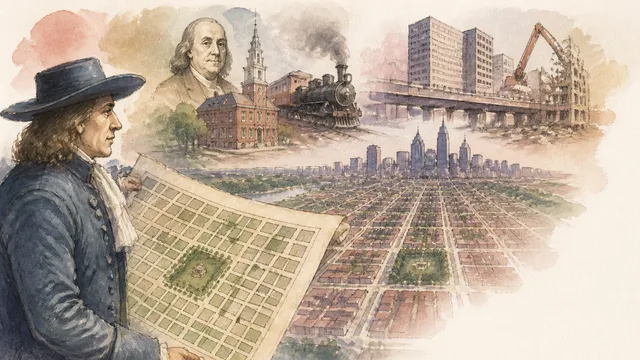
How William Penn's 1682 Grid Still Shapes Philadelphia
From Penn's Quaker grid to Ed Bacon's urban renewal, Daniel Steiner's video traces how Philadelphia's original plan survived — and who it cost along the way.